Introduction: Why Businesses Can No Longer Ignore Data Analytics
Every business generates data. Every transaction, customer interaction, website click, payment record, support ticket, and operational workflow creates valuable information. Yet, despite having access to enormous amounts of data, many companies still struggle to make confident business decisions.
The problem is not the lack of data. The real challenge is turning raw, scattered information into actionable insights.
Today’s business environment moves faster than ever. Markets shift overnight. Customer expectations evolve constantly. Competition intensifies across every industry. As a result, businesses that rely only on instinct or historical assumptions often fall behind. Meanwhile, companies using advanced data analytics are identifying opportunities earlier, reducing risks faster, and improving operational efficiency at scale.
This is exactly where Data Analytics for Business becomes a strategic advantage.
Data analytics helps organizations transform unstructured information into meaningful intelligence. Instead of guessing what customers want, businesses can know. Instead of reacting to problems after damage occurs, they can predict and prevent them.
Modern AI-powered analytics goes even further. Machine learning models can detect hidden patterns, forecast future trends, and automate decision support with remarkable accuracy.
Businesses are no longer asking whether they need analytics. They are asking how quickly they can implement it.
What Is Data Analytics for Business?
Data analytics for business refers to the process of collecting, cleaning, organizing, analyzing, and interpreting business data to improve decision-making.
At its core, analytics answers critical business questions such as:
How can revenue grow faster? Why are customers leaving? Which products perform best? Where are operational inefficiencies?
How can costs be reduced without harming quality? Without analytics, these questions often rely on assumptions. With analytics, they rely on measurable evidence. Businesses typically work with four major types of analytics.
Descriptive Analytics: Understanding What Happened
Descriptive analytics focuses on historical data. It helps businesses understand past performance.
For example, a retail company may analyze last quarter’s sales performance and identify which products sold best. This creates visibility but does not explain future outcomes.
Diagnostic Analytics: Understanding Why It Happened
Diagnostic analytics identifies root causes. Suppose customer churn increases by 18%. Diagnostic analytics can reveal whether pricing, service delays, or product quality caused the issue. This helps businesses move from observation to explanation.
Predictive Analytics: Understanding What May Happen Next
Predictive analytics uses AI and statistical models to forecast future outcomes. For example, banks predict loan default risk. E-commerce companies predict customer purchasing behavior. This allows proactive decisions.
Prescriptive Analytics: Recommending What to Do
Prescriptive analytics provides actionable recommendations. For example, a logistics company may receive route optimization suggestions that reduce delivery time and fuel costs. This represents the highest level of business intelligence.
Why Traditional Decision-Making Is Failing Modern Businesses
For decades, business decisions were largely based on leadership experience, intuition, and manual reporting. That approach worked in slower markets. It fails today. Modern businesses face multiple pain points.
Fragmented Data Across Departments
One of the biggest problems companies face is disconnected systems. Sales teams use CRM platforms. Finance uses accounting tools. Operations rely on ERP systems. Marketing uses campaign software.
These systems rarely communicate efficiently. As a result, leadership sees incomplete information. A customer may appear profitable in sales reports but unprofitable in finance systems due to hidden servicing costs. Without unified analytics, decisions become flawed.
Slow Reporting Delays Critical Action
Traditional reporting often takes days or weeks. By the time reports reach leadership, opportunities may already be lost. For example, if product demand spikes suddenly, delayed reporting can lead to stock shortages. Real-time analytics solves this problem.
Human Bias in Decision-Making
Even experienced leaders carry biases. People naturally trust past experience. However, market behavior constantly changes. Analytics reduces emotional decision-making by introducing objective evidence. That leads to better business outcomes.
How Data Analytics Solves Real Business Pain Points
Businesses adopt analytics because it solves costly operational problems.
Improving Customer Retention
Acquiring new customers is expensive. Research consistently shows customer acquisition costs are significantly higher than retention costs across most industries. Yet many companies only realize customers are leaving after revenue drops. Analytics changes this.
AI models track customer behavior signals such as:
Reduced engagement, Lower purchase frequency, Negative sentiment, Delayed renewals, Support complaints These indicators help predict churn before customers leave. Businesses can then intervene with targeted offers or support. This directly improves retention and lifetime value.
Optimizing Operational Efficiency
Operational inefficiency silently drains profit. Manual processes, delays, resource wastage, and workflow bottlenecks increase costs. Analytics reveals inefficiencies across operations.
For example, manufacturing companies use analytics to identify machine downtime patterns. Healthcare providers analyze patient flow to reduce wait times. Supply chain companies optimize inventory movement. Small improvements across operations create massive savings over time.
Reducing Financial Risk
Risk management is becoming increasingly data-driven. Banks use analytics to detect fraud. Insurance companies assess claim probability. Fintech platforms evaluate transaction anomalies in real time. AI algorithms identify suspicious patterns faster than humans. This dramatically improves risk mitigation.
Increasing Revenue Opportunities
Revenue growth becomes more predictable with analytics.
Businesses can identify:
High-value customers, Best-performing products, Profitable channels, Seasonal buying patterns, Cross-sell opportunities. Instead of broad strategies, companies focus resources where ROI is highest. That accelerates growth.
The Role of AI in Modern Data Analytics
Traditional analytics tells businesses what happened. AI-powered analytics tells businesses what happens next. That difference is transformational. Artificial intelligence enhances data analytics by automating pattern recognition, forecasting, and anomaly detection. Modern enterprises increasingly combine analytics with AI models for better decision intelligence.
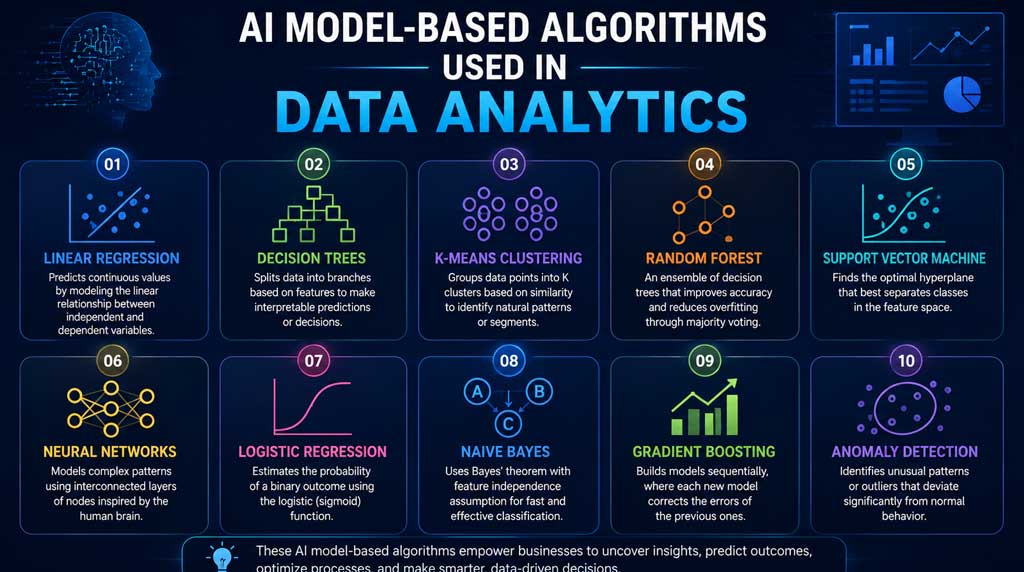
AI Model-Based Algorithms Used in Data Analytics
Several advanced algorithms power intelligent analytics systems.
Machine Learning Algorithms
Machine learning models learn patterns from historical data. Popular models include:
Linear Regression, Random Forest, Gradient Boosting, Support Vector Machines, Neural Networks These models predict future outcomes based on past behavior. For example, retailers forecast demand using machine learning.
Clustering Algorithms
Clustering groups similar data points together. Common clustering algorithms include:
K-Means Hierarchical Clustering DBSCAN. These help businesses segment customers based on behavior. Customer segmentation improves marketing personalization.
Classification Algorithms
Classification predicts categories.
Examples include:
Fraud or Not Fraud, Likely to Churn or Not, High Risk or Low Risk, Algorithms like Logistic Regression and XGBoost perform well here. This improves decision speed.
Deep Learning Models
Deep learning handles complex, high-volume data. Neural networks process:
Images, Voice, Text, Large-scale behavior patterns, These models power advanced analytics in healthcare, cybersecurity, and financial services.
NLP-Based Analytics
Natural Language Processing analyzes text data. Businesses use NLP to understand:
Customer reviews, Emails, Chat conversations, Support tickets. Sentiment analysis helps companies understand customer emotion at scale. This improves customer experience.
Real-Time Data Analytics: The Competitive Advantage
Speed matters in modern business. Static dashboards are no longer enough. Real-time analytics provides live visibility into operations. This enables immediate action. For example, in e-commerce, real-time analytics can detect cart abandonment patterns instantly.
Marketing systems can trigger automated recovery campaigns. That increases conversions. Similarly, fraud detection systems monitor transactions in milliseconds. Without real-time analytics, fraud losses increase.
Organizations embracing real-time intelligence gain faster decision cycles. That creates measurable competitive advantage.
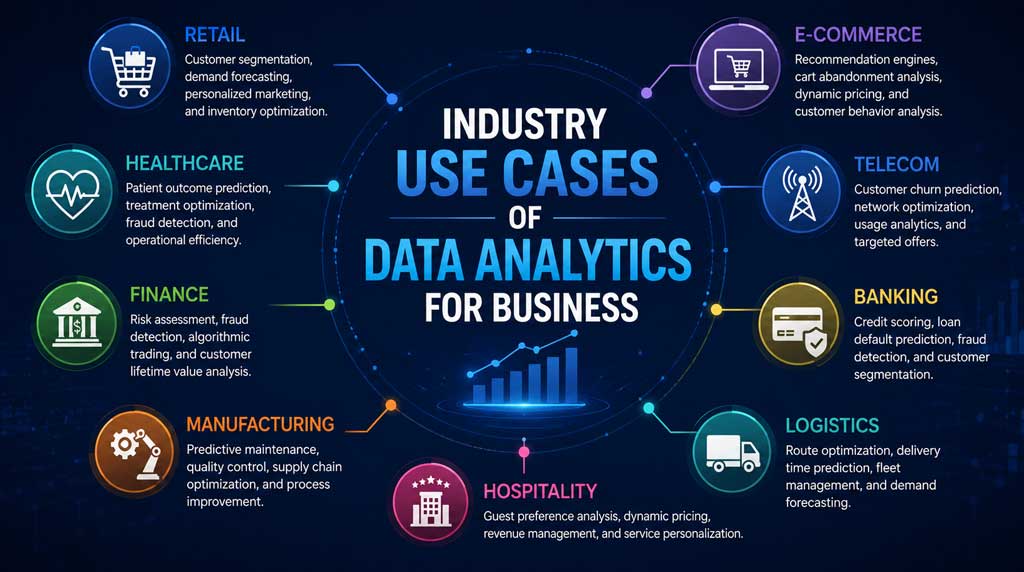
Industry Use Cases of Data Analytics for Business
Data analytics delivers value across industries.
Banking and Financial Services
Banks use analytics for:
Fraud detection, Credit scoring, Risk analysis, Customer segmentation, Loan approval automation, AI improves accuracy while reducing manual review.
Healthcare
Healthcare analytics improves:
Patient diagnosis, Treatment optimization, Resource allocation, Predictive care. Hospitals use predictive analytics to anticipate patient demand. This improves care quality.
Retail and E-Commerce
Retail businesses use analytics for:
Demand forecasting, Personalized recommendations, Inventory optimization, Pricing strategies.Recommendation engines significantly improve conversions.
Manufacturing
Manufacturers leverage analytics for: Predictive maintenance, Production efficiency, Quality assurance, Supply chain forecasting. This reduces downtime and cost.
SaaS and Technology
SaaS businesses track:
Product usage, Customer engagement, Subscription churn, Feature adoption. Analytics helps improve retention and product growth.
Challenges Businesses Face While Implementing Data Analytics
Despite the benefits, implementation challenges remain.
Poor Data Quality
Bad input creates bad output. Duplicate, incomplete, or inaccurate data reduces insight quality. Data governance becomes essential.
Lack of Skilled Talent
Many organizations collect data but lack analytics expertise. Data scientists, analysts, and AI engineers remain in high demand. This creates execution gaps.
Legacy Infrastructure
Older systems often lack integration capability. This slows digital transformation. Cloud-based analytics platforms help solve this.
Security and Compliance Risks
Data privacy regulations continue evolving. Businesses must ensure secure storage and compliance. Governance is non-negotiable.
Building a Strong Data Analytics Strategy
Successful analytics adoption requires more than tools. It requires strategy. Organizations must align analytics initiatives with business goals. The process usually starts with identifying major business pain points.
Are costs too high? Is churn rising? revenue stagnating? Is fraud increasing? Clear goals improve implementation success. Next, businesses need centralized data architecture. Unified systems improve visibility. After that, AI models should be selected based on use case. Not every problem requires deep learning. Sometimes simple predictive models deliver excellent ROI. Finally, continuous monitoring matters.
Analytics systems improve over time through feedback loops. This creates long-term intelligence.
SEO and Business Growth: Why Analytics Matters for Digital Visibility
Data analytics also transforms digital marketing performance. Businesses competing online need visibility. Analytics improves SEO strategy by revealing:
Search intent, Keyword performance, CTR trends, Bounce rate, User engagement signals, Conversion pathways. This improves search ranking. Modern SEO algorithms reward pages that satisfy user intent and deliver high engagement. Analytics helps businesses understand exactly what users want. That improves traffic quality.
How Google’s SEO Algorithm Rewards Data-Driven Content
Search engine algorithms prioritize content that demonstrates:
Experience, Expertise, Authority, Trust, This is known as E-E-A-T. Google increasingly rewards content that provides real solutions to user pain points. That means shallow content struggles to rank. High-performing content includes:
Accurate information, Original insights, Practical value, User-focused solutions, Clear structure, Semantic relevance. This is why businesses using analytics create better content. They understand user intent using data. That increases rankings.
The Future of Data Analytics in Business Strategy
The future belongs to intelligent decision systems. Businesses are rapidly moving toward autonomous analytics. Instead of manually requesting reports, leaders will interact with AI assistants that explain insights in natural language. Generative AI is accelerating this shift.
Decision intelligence platforms now combine:
Machine learning, Natural language AI, Predictive analytics, Automation. This creates faster decision ecosystems. Companies that adapt early gain major strategic advantages. Those that delay risk losing market relevance.
Conclusion: Data-Driven Businesses Win Faster
Business success increasingly depends on decision quality. Better decisions require better intelligence. That is why Data Analytics for Business has become essential rather than optional. Organizations today face rising complexity, stronger competition, and rapidly changing customer expectations. Traditional decision-making methods cannot keep up.
Data analytics solves this challenge by transforming raw information into actionable business intelligence. When combined with AI-powered algorithms, analytics becomes even more powerful. Businesses can predict trends, reduce risk, improve customer retention, optimize operations, and unlock new growth opportunities.
The companies winning tomorrow are investing today in smarter analytics strategies. The question is no longer whether businesses should adopt analytics. The real question is how quickly they can use data to lead their markets.