Digital transformation has evolved significantly over the last decade. What began as simple task automation has now become a critical business strategy for growth and competitiveness. For many years, Robotic Process Automation (RPA) served as the backbone of enterprise automation, helping businesses eliminate repetitive manual tasks, reduce operational costs, improve productivity, and minimize human error. However, as business processes became more complex, organizations began shifting toward Intelligent Automation, which combines RPA with AI and machine learning to enable smarter, faster, and more adaptive decision-making.
Initially, the results were highly promising.
Organizations automated invoice processing, employee onboarding, report generation, claims processing, data migration, and many other repetitive workflows. As a result, businesses saved thousands of hours and reduced manual workload across departments.
However, the business environment in 2026 is far more complex than it was even a few years ago.
Today, companies are no longer dealing only with repetitive rule-based workflows. Instead, they are facing rapidly changing market conditions, increasingly complex customer expectations, massive volumes of unstructured data, and continuous pressure to improve decision-making speed. This shift has exposed a critical limitation.
Traditional RPA works well only when tasks are structured, predictable, and rule-driven. The moment processes become dynamic, data becomes unstructured, or decision-making requires contextual understanding, RPA begins to struggle. That is why businesses across the globe are moving beyond traditional automation. They are now embracing Intelligent Automation.
Intelligent Automation combines Artificial Intelligence (AI), Machine Learning (ML), Natural Language Processing (NLP), Computer Vision, predictive analytics, and RPA to create automation systems that not only execute tasks but also analyze, learn, adapt, and make decisions.
This is no longer a futuristic concept. It is happening now. In 2026, the question is no longer whether your business should automate. The real question is whether your automation is intelligent enough to keep up with modern business demands.
Why Traditional RPA Became Popular
To understand why businesses are shifting away from RPA-only strategies, we first need to understand why RPA became so popular in the first place. RPA gained rapid adoption because it solved one major business problem: repetitive manual work. Many business processes involve structured, repetitive actions such as logging into applications, copying data between systems, generating reports, processing forms, validating entries, and sending notifications. These tasks consume valuable employee time while adding little strategic value.
RPA bots excelled at these tasks. Unlike traditional software integration, RPA did not require major infrastructure changes. Bots interacted with existing systems through the user interface, making implementation faster and more cost-effective. This created immediate value.
For example, finance teams used bots to process invoices. HR teams automated employee onboarding workflows. Customer service teams used bots for ticket routing. Healthcare providers automated claims processing.
The benefits were clear in Intelligent Automation
Lower operational costs. Faster processing time. Reduced human error. Improved compliance. Higher productivity. Because of these advantages, RPA became a major pillar of digital transformation. However, businesses soon realized something important. Automating tasks is not the same as automating intelligence. That distinction defines the future of automation.
The Biggest Problem with RPA in 2026
The biggest weakness of traditional RPA lies in one simple fact:
RPA follows instructions but does not understand context. This creates major limitations. An RPA bot can click buttons and move data between systems, but it cannot understand customer emotions, interpret unstructured documents, detect anomalies, predict outcomes, or adapt to changing conditions without human intervention. In 2026, these limitations have become impossible to ignore.
Modern business workflows are no longer static. Customers communicate through chat, voice, email, images, and social platforms. Business data arrives in multiple formats. Regulatory rules change frequently. Market behavior shifts rapidly. Static bots struggle in such environments. This creates four major pain points.
RPA Pain Point #1: Automation Breaks Whenever Systems Change
One of the most frustrating issues companies face with RPA is maintenance. Traditional bots rely heavily on predefined UI elements, field locations, workflows, and rule sets. Even small software changes can break automation. A button moves. A field label changes. A page layout updates. Suddenly, the bot fails. This creates a serious operational issue.
Instead of reducing IT workload, organizations often find themselves spending substantial resources maintaining automation scripts. This increases the total cost of ownership. Worse, when bots fail unexpectedly, business-critical processes stop. Invoice approvals get delayed. Customer requests remain unresolved. Internal operations slow down. This reduces trust in automation.
The Solution: AI-Powered Adaptive Automation
Intelligent Automation solves this issue by introducing adaptive intelligence. Instead of relying purely on fixed scripts, AI-powered systems use Computer Vision and contextual recognition models to understand interfaces dynamically.
AI models such as Convolutional Neural Networks (CNNs) and Vision Transformers (ViTs) can identify UI elements based on visual and contextual understanding rather than static coordinates. This makes automation more resilient. Even when layouts change, intelligent systems continue functioning. As a result, businesses experience fewer failures and lower maintenance costs.
RPA Pain Point #2: RPA Cannot Handle Unstructured Data
This is perhaps the biggest limitation of traditional automation. Modern enterprises generate massive amounts of unstructured data every day. This includes:
Emails. PDF documents. Scanned invoices. Contracts. Audio files. Images. Chat messages. Customer conversations. Traditional RPA cannot interpret such data. It can move information only if the data is already structured. That creates manual bottlenecks.
For example, consider invoice processing.
If every invoice follows the exact same template, RPA works perfectly. But in reality, vendors use different layouts, fonts, structures, and formats. Traditional bots fail. Employees must manually intervene. The same issue occurs in customer support.
Customers rarely communicate using predefined templates. They write emails naturally, describe problems differently, and use emotional language. RPA cannot understand intent. This slows response times.
The Solution: AI Document Intelligence
Intelligent Automation introduces cognitive capability into document processing. Using Optical Character Recognition (OCR) combined with Natural Language Processing, AI systems can extract, classify, and understand unstructured content. This enables automation of tasks that previously required human interpretation. Modern NLP models can identify:
Customer intent, Invoice numbers, Due dates, Contract clauses, Risk indicators, Sentiment
Priority level. Advanced AI models such as transformer-based language architectures understand context rather than keywords alone. That is a major difference. Instead of simply reading text, these systems understand meaning. This transforms automation from mechanical execution into intelligent workflow orchestration.
RPA Pain Point #3: No Decision-Making Capability
Traditional bots do not think. They execute. That is all. In dynamic business environments, this becomes a serious problem. Many workflows require judgment. Consider fraud detection. A transaction may appear normal based on basic rules but suspicious when analyzed in context. Traditional RPA cannot detect hidden behavioral patterns. Similarly, in customer service, not every issue should be treated equally. A frustrated high-value customer requires a different response than a routine support request.
RPA cannot make such decisions intelligently. This limits scalability. Human intervention becomes necessary. That slows business operations.
The Solution: Machine Learning Decision Intelligence
This is where AI fundamentally changes automation. Machine Learning models identify patterns hidden within large datasets. Unlike rule-based systems, ML improves with more data. This allows businesses to automate decision-making. Several AI algorithms are powering intelligent automation in 2026.
Random Forest Models are widely used for fraud detection, risk scoring, and anomaly identification because they classify complex behavioral patterns effectively. Gradient Boosting Algorithms are highly effective in churn prediction, lead scoring, and revenue forecasting because they optimize prediction accuracy.
Neural Networks excel in identifying deep relationships within large-scale datasets, making them ideal for advanced analytics and behavioral prediction. These models continuously learn. That means automation improves over time. This creates massive competitive advantage.
RPA Pain Point #4: Poor Customer Experience
Customer expectations have changed dramatically. Modern customers expect instant service. They want fast responses, personalized interactions, contextual understanding, and seamless support across channels. Traditional automation struggles here. Basic bots often frustrate customers because they fail to understand intent beyond simple scripts.
This leads to: Poor resolution quality, Long wait times, Higher escalations, Lower satisfaction, Customer churn
In competitive markets, poor customer experience directly impacts revenue. Customers no longer compare your service only with competitors in your industry. They compare it with the best digital experiences they receive anywhere. That raises the bar significantly.
The Solution: Conversational AI
Intelligent Automation enables human-like customer interactions. Modern conversational AI combines:
Natural Language Processing, Generative AI, Sentiment analysis, Context memory, Decision intelligence. This allows systems to understand not only what customers say but also what they mean. For example, AI can detect frustration in a customer message and prioritize escalation.
It can recognize urgency, intent, and context. This improves response quality dramatically. Instead of robotic interactions, customers experience meaningful support. That builds trust. And trust drives retention.
Why Intelligent Automation Is Dominating in 2026
Intelligent Automation is not simply advanced RPA. It is a completely new automation model. Traditional automation focuses on tasks. Intelligent Automation focuses on outcomes. That distinction matters.
Modern automation systems combine multiple technologies:
RPA for task execution. AI for cognitive capability. ML for learning. NLP for language understanding. Computer Vision for image processing. Predictive analytics for forecasting. Together, these technologies create automation systems capable of thinking, adapting, and improving. This is exactly why enterprises are investing heavily in Intelligent Automation.
Real-Time Business Trends Driving Adoption
Several global business trends are accelerating this shift. First, labor costs continue rising. Businesses need scalable operational efficiency without proportional headcount growth. Second, data volumes are exploding. Organizations now process far more data than humans can handle manually.
Third, competition is becoming faster. Companies that make decisions faster gain major market advantage. Fourth, customer expectations continue increasing. Speed and personalization are now essential. These factors make traditional automation insufficient. Businesses need systems that can process complexity. That is what Intelligent Automation delivers.
Industry Use Cases of Intelligent Automation
The impact of Intelligent Automation is visible across industries.
Banking and Financial Services with Intelligent Automation
Banks process enormous transaction volumes daily. They face challenges in fraud detection, KYC verification, risk scoring, and compliance management. AI-powered automation helps banks analyze customer behavior, detect suspicious activity, and accelerate approvals. This reduces risk while improving service speed.
Healthcare with Intelligent Automation
Healthcare organizations deal with overwhelming administrative workloads. Claims processing, patient records, billing, and appointment scheduling often involve manual bottlenecks. Intelligent Automation reduces administrative burden by automating document interpretation, workflow routing, and predictive scheduling. This allows healthcare professionals to focus more on patient care.
Manufacturing with Intelligent Automation
Manufacturers need operational precision. Equipment failures, quality issues, and supply chain disruptions create expensive downtime. Machine learning models enable predictive maintenance. AI identifies failure patterns before breakdown occurs. This reduces losses significantly.
Retail and Ecommerce with Intelligent Automation
Retail businesses depend on customer experience and demand forecasting. Challenges include:
Cart abandonment, Inventory imbalance, Poor personalization, Demand uncertainty, AI-powered automation improves recommendations, dynamic pricing, inventory planning, and personalized engagement. This boosts revenue.
AI Model-Based Algorithms Behind Intelligent Automation
The real engine behind Intelligent Automation is AI. Several algorithm categories power these systems.
Supervised Learning
These models predict future outcomes based on labeled historical data. Common applications include revenue forecasting, churn prediction, and fraud detection. Popular algorithms include regression models, decision trees, random forests, and XGBoost.
Unsupervised Learning
These models identify hidden patterns in unlabeled data. They are widely used for anomaly detection, segmentation, and behavioral analysis. Popular algorithms include K-Means clustering and PCA.
Deep Learning
Deep learning models process highly complex data. They are especially useful for language, vision, and advanced prediction tasks. Examples include:
CNN, RNN, Transformers. These models drive modern AI assistants, document understanding, and intelligent recommendations.
Reinforcement Learning
Reinforcement learning enables systems to improve decisions based on feedback. This is valuable for optimization problems such as pricing, resource allocation, and scheduling. Over time, systems learn the most efficient strategies. This increases business performance.
How Businesses Should Transition from RPA to Intelligent Automation
The transition does not require abandoning RPA. That is a common misconception. RPA still provides value. However, businesses should treat RPA as one component within a broader automation strategy. The transition should begin by identifying processes with high failure rates or frequent manual intervention. These workflows typically involve decision points, unstructured data, or dynamic conditions. Once identified, AI layers can be introduced. For example, document-heavy workflows benefit from OCR and NLP.
Decision-heavy workflows benefit from machine learning. Customer-facing workflows benefit from conversational AI. Over time, automation becomes smarter. Eventually, businesses move from isolated task automation to enterprise-wide intelligent orchestration. That is the real transformation.
The Hidden Cost of Delaying Intelligent Automation
Many businesses are waiting. They believe current automation is “good enough.” That mindset is dangerous. Because while they wait, competitors are becoming faster. Competitors are reducing costs and improving customer experience. Competitors are scaling more efficiently. The cost of inaction is growing. Every quarter spent delaying modernization increases competitive risk.
In 2026, speed is no longer optional. Agility is no longer optional. Intelligence is no longer optional. Businesses that fail to modernize automation strategies will struggle to remain competitive.
Conclusion
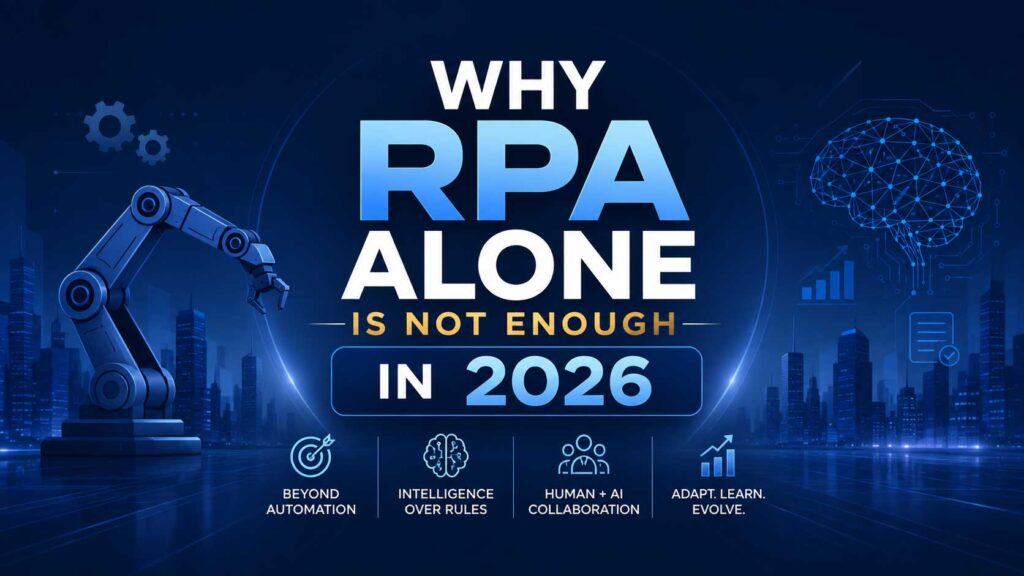
RPA transformed business automation. It introduced speed, consistency, and operational efficiency at scale. However, the business world has changed. Processes are no longer static. Data is no longer structured. Customer expectations are no longer simple. Static automation alone cannot handle dynamic business complexity. That is why RPA alone is no longer enough in 2026.
The future belongs to Intelligent Automation. Organizations that combine RPA with AI, Machine Learning, NLP, predictive analytics, and decision intelligence will gain the ability to operate faster, scale smarter, reduce costs, and deliver superior customer experiences. This is not just about automation anymore. It is about creating intelligent businesses. The companies that embrace this shift today will lead tomorrow’s markets. The companies that ignore it risk falling behind.
The future of automation is no longer about bots that follow rules. It is about systems that understand, learn, and decide. And that future has already arrived.