Bank reconciliation is one of the most important financial control processes in any business. Every transaction recorded in accounting software must match the transactions reflected in bank statements. While the purpose sounds simple, the reality is far more complex. Organizations process thousands or even millions of transactions every month across multiple bank accounts, payment gateways, ERPs, accounting platforms, and financial institutions.
Yet, many companies still rely on spreadsheets, manual data entry, and repetitive verification processes to complete bank reconciliation. Although this traditional approach has existed for decades, it has become one of the largest hidden financial drains for modern businesses.
The true cost of manual bank reconciliation extends beyond employee salaries. It creates delayed financial reporting, cash flow uncertainty, human errors, compliance risks, fraud exposure, customer dissatisfaction, and poor strategic decision-making. As businesses continue adopting Artificial Intelligence (AI), Intelligent Automation, and Machine Learning for finance operations, organizations that continue manual reconciliation are increasingly falling behind.
This guide explains why manual bank reconciliation is costing businesses millions, the hidden operational challenges behind outdated financial processes, and how AI-powered reconciliation is transforming finance departments into faster, smarter, and more accurate business units.
What Is Manual Bank Reconciliation?
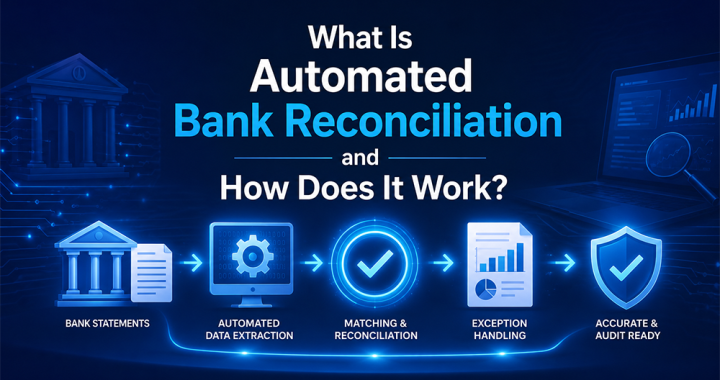
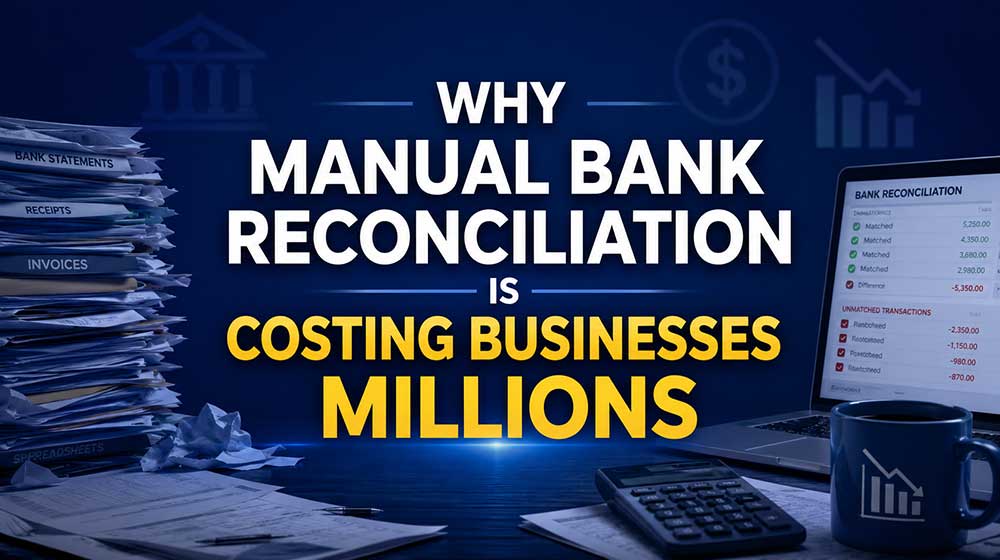
Manual bank reconciliation is the process of comparing transactions recorded in a company’s accounting system with bank statements using spreadsheets or manual verification. Finance teams review deposits, withdrawals, invoices, payments, refunds, bank charges, interest entries, and adjustments to identify discrepancies before financial reports are finalized.
Although the objective is accuracy, the process often requires employees to switch between multiple systems, download statements, compare thousands of transaction lines, identify unmatched records, investigate exceptions, and manually update accounting entries. As transaction volumes grow, this process becomes increasingly difficult to manage.
For organizations handling high daily transaction volumes through ERP systems, payment gateways, POS platforms, online banking, payroll systems, and multiple subsidiaries, manual reconciliation quickly becomes a major operational bottleneck.
Why Manual Bank Reconciliation Has Become a Business Risk
Business operations have evolved significantly. Digital payments, instant bank transfers, e-commerce platforms, subscription billing, international transactions, and multi-channel payment systems generate enormous amounts of financial data every day.
Unfortunately, many finance teams still rely on processes designed years ago when transaction volumes were much lower. As a result, finance professionals spend countless hours verifying transactions instead of analyzing financial performance, improving cash flow, or supporting business growth. The problem is no longer simply about saving time. It is about protecting profitability, reducing operational risk, and enabling better financial decisions.
The Hidden Costs of Manual Bank Reconciliation
Employee Productivity Continues to Decline
Finance professionals often spend several days every month matching transactions line by line. During month-end closing, this workload increases significantly, forcing teams to work overtime to meet reporting deadlines.
Instead of contributing strategic financial insights, highly skilled finance professionals perform repetitive tasks that automation can complete in minutes. This reduces overall productivity while increasing operational costs.
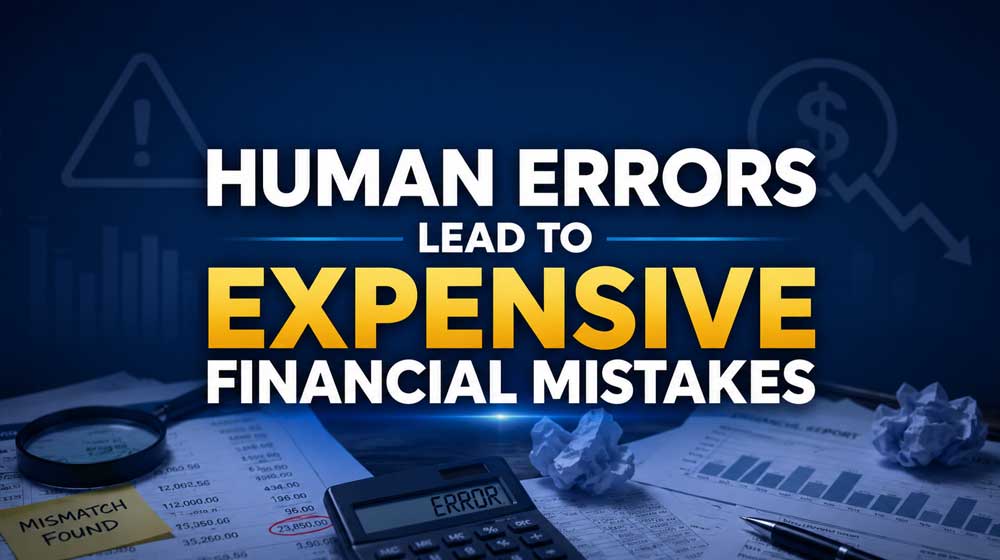
Human Errors Lead to Expensive Financial Mistakes
Manual reconciliation depends heavily on concentration and consistency. Even experienced accountants can accidentally overlook duplicate transactions, miss adjustments, enter incorrect values, or reconcile transactions against the wrong accounts.
Small errors frequently become larger financial problems when they remain undetected for weeks or months. Incorrect reconciliations may result in inaccurate financial statements, delayed audits, tax reporting issues, or poor executive decisions based on incorrect cash positions.
Delayed Financial Reporting Affects Business Decisions
Executives require real-time financial visibility to make informed decisions regarding investments, hiring, procurement, budgeting, and expansion. However, manual reconciliation delays financial closing because finance teams cannot finalize reports until every transaction has been verified. When financial data becomes outdated, business leaders lose the ability to respond quickly to market changes.
Fraud Detection Becomes More Difficult
According to global fraud studies published by the Association of Certified Fraud Examiners (ACFE), organizations lose an estimated 5% of annual revenue to occupational fraud, with financial statement manipulation and payment fraud remaining significant concerns. Timely reconciliation is one of the strongest internal controls for identifying unusual transactions before losses escalate.
Manual reviews increase the likelihood that suspicious transactions remain unnoticed because employees simply cannot investigate every exception immediately. AI-powered reconciliation systems continuously monitor transactions and identify anomalies much earlier than manual processes. This significantly strengthens fraud prevention and financial governance. (Source: ACFE Report to the Nations)
Compliance Risks Continue to Increase
Businesses must comply with various accounting standards, audit requirements, taxation regulations, internal financial controls, and industry-specific compliance frameworks. Manual reconciliation creates incomplete audit trails because spreadsheet modifications are often difficult to track. Missing documentation increases audit complexity while exposing organizations to regulatory penalties.
Why Businesses Lose Millions Every Year
The financial impact of manual reconciliation rarely appears as a single expense. Instead, losses accumulate gradually through overtime costs, delayed collections, duplicate payments, unidentified fraud, inaccurate reporting, compliance penalties, poor cash management, operational inefficiencies, and customer disputes.
A finance team may believe reconciliation is functioning adequately because monthly reports are eventually completed. However, executives rarely calculate how much revenue is lost due to delayed financial visibility, inefficient resource allocation, or inaccurate forecasting. When these hidden costs are measured across multiple departments, annual losses can easily reach hundreds of thousands—or even millions—for medium and large enterprises.
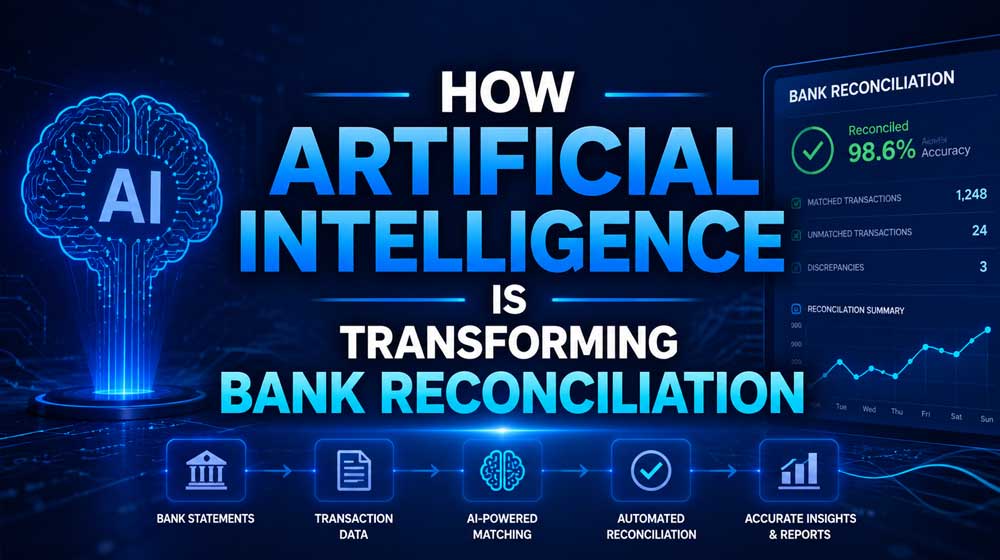
How Artificial Intelligence Is Transforming Bank Reconciliation
Artificial Intelligence has fundamentally changed financial operations. Modern AI-powered reconciliation platforms combine Machine Learning, Intelligent Document Processing (IDP), Optical Character Recognition (OCR), Natural Language Processing (NLP), predictive analytics, and workflow automation to eliminate repetitive manual work.
Instead of comparing transactions one by one, AI analyzes large financial datasets simultaneously, identifies matching patterns, detects anomalies, and continuously improves matching accuracy using historical transaction behavior. The result is significantly faster reconciliation with substantially fewer errors.
AI Algorithms Behind Intelligent Bank Reconciliation
Modern reconciliation platforms leverage advanced AI models rather than simple rule-based automation. Machine Learning algorithms continuously learn transaction patterns, allowing systems to recognize recurring payments, supplier invoices, payroll entries, bank charges, subscription payments, and customer receipts automatically.
Natural Language Processing interprets payment descriptions, invoice references, and banking remarks that vary across financial institutions. Optical Character Recognition extracts structured financial data from bank statements, invoices, and payment documents without manual entry. Anomaly Detection algorithms identify suspicious transactions that differ from normal financial behavior, enabling finance teams to investigate potential fraud immediately.
Predictive AI further recommends likely transaction matches before users review exceptions, significantly accelerating reconciliation accuracy. As AI models continue learning, reconciliation becomes faster and more accurate every month.
Business Benefits of AI-Powered Bank Reconciliation
Organizations adopting AI-driven reconciliation experience measurable improvements across finance operations. Financial close cycles become significantly shorter because AI automatically matches the majority of transactions before human review begins.
Finance professionals spend more time analyzing business performance rather than performing repetitive administrative work. Cash flow visibility improves because executives receive near real-time financial reporting. Operational risks decrease through consistent reconciliation, automated audit trails, and continuous anomaly detection.
Customer satisfaction also improves because payment discrepancies are identified and resolved much faster. Perhaps most importantly, finance departments evolve from transaction-processing teams into strategic business partners capable of delivering valuable financial insights.
Why AI Is Becoming Essential Rather Than Optional
Global finance leaders are rapidly increasing investments in Artificial Intelligence because transaction complexity continues growing every year. Businesses now manage payments across banks, digital wallets, payment gateways, subscription platforms, ERP systems, marketplaces, international currencies, and cloud accounting software.
Manual reconciliation simply cannot scale efficiently within this environment. Organizations delaying AI adoption risk increasing operational costs while competitors improve speed, financial accuracy, and decision-making capabilities. AI is no longer replacing finance professionals. Instead, it empowers them to focus on higher-value financial analysis, forecasting, compliance, and strategic planning.
How to Choose the Right AI Bank Reconciliation Solution
The most effective reconciliation platforms integrate seamlessly with ERP systems, accounting software, banking platforms, payment gateways, payroll systems, and financial applications. They should provide intelligent transaction matching, customizable approval workflows, automated exception handling, predictive analytics, complete audit trails, role-based access control, enterprise-grade security, and real-time dashboards.
Scalability is equally important. A solution that performs well for ten thousand monthly transactions should also support millions as the business expands. Choosing technology with explainable AI, continuous learning capabilities, and enterprise security ensures long-term operational success.
Frequently Asked Questions
Does AI completely replace accountants?
No. AI automates repetitive reconciliation tasks while accountants focus on financial analysis, compliance, strategic planning, audits, and business advisory responsibilities.
Is AI reconciliation suitable for small businesses?
Yes. Cloud-based AI reconciliation solutions now support startups, SMEs, and large enterprises. Smaller businesses benefit from improved accuracy and reduced administrative effort without requiring large finance teams.
How accurate is AI-powered bank reconciliation?
Modern AI reconciliation platforms typically achieve very high automatic matching rates after learning historical transaction patterns. Final accuracy depends on data quality, business rules, and continuous model training.
Can AI detect fraudulent transactions?
Yes. AI analyzes transaction behavior, identifies unusual payment patterns, duplicate transactions, unexpected amounts, and abnormal activities much earlier than manual reviews.
Final Thoughts
Manual bank reconciliation is no longer simply an administrative finance activity. It has become a significant business risk that quietly reduces profitability, slows decision-making, increases compliance exposure, and limits organizational growth.
Artificial Intelligence is redefining financial operations by delivering faster reconciliation, greater accuracy, stronger fraud detection, real-time financial visibility, and intelligent automation that continuously improves over time.
Organizations that modernize their reconciliation process gain more than operational efficiency. They create a finance function capable of supporting business growth with reliable data, faster reporting, and strategic financial intelligence.
If your finance team still spends days reconciling spreadsheets every month, the cost is likely much higher than it appears. Investing in AI-powered bank reconciliation is no longer just a technology upgrade—it is a strategic business decision that protects revenue, strengthens financial control, and prepares your organization for sustainable growth.
Ready to Modernize Your Bank Reconciliation Process?
If your organization is struggling with delayed financial closing, reconciliation errors, fragmented financial systems, or rising operational costs, now is the ideal time to adopt AI-powered automation.
PMDG Technologies delivers intelligent Bank Reconciliation solutions powered by Artificial Intelligence, Machine Learning, OCR, and Intelligent Automation. Our platform helps businesses automate transaction matching, detect anomalies, accelerate month-end closing, strengthen compliance, and gain real-time financial visibility.
Book a free AI finance automation consultation today and discover how your finance team can reduce reconciliation time, improve financial accuracy, and unlock measurable business value.
Lead Magnet: Download our free guide, “AI Bank Reconciliation Readiness Checklist: 25 Questions Every CFO Should Ask Before Automating Finance Operations,” and assess whether your current reconciliation process is limiting business growth.