Introduction: Why Single-Prompt AI Is No Longer Enough
Artificial Intelligence has transformed the way organizations operate. From customer support automation and content generation to business intelligence and workflow optimization, Large Language Models (LLMs) have become central to digital transformation strategies. However, as businesses increasingly deploy AI for mission-critical operations, a major challenge has emerged.
While standalone LLMs are powerful, they often struggle with complex reasoning, contextual understanding, data verification, compliance requirements, and multi-step decision-making processes. Consequently, organizations frequently encounter inaccurate outputs, hallucinations, inconsistent responses, and limited scalability.
Therefore, forward-thinking enterprises are moving beyond single-prompt AI implementations and embracing Multi-Stage LLM Pipelines.
Rather than relying on one AI model to perform every task simultaneously, multi-stage pipelines divide complex operations into structured stages. As a result, AI systems become more accurate, reliable, explainable, and efficient.
In 2026, many leading AI deployments across healthcare, finance, manufacturing, logistics, SaaS, and eCommerce sectors are powered by multi-stage LLM architectures. Therefore, understanding how these pipelines work has become essential for organizations seeking competitive advantages through AI.
This guide explores everything businesses need to know about multi-stage LLM pipelines, including architecture, benefits, implementation strategies, AI algorithms, business use cases, and future trends.
What Are Multi-Stage LLM Pipelines?
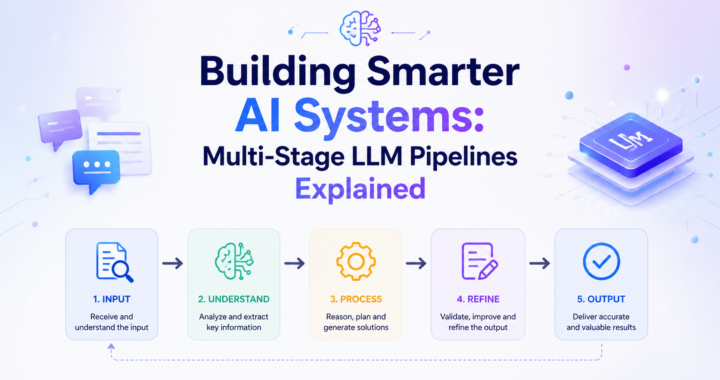
A Multi-Stage LLM Pipeline is an AI architecture that breaks a complex task into multiple sequential processing stages. Instead of asking a single model to perform all reasoning, analysis, validation, and output generation at once, the system distributes responsibilities across specialized stages.
Consequently, each stage performs a specific function before passing information to the next stage.
For example, when a customer asks a complex business question, the pipeline may first classify the query, then retrieve relevant information, subsequently validate the data, next perform reasoning, and finally generate a response.
As a result, the final output becomes significantly more reliable than traditional single-step AI interactions.
Furthermore, this structured approach closely resembles how human experts solve problems. Rather than jumping directly to conclusions, professionals gather information, verify facts, analyze scenarios, evaluate alternatives, and then provide recommendations.
Therefore, multi-stage pipelines create AI systems that behave more like experienced professionals than simple text generators.
Why Businesses Are Adopting Multi-Stage AI Architectures
As organizations scale their AI initiatives, they quickly discover limitations within traditional LLM deployments.
Although single-model systems can answer straightforward questions, they often struggle with enterprise-grade requirements.
For instance, businesses frequently need AI systems capable of accessing multiple databases, complying with regulations, validating facts, maintaining audit trails, and integrating with operational workflows.
Consequently, organizations require more sophisticated architectures.
Multi-stage pipelines solve these challenges by introducing structure, accountability, and intelligence into AI workflows.
Moreover, enterprises benefit from higher response accuracy, improved compliance, enhanced transparency, reduced hallucinations, and greater operational reliability.
As a result, AI transitions from experimental technology into a dependable business asset.
The Core Components of a Multi-Stage LLM Pipeline
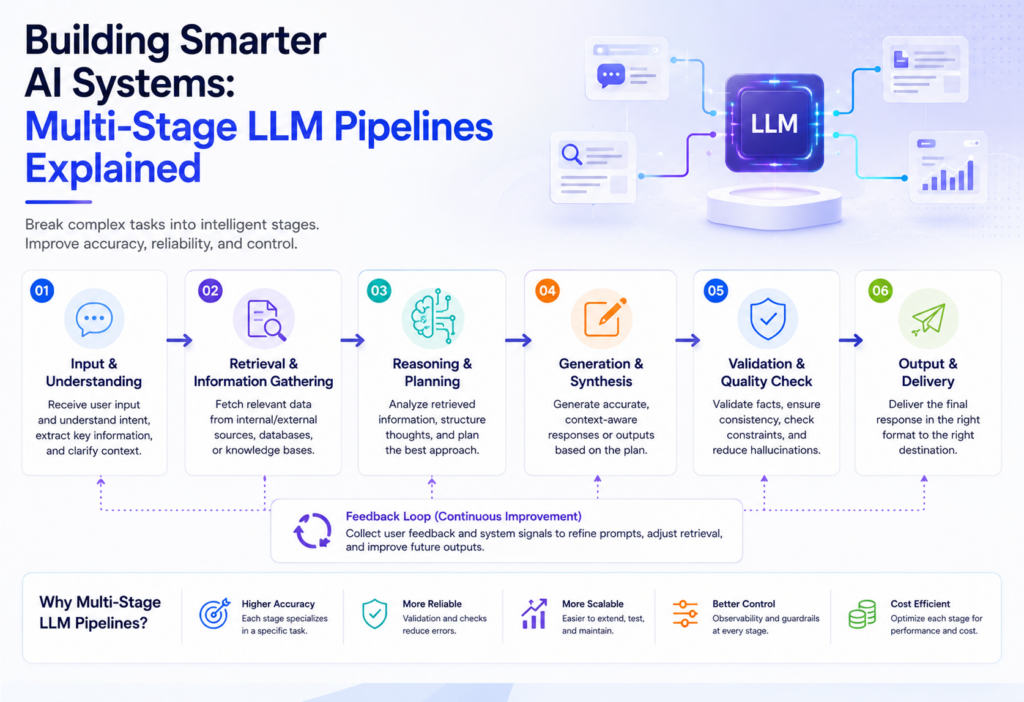
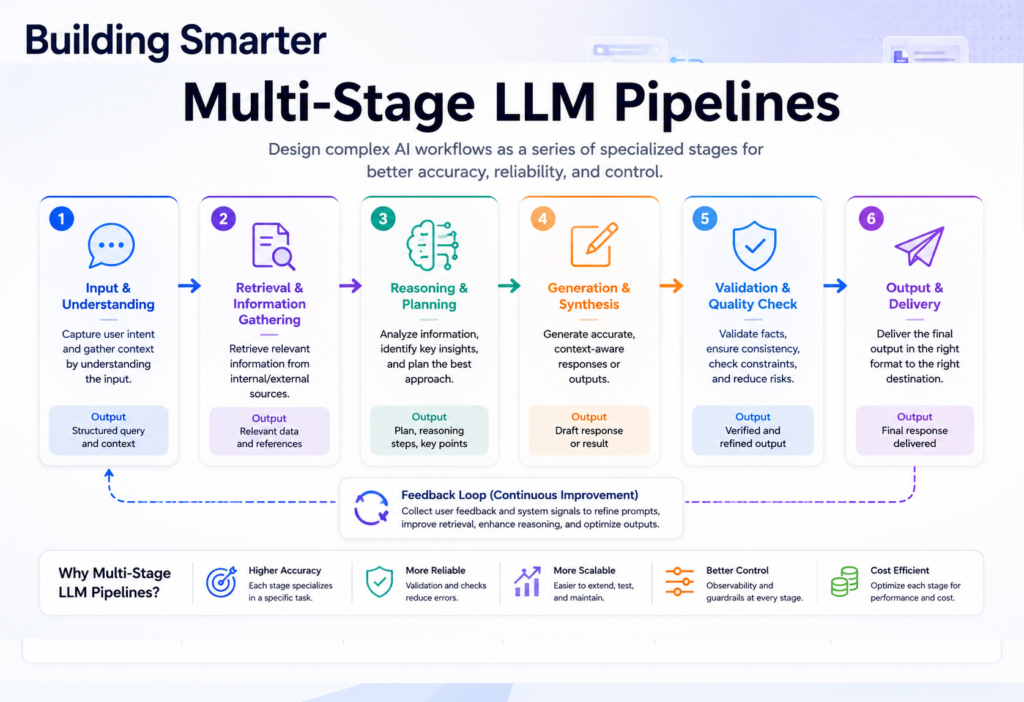
Input Processing and Query Understanding
Every intelligent AI system begins with understanding user intent.
When a request enters the pipeline, the first stage analyzes the input to determine context, objectives, sentiment, urgency, and complexity.
Instead of immediately generating a response, the system evaluates what the user actually wants to achieve.
For example, a customer inquiry about delayed shipments requires different processing compared to a financial forecasting request.
Therefore, intent classification becomes a critical foundation for pipeline performance.
Additionally, Natural Language Processing algorithms identify key entities, keywords, industry-specific terminology, and contextual relationships.
As a result, downstream stages receive highly structured information.
Intelligent Retrieval Layer
After understanding the request, the system retrieves relevant information from trusted sources.
This stage typically leverages Retrieval-Augmented Generation (RAG) architectures.
Instead of relying solely on model training data, the AI accesses current business databases, knowledge repositories, CRM systems, ERP platforms, internal documentation, and external data sources.
Consequently, responses become grounded in real-world information.
Furthermore, retrieval systems significantly reduce hallucinations because outputs are based on verified data rather than assumptions.
For organizations handling sensitive information, this stage provides substantial improvements in reliability and compliance.
Context Enrichment Engine
Once information is retrieved, the next stage enriches the context.
Rather than simply forwarding raw data, the pipeline organizes and prioritizes relevant information.
For example, customer history, transaction records, support interactions, operational metrics, and business rules may all contribute to contextual understanding.
As a result, subsequent reasoning models receive a comprehensive view of the situation.
Furthermore, context enrichment ensures consistency across different departments and workflows.
Therefore, AI decisions align more closely with organizational objectives.
AI Reasoning and Decision Layer
The reasoning layer represents the intelligence core of the pipeline.
At this stage, advanced LLMs analyze enriched context and evaluate possible solutions.
Instead of generating immediate outputs, the system applies structured reasoning techniques.
For example, chain-of-thought reasoning, tree-of-thought reasoning, agentic planning, and multi-agent collaboration models may be utilized.
Consequently, the AI evaluates alternatives before selecting the most appropriate response.
This approach mirrors how experienced consultants and decision-makers solve complex problems.
As a result, organizations receive higher-quality recommendations and insights.
Validation and Fact-Checking Layer
One of the most significant weaknesses of traditional LLM systems is hallucination.
Therefore, modern multi-stage pipelines include dedicated validation mechanisms.
Before outputs reach users, verification models assess factual accuracy, compliance requirements, logical consistency, and policy adherence.
Furthermore, external databases and business rules can cross-check generated content.
As a result, organizations reduce misinformation risks and improve trust in AI-generated outputs.
For highly regulated industries such as healthcare and finance, this validation stage has become essential.
Response Generation Layer
After validation, the final response generation stage creates the user-facing output.
Because previous stages have already handled retrieval, reasoning, and verification, the response model can focus entirely on communication quality.
Consequently, outputs become clearer, more accurate, and more relevant.
Additionally, responses can be personalized according to customer profiles, communication preferences, and business objectives.
As a result, user satisfaction improves significantly.
AI Algorithms Powering Multi-Stage LLM Pipelines
Modern multi-stage systems combine several AI methodologies to achieve superior performance.
Transformer architectures remain the foundation of most LLMs. However, successful pipelines integrate additional algorithms to address enterprise requirements.
Machine Learning models support classification and prediction tasks. Retrieval algorithms identify relevant information sources. Reinforcement Learning optimizes decision pathways. Knowledge Graphs enhance contextual understanding. Vector Databases facilitate semantic search. Agentic AI frameworks coordinate specialized agents.
Consequently, the pipeline becomes far more capable than any individual model operating independently.
Furthermore, continuous learning mechanisms allow systems to improve over time.
As a result, business outcomes steadily increase as more operational data becomes available.
Multi-Agent AI Systems: The Next Evolution of LLM Pipelines
While traditional pipelines follow sequential workflows, modern architectures increasingly utilize multiple AI agents working collaboratively.
Each agent specializes in a particular responsibility.
One agent may perform research, another may validate information, while another focuses on compliance assessment.
Consequently, complex tasks can be divided into manageable components.
Furthermore, agent collaboration enables dynamic problem-solving capabilities.
Rather than following rigid workflows, agents communicate and adapt based on evolving requirements.
As a result, organizations achieve higher flexibility and scalability.
This emerging approach is rapidly becoming a cornerstone of enterprise AI infrastructure.
How Multi-Stage Pipelines Solve Real Business Problems
Eliminating AI Hallucinations
Many organizations hesitate to deploy AI because inaccurate responses can create operational risks.
However, retrieval and validation stages dramatically reduce hallucination rates.
Consequently, outputs become grounded in verified information.
As a result, organizations can confidently integrate AI into critical workflows.
Improving Customer Support Automation
Customer support teams often struggle with high ticket volumes and inconsistent service quality.
Multi-stage AI pipelines address these challenges by retrieving customer history, analyzing issues, validating solutions, and generating personalized responses.
Consequently, customers receive faster and more accurate assistance.
Furthermore, support teams can focus on complex cases requiring human expertise.
Enhancing Business Intelligence
Executives require reliable insights to guide strategic decisions.
Traditional dashboards often present data without interpretation.
However, multi-stage AI systems retrieve operational data, analyze trends, identify anomalies, and generate actionable recommendations.
As a result, leadership teams gain deeper visibility into business performance.
Optimizing Workflow Automation
Organizations frequently rely on fragmented workflows involving multiple applications and departments.
Multi-stage pipelines coordinate activities across systems.
Consequently, approvals, notifications, compliance checks, and operational processes become automated.
As a result, productivity improves while manual effort decreases.
Enterprise Use Cases Across Industries
Healthcare
Healthcare providers utilize multi-stage pipelines for clinical documentation, patient communication, medical research assistance, and treatment recommendations.
Because validation layers verify medical information, organizations improve safety and compliance.
Consequently, healthcare professionals spend more time focusing on patient care.
Financial Services
Financial institutions leverage these systems for risk assessment, fraud detection, regulatory compliance, and customer advisory services.
As a result, decision-making becomes faster while maintaining strict compliance standards.
Manufacturing
Manufacturers deploy AI pipelines for predictive maintenance, inventory optimization, production planning, and quality control.
Consequently, operational efficiency increases while downtime decreases.
Retail and eCommerce
Retail businesses utilize multi-stage architectures to personalize recommendations, forecast demand, optimize inventory, and improve customer experiences.
As a result, conversion rates and customer retention improve significantly.
SEO and AI Search Optimization in the Era of Intelligent Systems
As Google increasingly integrates AI-driven search experiences, businesses must adapt their content strategies.
Modern search algorithms prioritize expertise, trustworthiness, relevance, and user satisfaction.
Therefore, organizations should focus on creating authoritative content supported by verified information.
Additionally, AI systems used for content generation must include validation mechanisms to ensure quality.
Consequently, websites gain stronger visibility within traditional search results and AI-generated search experiences.
Future Trends in Multi-Stage LLM Pipelines
The next generation of AI systems will become increasingly autonomous.
Agentic AI frameworks will manage complex workflows with minimal human intervention.
Additionally, multimodal capabilities will allow systems to process text, images, video, audio, and structured data simultaneously.
Furthermore, real-time reasoning engines will continuously analyze changing business environments.
Consequently, AI will evolve from an assistant into an active operational partner.
Organizations adopting these technologies early will gain substantial competitive advantages.
Conclusion
As businesses demand more accurate, scalable, and trustworthy AI solutions, single-model implementations are rapidly becoming insufficient.
Multi-Stage LLM Pipelines provide a structured approach that combines retrieval, reasoning, validation, and response generation into a unified intelligent system.
Consequently, organizations achieve higher accuracy, reduced hallucinations, improved compliance, and stronger business outcomes.
Moreover, by integrating advanced AI algorithms, multi-agent collaboration, and enterprise data sources, these architectures create smarter systems capable of addressing real-world challenges.
For companies seeking to maximize the value of AI investments in 2026 and beyond, implementing multi-stage LLM pipelines is no longer an innovation initiative—it is becoming a business necessity.
By adopting these advanced architectures today, organizations can build reliable, scalable, and future-ready AI ecosystems that drive sustainable growth, operational excellence, and long-term competitive advantage.