Introduction:
Artificial Intelligence has moved far beyond simple chatbots and one-shot automation. Today, businesses need AI systems that can reason, verify, retrieve data, make decisions, and continuously improve outputs. However, many companies still rely on single Large Language Model (LLM) prompts and expect enterprise-grade intelligence.
That creates a major problem.
A single AI prompt may generate fluent responses, yet it often struggles with consistency, factual accuracy, contextual understanding, and complex business workflows. As a result, companies face hallucinations, poor decision-making, inconsistent outputs, and rising operational risk.
This is exactly where multi-stage LLM pipelines become essential.
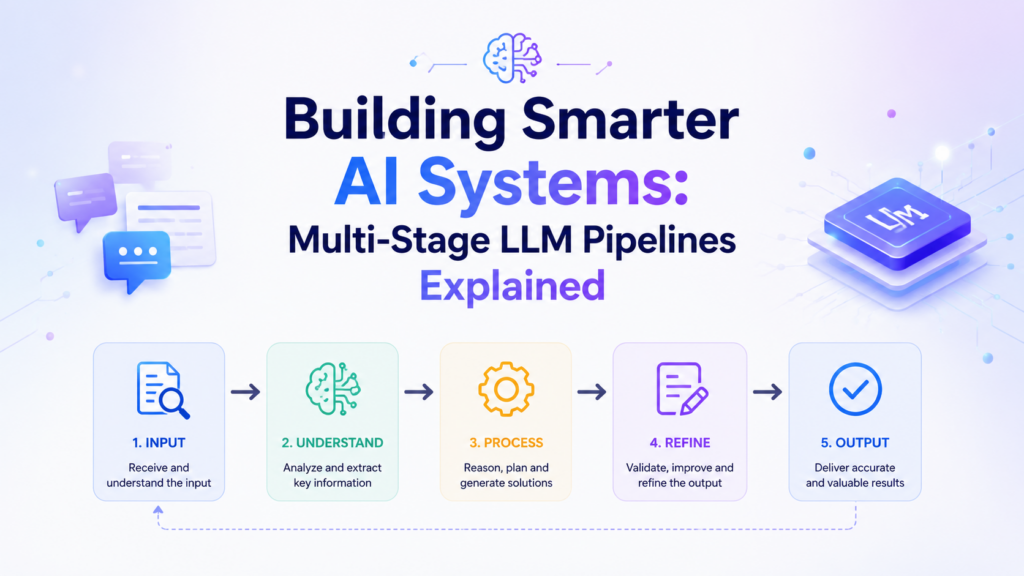
Instead of relying on one prompt, smarter AI systems divide tasks into multiple intelligent stages. Each stage performs a specialized function such as input analysis, retrieval, reasoning, verification, memory handling, and response optimization.
Consequently, the AI behaves less like a chatbot and more like an intelligent enterprise system.
Organizations across healthcare, banking, retail, manufacturing, logistics, and SaaS are rapidly adopting multi-stage LLM architectures because they improve reliability, reduce hallucination rates, and increase automation quality.
According to McKinsey & Company, generative AI could add up to $4.4 trillion annually to the global economy. Meanwhile, Gartner predicts that by 2027, over 60% of enterprise AI deployments will use orchestrated multi-model systems rather than single-model deployments.
That shift is already happening.
The companies winning with AI are not simply using bigger models. Instead, they are building smarter AI pipelines.
In this article, we will deeply explore what multi-stage LLM pipelines are, why they matter, how they work, their architecture, algorithms, real-world applications, and how businesses can build scalable AI systems for long-term growth.
What Is a Multi-Stage LLM Pipeline?
A multi-stage LLM pipeline is an AI architecture where multiple processing stages work together sequentially or dynamically to generate highly reliable outputs.
Rather than sending raw user input directly to a language model, the system processes the request through several intelligent layers.
For example, a pipeline may look like this:
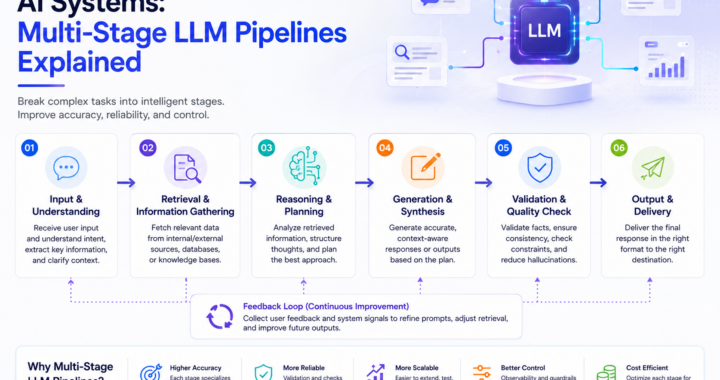
Input Understanding Stage
The system first analyzes the user’s intent.
At this stage, the AI determines:
- What is being asked
- Required context
- Urgency
- Domain relevance
- Complexity level
This stage ensures the model understands the problem correctly before processing.
Without this layer, even powerful models can misunderstand intent.
Retrieval Stage
Next, the pipeline gathers relevant data.
This may include:
- Internal enterprise databases
- CRM records
- ERP systems
- Knowledge bases
- Real-time web data
- Historical records
This stage uses Retrieval-Augmented Generation (RAG).
RAG dramatically reduces hallucination because the model works with real data rather than memory alone.
For example, a finance AI assistant should not answer from training data alone. Instead, it must retrieve live stock prices, compliance policies, and customer account details.
Reasoning Stage
This is where the LLM performs advanced reasoning.
The AI may:
- Compare multiple options
- Perform chain-of-thought reasoning
- Evaluate dependencies
- Predict outcomes
- Analyze risk
For enterprise workflows, reasoning is critical.
For instance, a logistics AI may evaluate delivery delays caused by weather, route congestion, inventory shortage, and vehicle availability simultaneously.
Single-stage AI often fails here.
Multi-stage pipelines excel.
Verification Stage
This stage validates outputs before final delivery.
Verification includes:
- Fact checking
- Policy compliance
- Security validation
- Mathematical accuracy
- Business rule enforcement
This stage prevents costly errors.
Imagine a healthcare AI recommending wrong dosage due to hallucination. Verification acts as a safeguard.
This dramatically improves trust.
Response Optimization Stage
Finally, the output gets optimized.
This includes:
- Formatting
- Tone adaptation
- Language localization
- User personalization
- CTA optimization
As a result, responses become highly relevant and user-centric.
Why Traditional LLM Systems Fail in Enterprise Use Cases
Many companies rush into AI adoption expecting instant transformation.
However, several challenges emerge.
Hallucinations
LLMs can confidently generate false information.
This creates major risks in finance, healthcare, law, and operations.
Lack of Real-Time Awareness
Static training data becomes outdated.
For example, models trained months ago cannot reliably answer today’s pricing, regulations, or market trends.
Poor Memory
Single prompts often lose context across long workflows.
Customer support systems suffer greatly from this limitation.
Inconsistent Decision Quality
The same prompt can produce different outputs.
That inconsistency hurts enterprise reliability.
Because of these pain points, businesses need structured AI systems rather than isolated prompts.
The Core Architecture of Smarter AI Systems
Modern AI pipelines typically follow orchestrated architecture.
Stage 1: Data Ingestion Layer
This layer collects data from multiple sources.
Typical sources include:
- APIs
- Documents
- Emails
- CRM systems
- ERP databases
- Web scraping
- IoT sensors
Clean data improves model performance.
Garbage in means garbage out.
Stage 2: Preprocessing Layer
Raw data is rarely usable.
Therefore, preprocessing is essential.
It involves:
- Data cleaning
- Noise removal
- Deduplication
- Token optimization
- Semantic chunking
This stage reduces token cost while improving relevance.
Stage 3: Embedding Generation
Here, textual data converts into vector representations.
Embedding models transform words into mathematical vectors.
These vectors capture semantic meaning.
As a result, similar concepts remain close in vector space.
Example:
“AI automation” and “intelligent workflow automation” become semantically related.
This powers semantic search.
Stage 4: Vector Database Search
Once embeddings are created, they are stored inside vector databases such as:
These systems enable high-speed similarity search.
This improves retrieval accuracy dramatically.
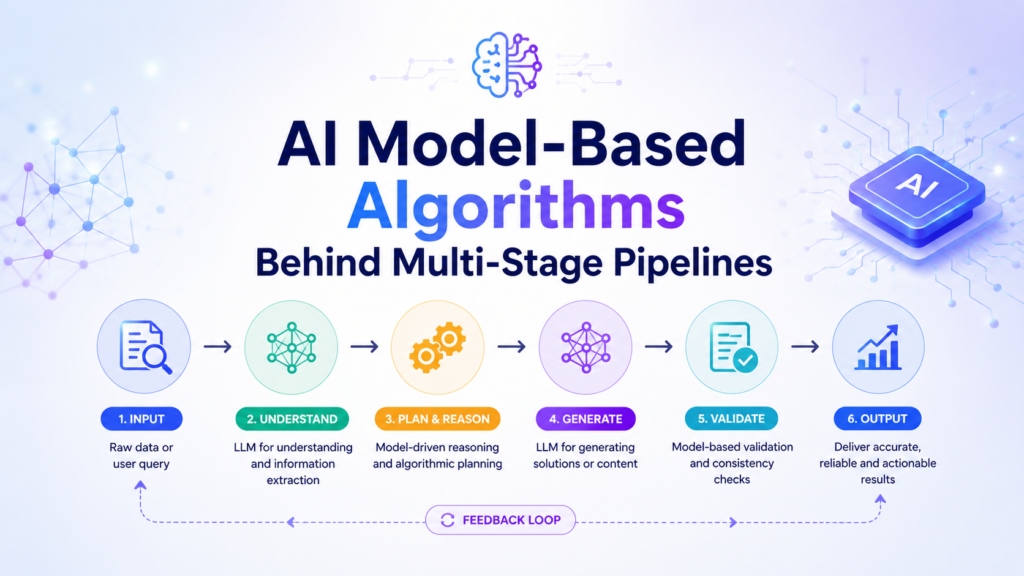
AI Model-Based Algorithms Behind Multi-Stage Pipelines
This is where true intelligence emerges.
Several advanced AI algorithms power modern LLM orchestration.
Transformer Attention Mechanism
Transformers analyze token relationships using attention.
Attention helps the model determine which words matter most.
For example, in financial analysis, attention identifies relationships between revenue, expenses, and profitability.
This improves contextual reasoning.
Reinforcement Learning from Human Feedback (RLHF)
RLHF aligns AI outputs with human preferences.
The feedback loop improves:
- Safety
- Relevance
- Accuracy
- Helpfulness
This makes enterprise AI more reliable.
Retrieval-Augmented Generation (RAG)
RAG combines search with generation.
Pipeline:
- Query arrives
- Relevant documents retrieved
- LLM processes retrieved context
- Response generated
Benefits include:
- Lower hallucination
- Better accuracy
- Real-time relevance
This is now a core enterprise AI strategy.
Agentic AI Orchestration
Agentic AI uses multiple specialized AI agents.
Each agent performs unique tasks.
Examples:
- Planner agent
- Research agent
- Coding agent
- Verification agent
- Reporting agent
This creates collaborative intelligence.
Companies adopting agentic AI are seeing major productivity gains.
Why Businesses Are Investing Heavily in Smarter AI Systems
The biggest pain point companies face today is inefficiency.
Teams waste time on repetitive processes.
Manual workflows slow decision-making.
Human bottlenecks reduce scalability.
Multi-stage AI solves these issues.
Faster Decision-Making
AI analyzes millions of data points in seconds.
Executives gain actionable insights faster.
Therefore, decisions improve.
Reduced Operational Costs
Automation reduces manual labor.
According to Deloitte, AI-driven automation can reduce operational costs by 25–40% in many enterprise processes.
That directly improves profitability.
Higher Accuracy
Verification layers reduce error rates.
This improves enterprise trust.
Better Customer Experience
AI delivers personalized interactions at scale.
Customers receive faster and more relevant support.
Retention improves.
Real-World Industry Applications
Healthcare
Healthcare organizations use multi-stage AI for:
- Clinical documentation
- Diagnosis assistance
- Risk prediction
- Patient engagement
This reduces administrative burden significantly.
Finance
Financial institutions use AI for:
- Fraud detection
- Credit scoring
- Compliance monitoring
- Portfolio analysis
This improves risk management.
Retail
Retail businesses use smarter AI for:
- Demand forecasting
- Dynamic pricing
- Personalized recommendations
- Customer behavior prediction
This increases revenue.
Manufacturing
Manufacturers deploy AI for:
- Predictive maintenance
- Supply chain optimization
- Quality control
- Inventory forecasting
Downtime decreases significantly.
Common Mistakes Companies Make When Building AI Systems
Even though AI adoption is growing, many projects fail.
Why?
Because architecture is poorly planned.
Mistake 1: Using Only One LLM
One model cannot do everything well.
Specialization matters.
Mistake 2: Ignoring Data Quality
Poor data leads to poor AI.
Always prioritize data governance.
Mistake 3: No Guardrails
Without verification, AI becomes risky.
Safety layers are mandatory.
Mistake 4: No Human Oversight
Human-in-the-loop systems remain essential.
AI should augment humans, not blindly replace them.
How to Build an Enterprise-Ready Multi-Stage LLM Pipeline
Successful implementation requires strategic planning.
Step 1: Define Business Goals
Ask:
What problem are we solving?
The AI system must solve measurable business pain.
Step 2: Identify Data Sources
Map all relevant structured and unstructured data.
Without data visibility, pipeline performance suffers.
Step 3: Select AI Stack
Choose:
- LLM provider
- Embedding model
- Vector database
- Orchestration framework
- Monitoring system
Popular frameworks include:
Step 4: Implement Guardrails
Guardrails improve trust.
These include:
- Content moderation
- Validation rules
- Security controls
- Human approval
Step 5: Continuously Monitor
AI systems must evolve.
Track:
- Accuracy
- Cost
- Latency
- User satisfaction
- Error rates
Continuous optimization improves ROI.
The Future of AI: Beyond LLM Pipelines
We are entering a new era.
The future belongs to autonomous AI ecosystems.
These systems will include:
- Long-term memory
- Multi-agent collaboration
- Self-correction
- Autonomous planning
- Adaptive reasoning
This means AI will move beyond answering questions.
It will execute business workflows independently.
That is the next evolution.
Final Thoughts: Smarter AI Wins the Future
The AI race is no longer about using the largest model.
It is about building the smartest system.
Companies still relying on single-prompt AI will struggle with hallucinations, inconsistency, and limited scalability.
Meanwhile, businesses adopting multi-stage LLM pipelines will gain:
- Better automation
- Higher reliability
- Lower operational cost
- Faster decisions
- Strong competitive advantage
The companies that invest in smarter AI architecture today will dominate tomorrow’s digital economy.
If your business wants reliable, scalable, and enterprise-grade AI transformation, multi-stage LLM pipelines are no longer optional.
They are the foundation of next-generation intelligent systems.