
Introduction: The Hidden Cost of Data Loss in Modern Businesses
Every day, businesses generate and process enormous amounts of information through invoices, purchase orders, customer forms, emails, contracts, receipts, support tickets, and digital applications. However, despite rapid digital transformation, many organizations still rely on manual data entry, disconnected systems, and outdated document processing methods. As a result, valuable business information is often delayed, misplaced, duplicated, or entered incorrectly, creating costly operational challenges that impact productivity, customer satisfaction, and profitability.
In today’s highly competitive environment, even small data errors can lead to significant consequences. Incorrect customer records, delayed invoice processing, compliance issues, inventory inaccuracies, and reporting mistakes can slow business operations and affect decision-making. Consequently, organizations are searching for smarter ways to capture, process, and utilize data with greater speed and accuracy.
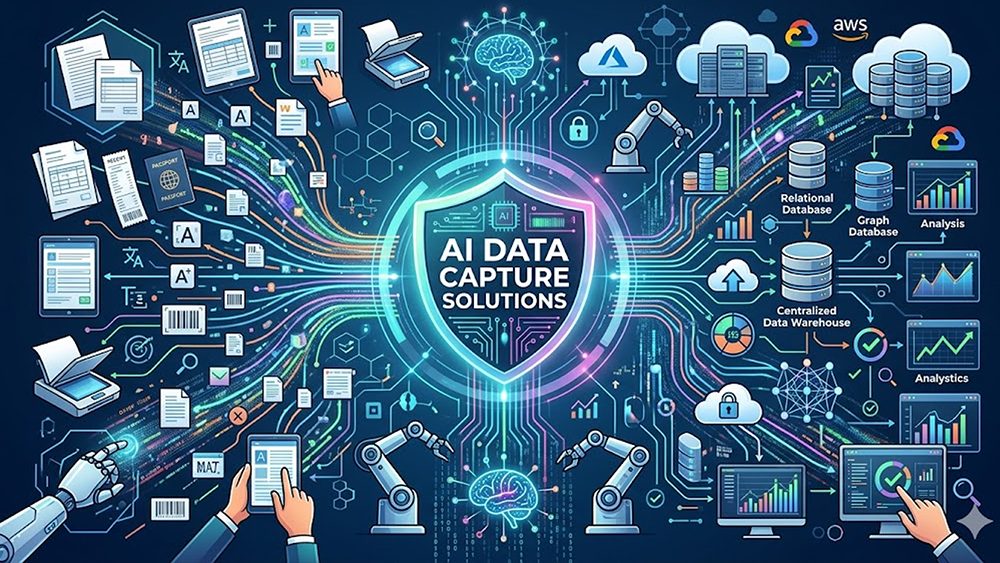
This is where AI Data Capture Solutions are transforming business operations. By combining Artificial Intelligence, Machine Learning, Optical Character Recognition (OCR), Natural Language Processing (NLP), and Intelligent Document Processing (IDP), modern AI-powered data capture systems automatically extract, classify, validate, and process information from multiple sources with minimal human intervention.
Rather than spending hours manually entering information into business systems, organizations can automate data extraction workflows, reduce errors, improve compliance, accelerate decision-making, and increase operational efficiency. Therefore, businesses that invest in AI-driven data capture solutions gain a significant competitive advantage while reducing costs and improving overall performance.
Understanding Why Businesses Continue to Lose Critical Data
Many organizations assume that data loss only occurs because of cybersecurity incidents or hardware failures. However, the reality is much broader. In most cases, data loss occurs during everyday business processes where information is manually captured, transferred, or entered into multiple systems.
When employees manually process hundreds or thousands of documents every week, mistakes become unavoidable. Human error, inconsistent formatting, duplicate records, incomplete forms, and delayed processing create data quality issues that spread across departments. As a result, management teams often make decisions based on inaccurate information, leading to poor business outcomes.
Furthermore, as organizations grow, the volume of incoming data increases significantly. Without automation, teams struggle to keep up with processing demands, resulting in operational bottlenecks and reduced productivity.
What Are AI Data Capture Solutions?
AI Data Capture Solutions are intelligent systems designed to automatically extract and process information from structured, semi-structured, and unstructured documents. Unlike traditional OCR tools that only convert images into text, AI-powered solutions understand document context, identify relevant information, validate extracted data, and integrate directly with business applications.
For example, when an invoice enters the system, AI algorithms can identify supplier information, invoice numbers, payment terms, tax details, line items, and total amounts without requiring manual intervention. Similarly, customer onboarding forms, insurance claims, contracts, healthcare records, and financial documents can be processed automatically.
As a result, organizations can significantly reduce processing time while improving accuracy and scalability.
The Growing Business Challenges Driving AI Data Capture Adoption
One of the biggest frustrations faced by business leaders is the amount of time employees spend on repetitive administrative tasks. Highly skilled professionals often dedicate substantial portions of their workday to locating documents, entering information, correcting errors, and verifying records.
Consequently, valuable resources are diverted away from strategic initiatives that generate growth and innovation.
Additionally, customer expectations continue to evolve. Modern customers expect faster responses, seamless experiences, and real-time service delivery. When organizations depend on manual workflows, response times increase and customer satisfaction declines.
Therefore, businesses increasingly recognize that AI-powered automation is not simply a technological upgrade but a strategic necessity.
How AI-Powered Data Capture Works
Modern AI data capture systems follow a multi-stage intelligent processing framework. First, documents are collected from multiple sources, including emails, scanned documents, mobile applications, cloud storage platforms, enterprise systems, and customer portals.
Next, Optical Character Recognition converts visual content into machine-readable text. However, unlike traditional OCR solutions, AI algorithms then analyze document structure, identify key fields, understand contextual relationships, and classify information based on business rules.
Machine Learning models continuously improve extraction accuracy by learning from previous processing activities. As more documents are processed, the system becomes increasingly accurate and efficient.
Finally, extracted data is validated and automatically transferred into ERP systems, CRM platforms, accounting software, workflow applications, and business intelligence tools.
This end-to-end automation dramatically improves both speed and accuracy.
The Role of AI Algorithms in Intelligent Data Capture
Artificial Intelligence serves as the foundation of modern data capture technology. Machine Learning models identify patterns across millions of data points, enabling systems to process documents that vary in format and structure.
Natural Language Processing helps systems understand written language, recognize business entities, and extract meaningful information from contracts, emails, customer communications, and reports.
Deep Learning models enhance image recognition capabilities, allowing organizations to process handwritten forms, receipts, signatures, and complex document layouts.
Meanwhile, predictive analytics algorithms continuously monitor data quality and identify potential anomalies before they impact business operations.
As a result, businesses achieve significantly higher levels of automation and accuracy compared to traditional data entry methods.
How AI Data Capture Improves Business Accuracy
Accuracy remains one of the most important benefits of AI-powered data capture solutions. Manual data entry processes frequently introduce errors that affect reporting, compliance, inventory management, customer service, and financial operations.
AI systems eliminate many of these challenges by automatically validating information against predefined business rules. If discrepancies are detected, the system flags them for review before inaccurate data enters operational systems.
Consequently, organizations gain greater confidence in their data quality while reducing costly mistakes.
Accelerating Business Operations Through Intelligent Automation
Speed is equally critical in today’s business environment. Delayed information often results in delayed decisions, slower customer service, and missed opportunities.
AI-powered data capture dramatically reduces document processing times from hours or days to minutes or seconds. Consequently, organizations can respond faster to customer inquiries, approve transactions more quickly, accelerate invoice processing, and improve operational efficiency across departments.
This increased agility enables businesses to adapt more effectively to changing market conditions.
Real-World Industry Applications of AI Data Capture
Healthcare organizations use AI-powered data capture to process patient records, insurance claims, and medical documentation more efficiently. Financial institutions automate loan applications, compliance documentation, and customer onboarding processes.
Retail companies improve inventory management, supplier coordination, and customer data accuracy. Manufacturing organizations streamline procurement, quality assurance, and supply chain documentation.
Similarly, logistics providers automate shipment records, customs documentation, and delivery verification processes.
Across industries, the common outcome is improved efficiency, accuracy, and customer satisfaction.
Future Trends Shaping AI Data Capture in 2026 and Beyond
As AI technologies continue to evolve, intelligent data capture solutions are becoming increasingly sophisticated. Generative AI, multimodal machine learning, real-time analytics, and autonomous business workflows are expanding automation capabilities across industries.
Organizations are moving beyond simple document extraction toward fully automated decision-making systems that can analyze information, generate recommendations, and initiate business actions without human intervention.
Consequently, businesses that adopt AI-driven data capture solutions today will be better positioned to compete in the increasingly digital economy of tomorrow.
Conclusion
Data is one of the most valuable assets in any organization, yet many businesses continue to lose productivity, revenue, and opportunities because of inefficient data processing methods. Manual data entry, fragmented workflows, and outdated systems create unnecessary delays and costly errors that impact business performance.
AI Data Capture Solutions provide a smarter alternative by automating information extraction, improving accuracy, accelerating operations, and enabling better decision-making. By leveraging Artificial Intelligence, Machine Learning, OCR, and Intelligent Document Processing technologies, organizations can transform how they capture, manage, and utilize data.
As digital transformation accelerates throughout 2026, businesses that embrace AI-powered data capture will gain a significant competitive advantage through improved efficiency, enhanced customer experiences, and data-driven growth. The question is no longer whether organizations should adopt AI data capture solutions, but how quickly they can implement them to stay ahead of the competition.