Manufacturing finance teams face a costly challenge that often remains hidden behind routine accounts payable operations: invoices that cannot be approved because purchase orders, goods receipts, and supplier bills do not match. A missing goods receipt, an unexpected price change, a duplicate invoice, or an incorrect quantity can delay payments, consume employee hours, and damage supplier relationships.
Traditional invoice automation helps extract invoice data and match records. However, when an exception occurs, finance employees often return to spreadsheets, ERP screens, email conversations, and manual approval workflows. As invoice volumes grow, these exceptions can become a bottleneck between procurement, warehouse operations, accounts payable, and production.
AI agents offer a more advanced approach. Instead of simply identifying mismatches, an AI-enabled finance workflow can investigate discrepancies, retrieve supporting records, identify likely causes, recommend corrective actions, and route decisions to authorized employees. With appropriate controls, it can also resolve predefined low-risk exceptions automatically.
For manufacturers seeking to reduce manual finance work without sacrificing financial control, the next step is not just faster invoice processing. It is a controlled transition from invoice matching to autonomous finance.
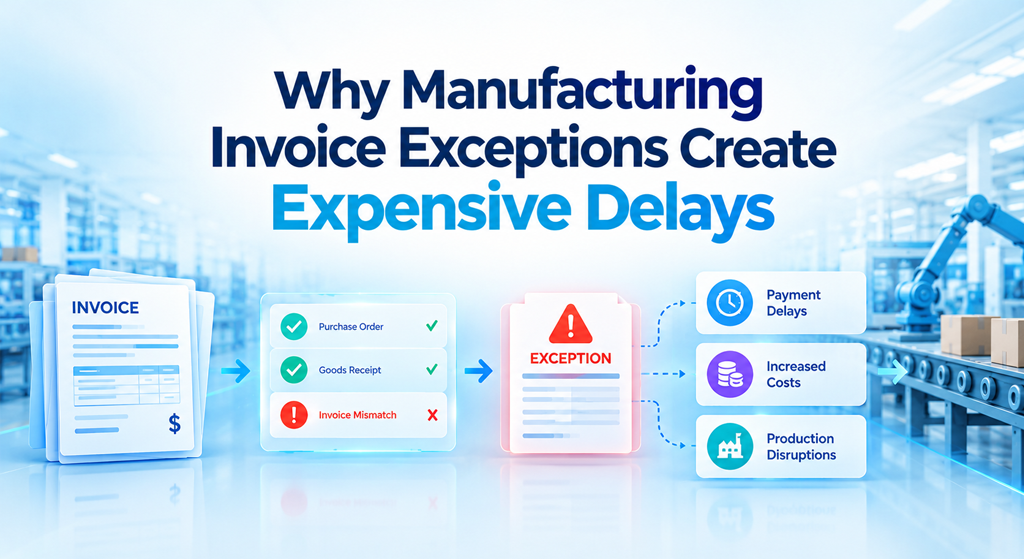
Why Manufacturing Invoice Exceptions Create Expensive Delays
Manufacturing invoices rarely exist in isolation. A supplier invoice may relate to a purchase order created by procurement, goods received at a warehouse, materials issued to production, and payment terms agreed with the supplier. Therefore, a discrepancy in one record can affect several departments.
For example, a manufacturer may order 1,000 industrial components but receive only 950 before the supplier submits an invoice for the full quantity. The accounts payable team cannot confidently approve the entire invoice because the goods receipt confirms a smaller quantity. Employees must contact the warehouse, verify delivery documents, review the purchase order, and communicate with the supplier.
Meanwhile, another invoice may contain a price that differs from the approved purchase order. Although the difference might result from an authorized contract revision, the finance team must establish whether the change is legitimate before releasing payment.
These situations become more difficult when a manufacturer operates multiple plants, uses different ERP systems, or processes invoices through email and spreadsheets alongside its financial software. Consequently, finance teams face more than an invoice-processing problem. They face a coordination problem in which essential information sits across disconnected systems and employees must manually determine what happened next.
AI-powered exception management addresses this challenge by connecting the evidence, identifying discrepancies, and guiding each case toward an appropriate resolution.
What Is Three-Way Invoice Matching in Manufacturing?
Three-way invoice matching is a financial control that compares three records before an organization approves a supplier invoice for payment. These records are the purchase order, the goods receipt, and the supplier invoice.
The purchase order establishes what the manufacturer authorized the supplier to provide, including quantities, prices, and agreed terms. The goods receipt records what the warehouse or receiving department actually accepted. Finally, the supplier invoice specifies what the supplier expects to be paid.
When all three records agree within the manufacturer’s approved tolerances, the invoice can move toward payment approval. However, when the records differ, the system should identify the discrepancy and prevent an unauthorized payment.
Consider a manufacturer that orders 500 machine components at ₹800 per unit. The purchase order totals ₹4,00,000 before applicable taxes and other charges. The warehouse records receipt of all 500 units, but the supplier submits an invoice charging ₹840 per unit.
The invoice total is ₹4,20,000 before taxes, creating a ₹20,000 price variance. A basic matching system flags the difference. An AI-enabled finance agent can go further by checking the contract, searching for an approved price revision, reviewing the purchase order’s change history, and gathering relevant correspondence.
If the agent finds an authorized amendment, it can present the supporting evidence for the designated approver. If it cannot establish authorization, it can retain the payment hold and route the case to procurement. This distinction is essential: matching identifies whether records agree, while intelligent exception management helps determine why they differ and what should happen next.
Why Traditional Invoice Automation Struggles With Exceptions
Conventional accounts payable automation can extract invoice fields, recognize supplier names, validate invoice numbers, and match transactions against ERP records. Nevertheless, many solutions still rely on predefined rules that struggle when business circumstances fall outside expected conditions.
For example, a supplier may deliver materials in several shipments while issuing one consolidated invoice. Alternatively, the warehouse may record receipt after the invoice reaches accounts payable. A purchase order might also contain an outdated price because an authorized amendment has not synchronized across systems.
In each situation, a rule-based system can flag the discrepancy without explaining its business context. Employees must then search for documents, request clarification, and update the relevant records.
The problem becomes more significant when exception queues grow faster than employees can resolve them. Critical suppliers may experience payment delays, finance teams may miss early-payment opportunities, and procurement employees may spend valuable time answering repetitive questions.
AI agents improve this process by using contextual information, retrieval from authorized business records, and controlled reasoning workflows to investigate exceptions. However, they still require reliable source data, clear business rules, and access permissions. They cannot reliably compensate for missing evidence or unclear approval policies.
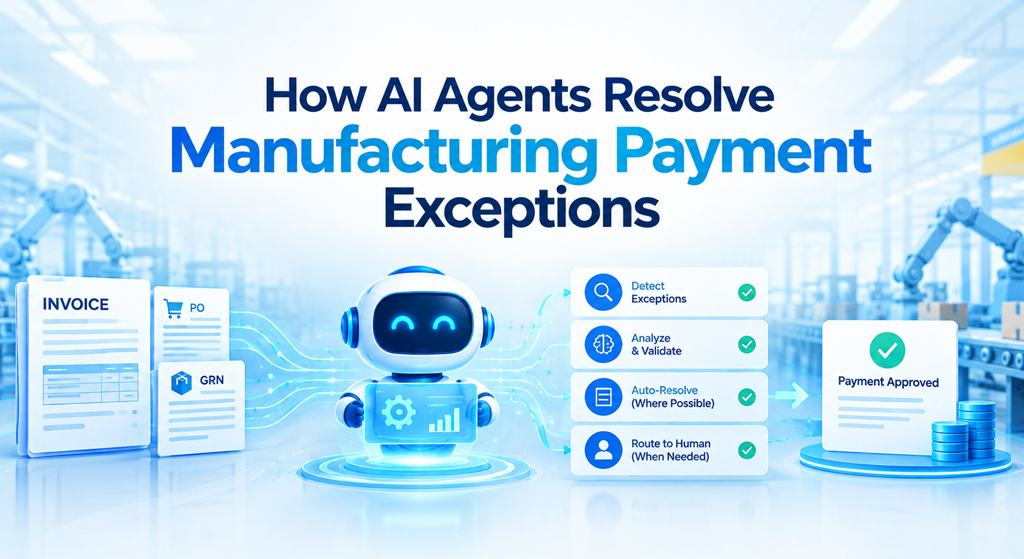
How AI Agents Resolve Manufacturing Payment Exceptions
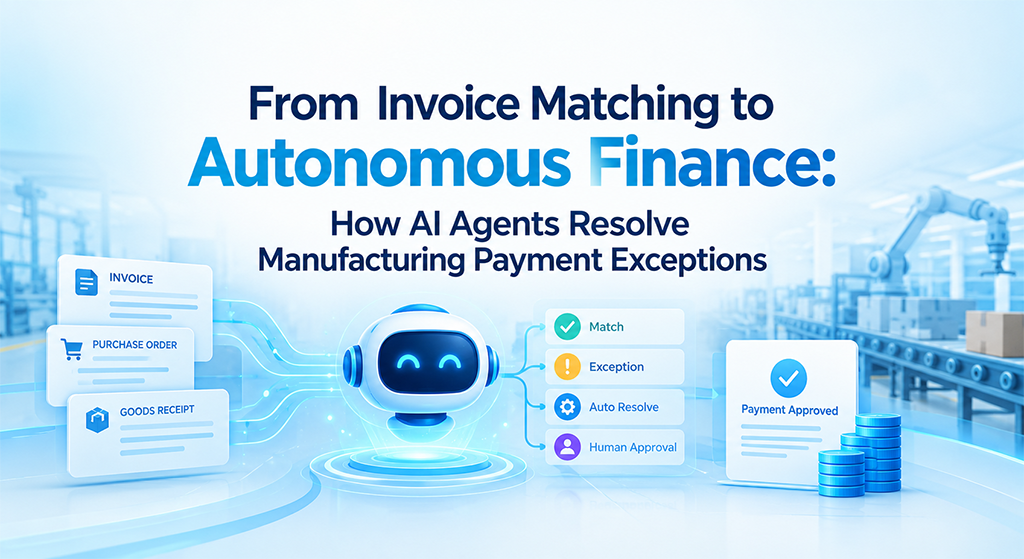
AI agents combine task planning, authorized data retrieval, business rules, and workflow execution to move an invoice exception toward resolution. Rather than treating every mismatch as an isolated error, they can follow a structured process that reflects the manufacturer’s financial controls.
1. Detect and Classify Invoice Discrepancies
The workflow begins when an invoice enters the accounts payable system. Document-processing models extract relevant fields, including supplier details, invoice number, purchase order reference, quantities, unit prices, taxes, and payment terms.
The system then compares the extracted information with the purchase order and goods receipt stored in the ERP or connected business systems. Validation rules check required fields, duplicate invoice indicators, arithmetic accuracy, and permitted quantity or price variances.
An AI agent can classify the resulting exception as a price mismatch, quantity discrepancy, missing receipt, duplicate risk, tax inconsistency, or supplier-data issue. It can also assign a priority based on factors such as payment deadlines, amount, production criticality, and supplier importance. As a result, employees can focus on cases requiring judgment instead of manually sorting every invoice.
2. Investigate the Root Cause Using Business Context
Identifying a mismatch is only the beginning. The next challenge is determining what caused it. Suppose a manufacturer receives an invoice for 300 units, while the goods receipt records only 200. The agent can retrieve available delivery notes, warehouse receiving records, shipment references, and relevant purchase order details through approved integrations.
If a second delivery remains unrecorded, the evidence may indicate a receiving-data delay rather than an incorrect supplier invoice. However, if the supplier never delivered the remaining 100 units, the case requires a different resolution. Similarly, when an invoice price exceeds the purchase order price, the agent can search authorized contract records and purchase order amendments to establish whether the difference has a documented explanation.
This process uses retrieval-augmented generation (RAG), where an AI model retrieves relevant information from approved records before generating a response. The model can summarize the evidence and identify missing information, while deterministic rules validate amounts, quantities, and approval limits. Importantly, the system should distinguish verified facts from probable explanations. If the evidence remains incomplete, it must report the uncertainty rather than invent a reason for the discrepancy.
3. Recommend or Execute the Correct Resolution
Once the agent identifies the likely cause, it can recommend the next action based on the manufacturer’s approved policies. For a missing goods receipt, it may request confirmation from the receiving department, and an unauthorized price difference, it may route the invoice to procurement. For a duplicate invoice risk, it may compare supplier identity, invoice number, amount, date, and available payment history before escalating the case.
Low-risk exceptions may qualify for automated resolution when the organization has explicitly defined the conditions. For example, an invoice within approved price and quantity tolerances may proceed through the normal approval workflow after all required validations succeed. Nevertheless, an AI-generated recommendation should not independently authorize a payment merely because its explanation sounds convincing. Financial actions must remain subject to defined permissions, deterministic validations, and the organization’s approval matrix.
4. Coordinate Human-in-the-Loop Approvals
Autonomous finance does not mean removing employees from financial decisions. Instead, it reduces repetitive investigation while preserving human authority over material or uncertain cases. An AI agent can prepare an exception summary containing the invoice amount, purchase order value, received quantity, variance, relevant documents, likely cause, and recommended action. It can then route the case to the appropriate employee based on amount thresholds, department ownership, supplier category, or financial risk.
For instance, an invoice with a ₹2,000 variance inside an approved tolerance may follow an established automated workflow. A ₹2,00,000 unexplained variance, however, may require procurement verification and finance approval before the system permits further action. The exact thresholds must reflect the manufacturer’s own policies rather than arbitrary AI recommendations.
Moreover, the approval process should record who reviewed the case, which evidence supported the decision, what action followed, and when the system changed the invoice status. This creates a traceable record for internal controls and audits.
5. Learn From Repeated Exceptions Without Weakening Controls
Manufacturers frequently encounter recurring discrepancies involving the same suppliers, materials, plants, or purchasing processes. Over time, these patterns can reveal opportunities for prevention. For example, repeated quantity mismatches from one warehouse may indicate delayed receiving entries. Frequent price variances from a particular supplier may suggest outdated purchasing agreements or poor master-data maintenance.
Analytics and machine-learning models can identify these patterns and help finance managers investigate their underlying causes. Where feedback is used to improve classifications or recommendations, the organization should validate model changes before deploying them into production.
However, the system must never interpret repeated exceptions as permission to bypass financial controls. Historical approvals do not automatically make future invoices safe. Every transaction must continue to satisfy the applicable authorization, evidence, and risk requirements.
The AI Model Architecture Behind Autonomous Accounts Payable
A reliable autonomous finance workflow requires several complementary technologies rather than a single AI model. Optical character recognition and document-understanding models extract invoice information from PDFs, scans, and supported electronic documents. Entity-matching and classification models help associate invoice records with suppliers, purchase orders, receipts, and exception categories.
Deterministic business rules validate mathematical calculations, required fields, contractual tolerances, duplicate indicators, and authorization limits. These checks are particularly important because financial calculations and payment permissions should not depend solely on probabilistic language-model output.
A retrieval-augmented generation layer can locate relevant contracts, purchase order amendments, delivery notes, and internal policies. An orchestration layer then assigns tasks, requests additional evidence, and routes cases to the correct department.
Finally, ERP and accounts payable integrations execute only permitted workflow actions. Role-based access, segregation of duties, approval controls, encrypted data handling, and comprehensive audit logs protect the process.
For higher-risk transactions, the architecture should include explicit confidence thresholds and exception escalation. Confidence scores can help prioritize reviews, but they must be calibrated against real transaction outcomes and must never replace mandatory approvals. This combination of AI reasoning and deterministic controls creates a more dependable foundation for manufacturing finance automation.
How Manufacturers Can Implement AI-Powered Invoice Exception Management
A successful implementation begins with understanding the current accounts payable process. Before introducing AI agents, manufacturers should measure invoice volumes, exception categories, average resolution time, manual handling effort, duplicate-payment incidents, and payment delays.
Next, the finance team should identify a manageable starting point, such as missing goods receipts or purchase order price discrepancies. These cases should have clearly defined resolution paths, accessible supporting data, and identifiable process owners.
The implementation team can then connect the invoice-processing platform with the ERP, procurement system, receiving records, and approved document repositories. Data quality should be assessed before automation expands, because inconsistent supplier identifiers or incomplete purchase order histories can undermine otherwise capable models.
During the pilot, the AI agent should operate in recommendation mode. Employees can review its classifications, evidence summaries, and proposed actions against actual outcomes. This allows the organization to measure accuracy, identify failure patterns, and adjust controls before granting limited workflow-execution permissions.
After validation, the manufacturer can enable automation for explicitly approved low-risk cases while retaining mandatory human approval for material variances, suspected fraud, policy exceptions, and uncertain evidence.
Finally, finance leaders should review performance continuously. Changes to supplier contracts, ERP configurations, purchasing policies, or model behavior can affect the reliability of automated decisions. Therefore, monitoring and periodic control testing must remain part of the operating model.
How to Measure the Business Value of Autonomous Finance
Manufacturers should evaluate AI finance automation using operational and financial outcomes rather than the number of tasks assigned to an AI agent. Invoice exception resolution time measures how quickly the team moves a discrepancy from detection to an approved outcome. Straight-through processing measures the proportion of eligible invoices that complete the defined workflow without manual intervention. First-pass matching measures how many invoices match successfully on their initial validation.
Finance leaders should also monitor manual touches per invoice, overdue invoices, supplier queries, duplicate-payment incidents, approval turnaround, and the percentage of exceptions reopened after an attempted resolution.
To calculate potential savings, consider a hypothetical manufacturer that processes 10,000 invoices each month. If 20% require manual exception handling, the team investigates 2,000 exceptions monthly. If a controlled automation program reduces that volume of manual investigations by 40%, it could eliminate 800 manual investigations each month.
That result represents a scenario, not a guaranteed industry benchmark. Actual savings depend on exception complexity, data quality, integration costs, model performance, and the amount of employee work that remains necessary.
A credible business case should compare measured baseline performance with pilot results and include software, implementation, oversight, and ongoing maintenance costs. It should also account for avoided late-payment costs, reduced duplicate-payment exposure, and improvements in supplier relationships where reliable data is available.
Common Risks Manufacturers Must Address Before Automating Payments
AI agents can introduce new operational risks if organizations give them broad access or allow them to act without sufficient validation.
Incorrect document extraction can produce false matches. Poor-quality master data can associate an invoice with the wrong purchase order. A language model can misinterpret an ambiguous contract clause, and manipulated documents may attempt to influence automated decisions.
To reduce these risks, manufacturers should validate critical financial fields, restrict agents to authorized records, separate recommendation permissions from payment permissions, and require independent approval for sensitive actions. Supplier bank-account changes should follow a separately verified process rather than relying on information extracted from an invoice or an AI-generated explanation.
Organizations should also protect against duplicate execution, preserve source documents, log decisions, and establish a clear recovery procedure when an automated action fails.
Most importantly, manufacturers should begin with bounded workflows and expand autonomy only after the system demonstrates acceptable performance under real operating conditions. The objective is not to automate every decision. It is to automate appropriate decisions reliably while escalating uncertainty and risk.
Frequently Asked Questions About AI Agents in Manufacturing Finance
Can AI agents automatically resolve three-way matching exceptions?
Yes, AI agents can help resolve eligible three-way matching exceptions by retrieving supporting records, identifying discrepancies, and recommending or executing predefined actions. However, automated resolution should occur only when the invoice satisfies approved business rules, required evidence is available, and the workflow grants the necessary permissions. Uncertain or high-risk exceptions should go to an authorized employee.
What is the difference between invoice automation and autonomous finance?
Invoice automation typically extracts invoice data, validates fields, and performs predefined matching tasks. Autonomous finance extends these capabilities by investigating exceptions, coordinating across business systems, gathering evidence, and progressing eligible cases through controlled workflows. It still requires governance, auditability, and human approval wherever policy or risk demands it.
How does AI handle missing goods receipts?
An AI agent can identify the missing receipt, retrieve delivery documents and shipment records, and request confirmation from the receiving team. If the evidence confirms that the goods arrived but the receipt remains unrecorded, the authorized receiving process can correct the record. If delivery cannot be verified, the invoice should remain on hold until the discrepancy is resolved.
Is autonomous accounts payable suitable for manufacturers using legacy ERP systems?
It can be, provided the required data and workflow actions are accessible through secure, supported integrations or controlled interfaces. However, manufacturers should assess integration reliability, data quality, access permissions, and audit requirements before deployment. A phased pilot is generally more practical than attempting to automate every invoice process at once.
How can manufacturers measure the ROI of AI invoice matching?
Manufacturers can compare baseline and post-implementation exception resolution time, manual effort, straight-through processing, overdue invoices, duplicate-payment incidents, and total cost per invoice. ROI calculations should include implementation, software, integration, governance, and maintenance costs rather than counting potential labor savings alone.
Move Beyond Invoice Matching With PMDG Technologies
Manufacturing finance teams need more than software that flags mismatches. They need connected workflows that help employees understand discrepancies, retrieve the right evidence, coordinate approvals, and prevent avoidable payment delays.
PMDG Technologies provides digital transformation services across AI, automation, enterprise applications, and software integration. These capabilities can support manufacturers exploring intelligent invoice processing, ERP-connected workflows, document automation, and controlled finance operations.
The right starting point is to identify where payment exceptions consume the most employee time, determine which records and systems contribute to the problem, and establish measurable targets for improvement. From there, a phased AI automation strategy can help manufacturers reduce repetitive investigations while preserving the financial controls their business depends on.
Ready to explore AI-powered finance automation for your manufacturing operations?
Contact PMDG Technologies at business@pmdgtech.com or visit https://www.pmdgtech.com/ to discuss your invoice processing challenges, ERP integration requirements, and opportunities to build a more efficient accounts payable workflow.
Manufacturing Invoice Exception Automation Readiness Checklist
Use a practical readiness assessment to identify your most frequent invoice mismatches, review purchase order and goods receipt data quality, document approval thresholds, evaluate ERP integration requirements, and prioritize safe automation opportunities.
Request a manufacturing finance automation consultation with PMDG Technologies to identify suitable pilot workflows and define measurable success criteria.