A delayed purchase order, an invoice mismatch or an unverified quality certificate can interrupt manufacturing operations long before a machine breaks down. Although factories increasingly use digital systems to manage production, many critical decisions still depend on employees manually reviewing documents, comparing records and updating enterprise resource planning (ERP) software. Consequently, even a digitally connected manufacturer can experience avoidable procurement delays, payment disputes and production bottlenecks.
Traditional optical character recognition (OCR) helps extract information from documents. However, extracting text alone does not resolve the business problem. Someone must still determine what the information means, verify it against operational records and initiate the appropriate action.
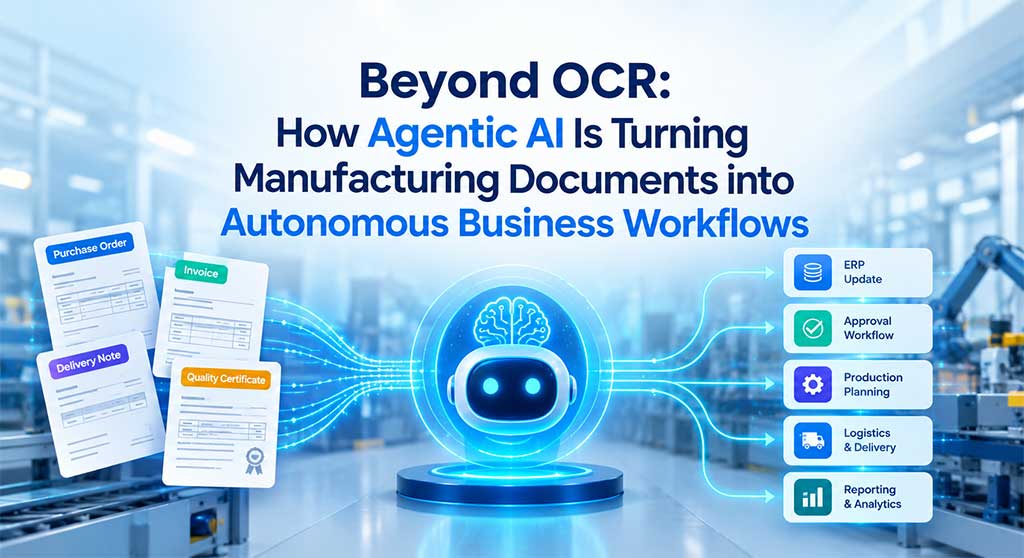
This is where agentic AI document automation in manufacturing introduces a more advanced approach. Instead of stopping after document extraction, AI agents can interpret business context, validate information across connected systems, identify exceptions and initiate approved workflows. As a result, manufacturers can move from document digitization towards intelligent business process execution.
What Is Agentic AI Document Automation in Manufacturing?
Agentic AI document automation combines intelligent document processing, AI reasoning, business rules and system integrations to execute document-driven workflows with controlled autonomy. Unlike conventional OCR or basic robotic process automation (RPA), an AI agent can evaluate the meaning of a document, determine the next permitted action and coordinate multiple steps across enterprise applications.
For example, when a manufacturer receives a supplier invoice, a conventional OCR system might extract the invoice number, amount, tax details and payment date. However, an agentic AI workflow can go further by comparing those details with the purchase order, checking the goods receipt note, identifying discrepancies and routing the invoice to the appropriate approval process.
Furthermore, the agent can record its findings, request missing information and notify the responsible employee when a decision requires human intervention.
The important distinction is that OCR reads the document, whereas agentic AI helps interpret the document and execute the associated business workflow. The actual execution must remain subject to configured permissions, validation rules and approval limits.
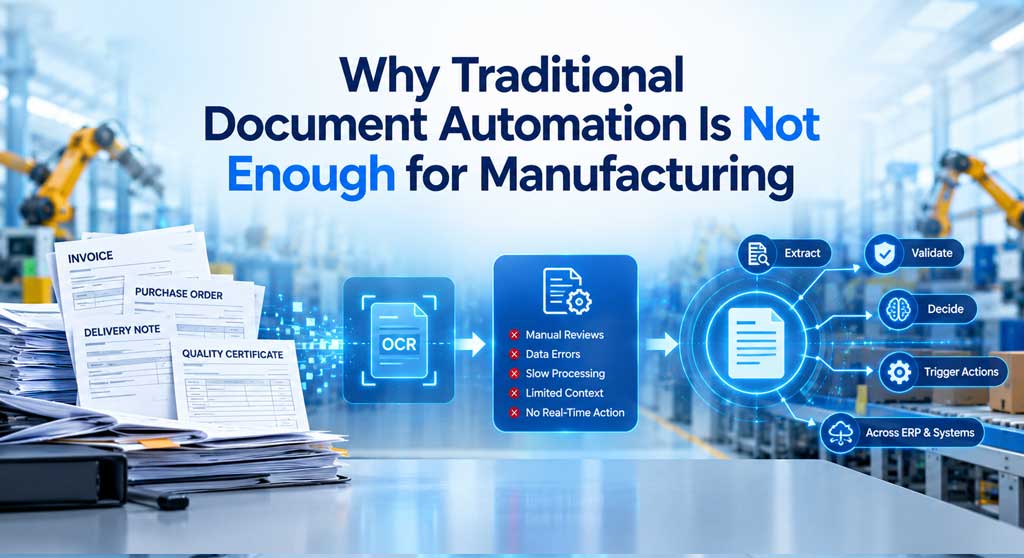
Why Traditional Document Automation Is Not Enough for Manufacturing
Manual Document Verification Creates Hidden Operational Costs
Manufacturers process purchase orders, supplier invoices, delivery notes, inspection reports and compliance certificates across multiple departments. However, these documents frequently arrive in different layouts, formats and levels of quality.
Consequently, employees spend valuable time locating information, comparing records and correcting data entry errors. Even when a company has implemented OCR, employees may still need to verify extracted information and manually update the ERP system.
These delays become particularly expensive when several departments depend on the same document. For instance, a procurement team may be waiting for a delivery confirmation while finance is waiting for an invoice match. Meanwhile, production planning may depend on the arrival of the same materials.
Agentic AI addresses this problem by coordinating document interpretation and subsequent actions instead of automating extraction alone.
ERP Systems Often Contain Data but Lack Document-Level Context
An ERP system may store purchase orders, supplier details, inventory transactions and financial records. Nevertheless, the information needed to make a decision may remain scattered across email attachments, scanned delivery notes, supplier portals and quality management systems.
As a result, employees often become the connection between otherwise separate applications. An AI agent can retrieve permitted records from connected systems, compare them with document contents and assemble the context required for a decision. Therefore, the business process becomes less dependent on employees manually transferring information between applications.
Exceptions Interrupt Otherwise Automated Workflows
A purchase order might specify 500 components, while the delivery note confirms only 450. Similarly, an invoice might include an unexpected charge or refer to an incorrect purchase order. Basic automation can detect some predefined mismatches, but unfamiliar exceptions frequently require additional investigation.
Agentic AI can classify the discrepancy, identify relevant supporting records, recommend the next action and route the case to the appropriate employee. Consequently, teams can concentrate on resolving genuine exceptions rather than reviewing every document from the beginning.
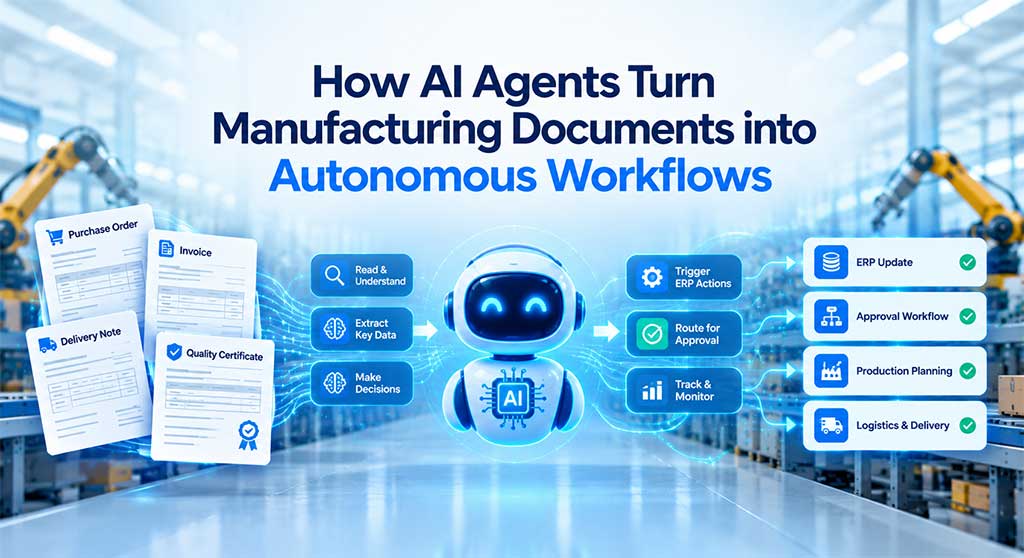
How AI Agents Turn Manufacturing Documents into Autonomous Workflows
Intelligent Document Understanding Beyond OCR
The first stage combines OCR, document classification and AI-based information extraction. Computer vision models can interpret scanned pages and document layouts, while language models can help identify relationships between extracted fields and business meaning.
For example, an agent can distinguish a purchase order number from a supplier reference number, even when different suppliers use different document templates. It can also identify line items, delivery dates, tax information and contractual terms.
However, extraction confidence matters. When the system encounters an unreadable value or an ambiguous field, it should request verification rather than silently treating an uncertain result as correct.
Contextual Validation Across ERP and Business Systems
After interpreting the document, the agent retrieves relevant information from connected enterprise applications. Depending on the workflow, this may include purchase orders, goods receipt notes, supplier master records, contracts, inventory balances and approval policies.
For example, the agent receives an invoice for industrial components and checks whether the supplier, quantities and agreed prices correspond with the purchase order and receipt records.
If the information matches within configured tolerances, the workflow can proceed to the next authorised step. Otherwise, the agent records the discrepancy and initiates the appropriate exception process. This approach makes document processing more context-aware because the system evaluates information against actual business records instead of relying exclusively on the document itself.
Autonomous Workflow Execution with Human Oversight
Once validation is complete, the agent can trigger permitted actions through APIs, ERP connectors or workflow orchestration tools. These actions may include creating a draft transaction, updating a document status, requesting missing information, sending notifications or routing an approval request.
Nevertheless, autonomy should reflect the business risk. Routine, low-risk actions may proceed automatically, while high-value payments, supplier bank-detail changes and material quality decisions should require appropriate authorisation.
Furthermore, every action should produce an auditable record of the source document, validation results, applicable rules, approvals and system changes. This ensures that faster execution does not come at the expense of financial control or accountability.
Real Manufacturing Use Cases for Agentic AI Document Automation
Purchase Order Processing and Supplier Coordination
Purchase order management often involves converting requisitions into orders, validating supplier confirmations and tracking changes to delivery schedules. An AI agent can interpret an approved requisition, check required information and prepare a purchase order within the organisation’s established rules. After sending the order, it can monitor supplier confirmations and identify discrepancies in quantities, prices or delivery dates.
If a supplier changes the promised delivery date, the agent can notify procurement and alert production planning when the change threatens material availability. Consequently, employees can address supply risks earlier instead of discovering them when production is already affected.
Invoice Matching and Accounts Payable Automation
Invoice processing is one of the most practical starting points for agentic AI because it connects document understanding with measurable financial outcomes. An AI agent can compare supplier invoices against purchase orders and goods receipt notes, identify price or quantity differences, and classify common exceptions. Depending on permissions, it can prepare an ERP posting, route an approval or request a corrected invoice.
For instance, if an invoice charges for 1,000 units but the warehouse recorded only 900 received units, the agent can flag the discrepancy and assemble the relevant records for review. Therefore, finance teams can investigate the actual issue without manually searching across multiple systems.
Delivery Notes and Inventory Reconciliation
Delivery notes provide evidence of what suppliers claim to have delivered. However, discrepancies between delivery documents, warehouse receipts and purchase orders can create inventory inaccuracies. An AI agent can extract delivery quantities, identify the associated purchase order and compare the document with warehouse records. When the quantities differ, it can create an exception for warehouse verification rather than automatically increasing inventory.
As a result, manufacturers gain a more reliable process for maintaining inventory records and identifying incomplete deliveries.
Quality Certificates and Compliance Documentation
Quality certificates, inspection reports and material test certificates often determine whether incoming materials can be accepted for production. An AI agent can extract certificate identifiers, batch numbers, material specifications and inspection results. It can then compare the information with purchase requirements and applicable quality rules.
If a certificate is missing, expired or inconsistent with the received batch, the workflow can flag the material for quality review and request the missing documentation. Importantly, the agent should not independently release nonconforming materials unless the organisation’s validated quality process explicitly permits that action.
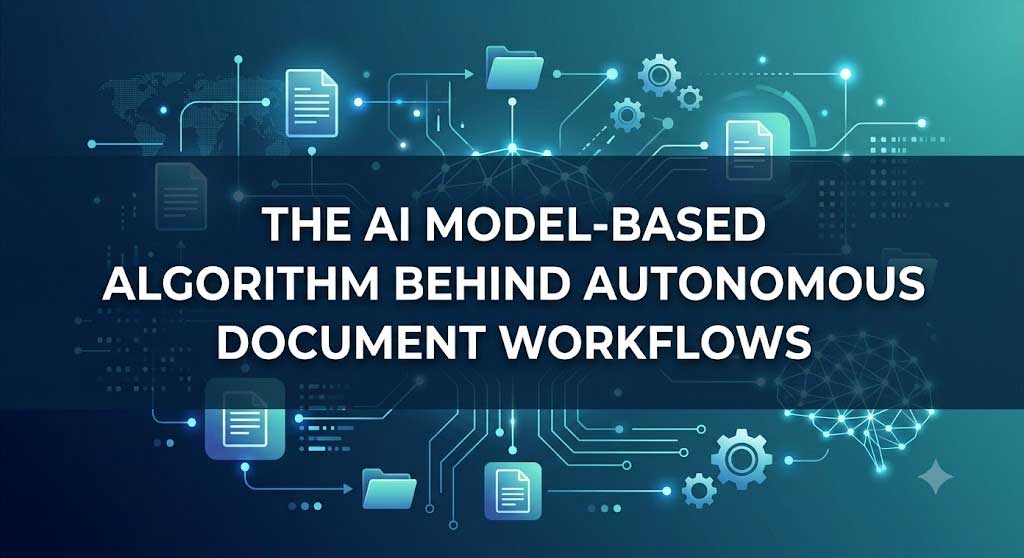
The AI Model-Based Algorithm Behind Autonomous Document Workflows
Reliable agentic AI document automation requires more than a single large language model. Instead, manufacturers can combine specialised models and deterministic business logic to balance flexibility, accuracy and control.
Step 1: Document Classification and Information Extraction
The system identifies the document type using a classification model. OCR and layout-aware document models then extract relevant fields, including identifiers, dates, quantities, totals and line items.
Step 2: Entity Resolution and Context Retrieval
The system maps extracted information to existing supplier records, purchase orders, inventory transactions and other business entities. Where identifiers are ambiguous, it checks additional context rather than selecting a match without sufficient evidence.
Step 3: AI Reasoning and Rule-Based Validation
A language model or specialised AI agent interprets relationships between the document and business context. Meanwhile, deterministic rules validate quantities, totals, tolerances, required fields and approval limits. For example, the AI model may explain why an invoice appears inconsistent with a delivery record, while the validation engine calculates the exact quantity difference.
Step 4: Confidence-Based Routing and Exception Management
The workflow combines extraction confidence, validation outcomes and business risk to decide whether to proceed, request verification or escalate the case. Low-confidence extraction, conflicting records and high-risk transactions should enter a controlled review process. Importantly, confidence thresholds must be calibrated against real documents and measured performance rather than chosen arbitrarily.
Step 5: Controlled Execution and Continuous Evaluation
After the required checks pass, the agent calls authorised tools or APIs to execute the next workflow step. The system logs the action and monitors the outcome. Over time, reviewed exceptions can help teams identify recurring document problems and improve extraction models, business rules and workflow design. Any model updates should be tested before deployment, particularly when financial or quality decisions are involved.
How Manufacturers Can Implement Agentic AI Without Replacing Their ERP
A successful implementation does not necessarily require replacing an existing ERP platform. Instead, manufacturers can introduce an intelligent document workflow layer that connects document sources, AI models and existing business applications.
First, select a process with frequent documents, measurable delays and clearly defined rules, such as invoice matching or delivery-note reconciliation. Next, document the existing workflow and establish a baseline for processing time, exception rates, manual intervention and error frequency.
Then, connect the document-processing pipeline to the relevant ERP records and test the workflow against representative historical documents. Include unusual layouts, incomplete records, duplicate invoices and conflicting quantities because these cases reveal whether the system can handle real operational conditions.
Afterwards, run the workflow in a controlled pilot with human review. Compare its decisions with verified outcomes, evaluate false matches and missed exceptions, and confirm that permissions and audit logs work correctly.
Finally, expand automation gradually as evidence supports greater autonomy. Manufacturers should measure actual improvements in processing time, exception resolution, data accuracy and cost per document rather than assuming that implementing AI automatically produces savings.
What Manufacturing Leaders Should Measure Before Scaling AI
The business value of agentic AI document automation should be evaluated through operational evidence. Useful measures include average document processing time, invoice exception resolution time, percentage of documents processed without manual correction, duplicate detection accuracy and the number of transactions requiring human intervention.
Manufacturers should also monitor the rate of incorrect matches, unauthorised actions and workflow failures. These safeguards matter because a system that processes documents quickly but introduces financial or inventory errors does not deliver sustainable improvement.
For an initial pilot, compare the same document categories before and after deployment, using a representative sample and clearly defined measurement periods. This gives finance, operations and IT leaders a defensible basis for deciding whether to expand the implementation.
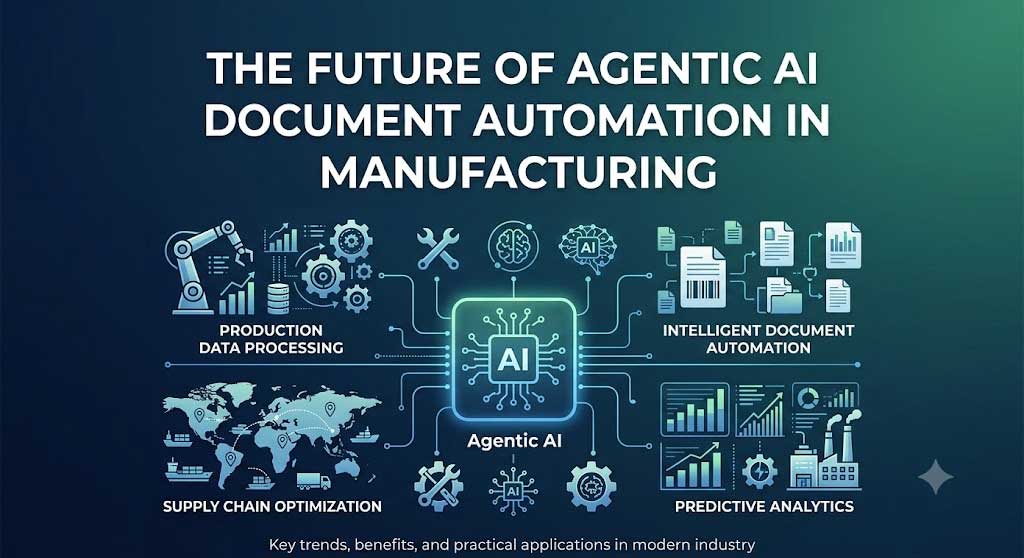
The Future of Agentic AI Document Automation in Manufacturing
The wider manufacturing industry is exploring ways to connect AI with operational systems, enterprise applications and decision-making processes. A February 2026 Gartner forecast projects that spending on ERP software with agentic capabilities will reach $72 billion by 2030, although adoption will depend on ecosystem readiness and other implementation constraints.
This direction reinforces an important distinction: manufacturers need more than intelligent document extraction. They need reliable connections between information, business decisions and controlled execution.
As these capabilities mature, document-driven workflows can become more responsive to changing supply conditions, financial exceptions and quality requirements. Nevertheless, the strongest implementations will combine AI flexibility with validated rules, secure integrations, human accountability and measurable operational outcomes.
For manufacturers, the opportunity is not simply to eliminate manual data entry. It is to reduce the time between receiving business information and taking the correct operational action.
Transform Manufacturing Documents into Intelligent Business Workflows with PMDG Technologies
When purchase orders, invoices, delivery notes and quality certificates move through disconnected processes, the resulting delays can affect procurement, finance, inventory and production.
PMDG Technologies helps businesses explore digital transformation through AI, automation, ERP solutions and intelligent business workflows. By assessing existing processes and integration requirements, manufacturers can identify opportunities to reduce repetitive document handling, improve information flow and introduce controlled AI-powered execution.
Ready to move beyond OCR? Explore how AI-driven document automation can support your manufacturing workflows.
Visit PMDG Technologies to discuss your automation requirements, or explore our automation services.
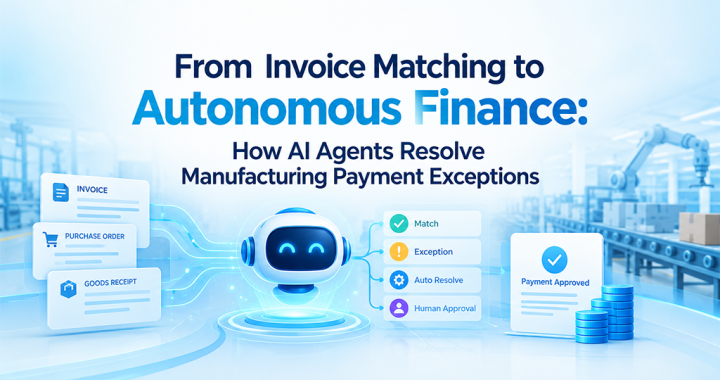
Get started with a manufacturing document automation assessment. Identify your highest-volume document workflows, recurring exceptions and opportunities for ERP-connected automation before committing to a wider implementation.
Frequently Asked Questions
What is agentic AI document automation in manufacturing?
Agentic AI document automation uses AI agents, document-processing models, business rules and system integrations to interpret manufacturing documents, validate information and initiate approved workflows across ERP and other enterprise applications.
How is agentic AI different from OCR?
OCR extracts text from scanned or digital documents. Agentic AI adds contextual interpretation, validation, decision-making and controlled workflow execution, allowing the system to do more than simply capture document data.
Can agentic AI integrate with an existing manufacturing ERP?
Yes. Depending on the ERP platform and available integration methods, AI agents can connect through APIs, supported connectors or workflow tools. Manufacturers can often extend existing systems without replacing the ERP, provided that integration, permissions and data quality requirements are addressed.
Can AI agents automatically approve manufacturing invoices?
AI agents can validate invoices and prepare or execute permitted workflow steps. However, payment approvals and other high-risk actions should follow configured authority limits, segregation-of-duties policies and human approval requirements where applicable.
Which manufacturing documents should businesses automate first?
Purchase orders, supplier invoices and delivery notes are often practical starting points because they have recurring formats, established validation rules and measurable operational outcomes. Quality certificates can also be suitable when the required checks and escalation procedures are clearly defined.
How can manufacturers measure the ROI of agentic AI document automation?
Manufacturers can compare processing time, manual effort, exception resolution, error rates and cost per document before and after deployment. They should also account for integration, model, maintenance and governance costs to calculate realistic financial returns.
Take the next step: Assess your current document workflows and identify where agentic AI can create measurable operational value.