Introduction
Many organizations today find themselves caught between two realities. On one side, they have legacy systems that have supported business operations for years, sometimes even decades. On the other side, they face growing pressure to adopt modern technologies that improve efficiency, enhance customer experiences, and enable data-driven decision-making.
While legacy applications continue to perform critical functions, they often struggle to keep pace with modern business demands. Consequently, companies encounter slow workflows, disconnected data, security vulnerabilities, rising maintenance costs, and limited scalability.
As artificial intelligence, automation, cloud computing, and advanced analytics reshape industries, organizations can no longer afford to operate with outdated infrastructure. However, replacing an entire legacy ecosystem is rarely practical. Such projects are expensive, disruptive, and risky.
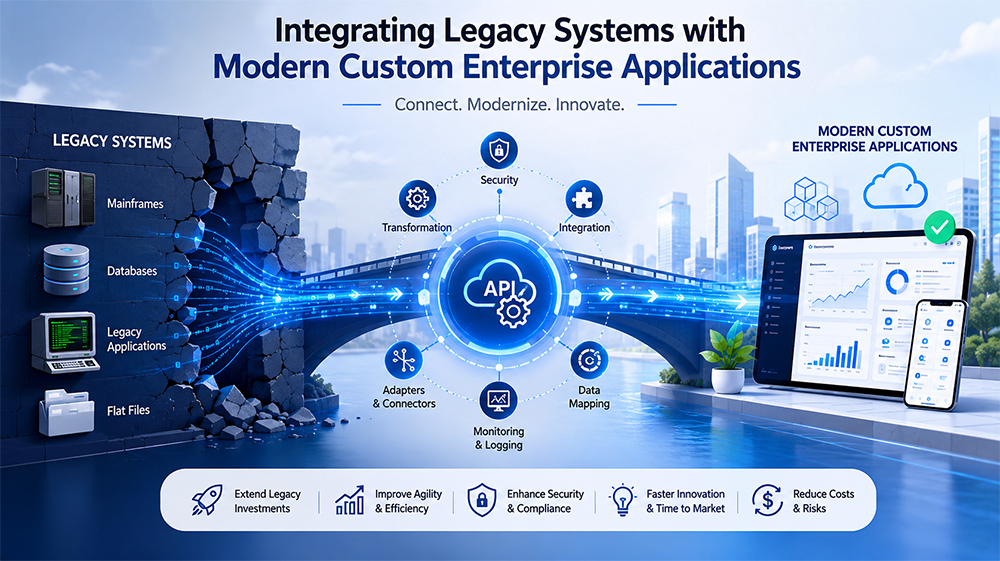
Therefore, the smarter approach is integrating legacy systems with modern custom enterprise applications.
This strategy enables businesses to preserve valuable existing investments while simultaneously unlocking innovation, agility, automation, and real-time intelligence.
In this comprehensive guide, we explore the challenges organizations face, why integration matters more than ever in 2026, and how custom enterprise applications powered by AI can transform legacy environments into future-ready digital ecosystems.
Understanding Legacy Systems and Why They Still Exist
Legacy systems are older software platforms, databases, applications, and infrastructures that continue supporting core business functions despite being built on outdated technologies.
Many enterprises still rely on these systems because they contain years of operational knowledge, customer data, transaction histories, and business rules.
For example, financial institutions often use legacy banking platforms. Manufacturing companies depend on long-established ERP systems. Healthcare providers operate legacy patient management systems. Government organizations frequently rely on decades-old software infrastructure.
Although these systems remain functional, several challenges emerge over time.
The Hidden Business Costs of Legacy Systems
Initially, legacy systems may appear cost-effective because they already exist. However, hidden expenses continue increasing year after year.
Organizations often experience:
Limited Scalability
As businesses grow, legacy platforms struggle to handle larger workloads, increasing user demands, and expanding data volumes.
Consequently, performance issues begin affecting employee productivity and customer satisfaction.
Data Silos
One of the biggest challenges involves fragmented information.
Departments often maintain separate databases that cannot communicate effectively.
As a result, decision-makers lack a complete view of business operations.
Security Risks
Cybersecurity threats continue evolving rapidly.
Unfortunately, older systems frequently lack modern security frameworks, exposing organizations to compliance violations and cyberattacks.
High Maintenance Costs
Legacy applications often require specialized expertise that becomes increasingly difficult to find.
Therefore, maintenance expenses continue rising while innovation slows down.
Poor Customer Experience
Modern customers expect instant responses, personalized interactions, and seamless digital experiences.
Legacy systems frequently struggle to deliver these expectations.
Consequently, customer retention becomes more difficult.
Why Modern Custom Enterprise Applications Are Becoming Essential
The digital economy rewards organizations that can adapt quickly.
Companies that successfully leverage automation, artificial intelligence, cloud computing, and advanced analytics gain significant competitive advantages.
Modern custom enterprise applications are specifically designed around unique business requirements rather than forcing organizations to adapt to generic software limitations.
Unlike off-the-shelf solutions, custom enterprise applications provide greater flexibility, scalability, and integration capabilities.
Most importantly, they create a bridge between existing systems and future innovation.
Addressing Current Business Challenges Through Custom Applications
Today’s enterprises face numerous operational challenges.
These challenges include:
Increasing Operational Complexity
Business processes have become more interconnected than ever.
Without integrated systems, teams waste valuable time manually transferring information between platforms.
Modern enterprise applications automate these workflows and eliminate inefficiencies.
Growing Demand for Real-Time Insights
Business leaders need immediate access to accurate data.
Custom applications consolidate information from multiple sources and provide real-time dashboards for faster decision-making.
Remote and Hybrid Work Requirements
Modern work environments require secure access from anywhere.
Custom enterprise solutions enable employees to collaborate efficiently regardless of location.
Customer Expectations Continue Rising
Customers increasingly demand personalized experiences.
Modern applications leverage AI-driven insights to deliver tailored interactions across channels.
The Business Impact of Legacy System Integration
Many organizations mistakenly believe digital transformation requires replacing everything.
However, successful enterprises often take a different path.
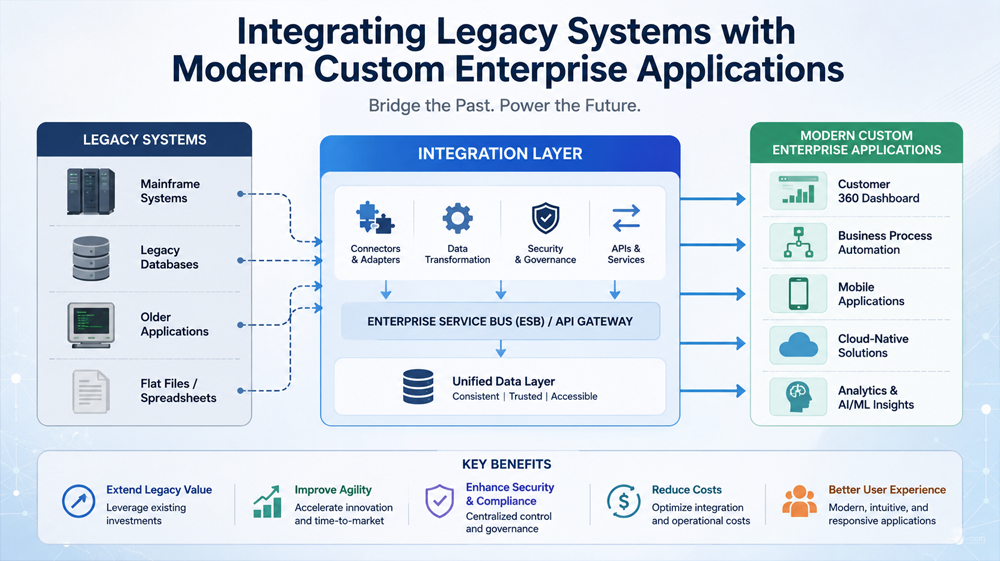
Instead of discarding existing infrastructure, they integrate legacy systems with modern applications.
This approach reduces risk while accelerating innovation.
Faster Digital Transformation
Full system replacement projects often take several years.
Conversely, integration strategies allow businesses to modernize gradually.
As a result, organizations begin realizing benefits much sooner.
Improved Data Accessibility
Integrated systems eliminate information silos.
Employees gain access to unified data across departments.
Consequently, collaboration improves significantly.
Enhanced Customer Experiences
When customer information flows seamlessly between systems, organizations can deliver faster and more personalized services.
This directly contributes to higher customer satisfaction and loyalty.
Reduced Operational Costs
Automation eliminates repetitive manual tasks.
Therefore, employees can focus on higher-value activities that drive growth and innovation.
Stronger Competitive Positioning
Organizations that integrate legacy systems effectively can respond faster to market changes.
This agility becomes a significant competitive advantage.
Common Integration Challenges Businesses Face
Although integration delivers substantial benefits, many companies encounter obstacles during implementation.
Understanding these challenges is essential for long-term success.
Incompatible Technologies
Legacy platforms often use outdated programming languages, databases, and communication protocols.
Modern applications must bridge these technological gaps effectively.
Data Quality Issues
Years of inconsistent data entry frequently create duplicates, inaccuracies, and incomplete records.
Without proper data cleansing, integration efforts may fail to deliver expected results.
Security and Compliance Requirements
Industries such as healthcare, finance, and manufacturing must comply with strict regulations.
Therefore, integration solutions must prioritize security and compliance from the beginning.
Business Continuity Concerns
Organizations cannot afford significant downtime.
Consequently, integration strategies must minimize disruptions to daily operations.
AI-Powered Integration: The Future of Enterprise Modernization
Artificial intelligence is revolutionizing enterprise integration strategies.
Instead of relying solely on traditional middleware, organizations now leverage AI-driven technologies to improve efficiency, accuracy, and scalability.
How AI Improves Legacy System Integration
Artificial intelligence helps organizations overcome many traditional integration challenges.
Intelligent Data Mapping
AI algorithms automatically identify relationships between data structures across different systems.
As a result, integration projects become faster and more accurate.
Predictive System Monitoring
Machine learning models continuously monitor system performance.
Potential failures can be identified before they disrupt operations.
Consequently, businesses reduce downtime significantly.
Automated Workflow Optimization
AI analyzes operational processes and identifies inefficiencies.
Organizations can then automate repetitive tasks and streamline workflows.
Enhanced Decision-Making
By combining data from legacy and modern systems, AI generates actionable insights that support strategic business decisions.
AI Model-Based Enterprise Integration Framework
Successful enterprise modernization increasingly relies on AI-powered frameworks.
A modern integration architecture typically includes several interconnected layers.
Data Collection Layer
This layer gathers information from legacy databases, ERP systems, CRM platforms, IoT devices, and third-party applications.
Data Processing Layer
Advanced AI algorithms clean, validate, and standardize incoming data.
This ensures accuracy and consistency across systems.
Intelligence Layer
Machine learning models analyze historical and real-time data to generate predictions, recommendations, and automation opportunities.
Application Layer
Custom enterprise applications deliver insights, dashboards, workflows, and user experiences tailored to business needs.
Security Layer
Modern cybersecurity frameworks protect data through encryption, identity management, access controls, and continuous monitoring.
Why Data Analytics Plays a Critical Role in Enterprise Integration
Integration alone is not enough.
Organizations must also transform collected information into actionable intelligence.
This is where data analytics becomes essential.
Modern enterprises generate enormous amounts of data every day.
Without analytics, valuable business opportunities remain hidden.
Data analytics enables organizations to identify trends, optimize operations, improve customer experiences, and uncover revenue opportunities.
Businesses that successfully combine integration and analytics consistently outperform competitors because they make decisions based on evidence rather than assumptions.
