Introduction: Why Secure Digital Onboarding Has Become a Business Necessity
Customer onboarding has changed dramatically over the last few years. People now expect to open a bank account, access financial services, purchase insurance, or sign up for digital platforms within minutes—without visiting a physical office. While this shift has made onboarding faster and more convenient, it has also created new security challenges for businesses.
Industries such as banking, fintech, insurance, healthcare, telecom, e-commerce, and enterprise SaaS increasingly rely on digital-first interactions. In many cases, the very first connection between a business and its customer happens online. That convenience improves user experience, but it also opens the door to identity fraud, fake documents, and sophisticated impersonation attacks.
Identity fraud has become one of the fastest-growing threats globally. According to recent industry research from identity security firms, synthetic identity fraud and AI-generated impersonation attacks increased significantly between 2024 and 2026. Fraudsters now use deepfakes, stolen documents, manipulated selfies, and AI-generated identities to bypass traditional verification systems.
This creates a painful business dilemma.
On one side, companies want frictionless onboarding to improve conversion rates and customer satisfaction. On the other side, security teams need strict identity verification to prevent fraud, regulatory penalties, and financial losses.
This is exactly where facial recognition and document verification have transformed digital onboarding.
Rather than relying on manual checks, businesses now use AI-powered verification pipelines that validate a user’s identity in real time. These systems compare government-issued IDs with live biometric scans, detect fraud attempts, and automate compliance checks within seconds.
As a result, organizations achieve both speed and trust.
Modern onboarding no longer needs to be slow, manual, or vulnerable.
It can be intelligent, automated, and secure.
What Is Facial Recognition in Digital Identity Verification?
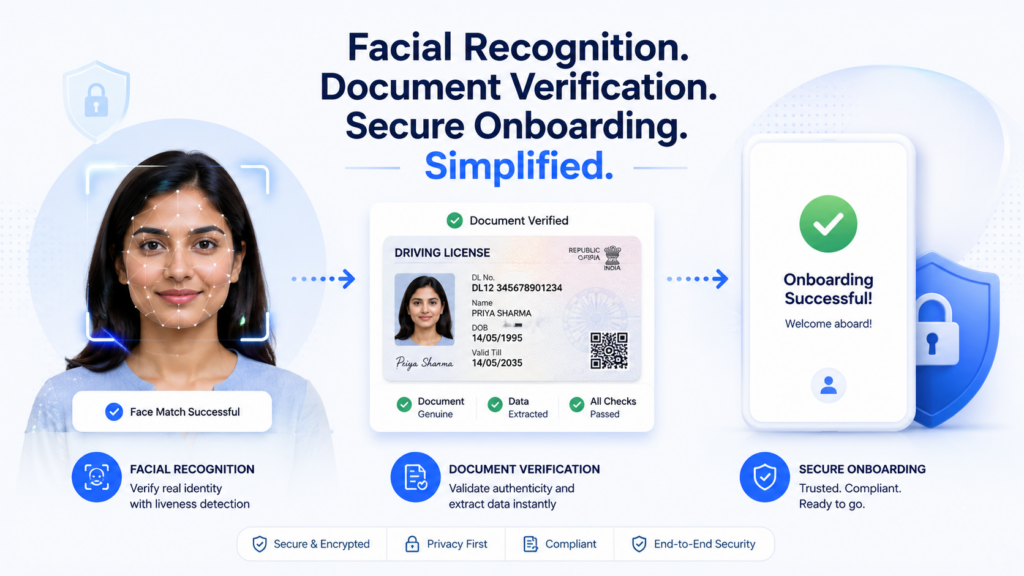
Facial recognition is a biometric authentication technology that identifies or verifies a person using facial features. Unlike passwords or OTPs, facial recognition relies on biological characteristics that are extremely difficult to duplicate.
During onboarding, the system captures a live image or video of the user’s face and converts it into mathematical feature vectors. These vectors represent facial landmarks such as:
- Eye distance
- Nose structure
- Jawline geometry
- Cheekbone proportions
- Facial contours
AI models then compare these features against the face shown in the uploaded identity document.
If similarity scores exceed predefined thresholds, the identity is verified.
This process happens within seconds.
However, modern facial recognition is far more advanced than simple image matching. AI-powered systems can detect spoofing attempts such as:
Photo Attacks
Fraudsters often attempt verification using printed photos or screen images. Advanced liveness detection algorithms identify unnatural texture patterns and screen reflections.
Deepfake Attacks
Generative AI has made deepfake creation easier. Sophisticated CNN-based verification models detect inconsistencies in synthetic face generation.
Video Replay Fraud
Attackers may use pre-recorded videos to impersonate legitimate users. Motion analysis and challenge-response liveness verification help prevent this.
Because of these capabilities, facial recognition has become a critical layer in secure onboarding workflows.
Why Traditional Customer Onboarding Is Failing Businesses
Many companies still depend on outdated onboarding systems. These include manual KYC verification, human document review, password-based identity checks, or OTP-only authentication.
While these approaches worked previously, they are now insufficient.
The biggest problem is scalability.
When customer volume increases, manual verification creates bottlenecks. Customers wait longer, drop off during registration, and operational costs rise.
Businesses commonly face the following onboarding challenges.
High Customer Drop-Off Rates
Lengthy verification forms frustrate users. Every extra step increases abandonment. Research consistently shows that complex onboarding directly impacts conversions.
If onboarding takes too long, customers leave. Competitors benefit.Revenue drops.
Rising Identity Fraud
Traditional systems struggle to detect forged IDs and AI-powered impersonation. Fraud has evolved. Unfortunately, many legacy verification methods have not.
Compliance Pressure
Governments worldwide continue tightening KYC and AML regulations. Industries such as banking, lending, insurance, and fintech must verify identities accurately or face severe penalties. Manual compliance processes are expensive and slow.
Poor Customer Experience
Modern users expect instant service. Waiting hours—or even days—for verification creates dissatisfaction and reduces trust. Businesses that fail to provide seamless onboarding risk losing market share rapidly.
What Is Document Verification?
Document verification is the process of validating identity documents to confirm authenticity and ownership.
These documents typically include:
- Passport
- Driver’s license
- National ID
- Voter ID
- PAN card
- Aadhaar (region dependent)
AI-powered document verification checks whether a document is:
- Genuine
- Untampered
- Valid
- Unexpired
- Belongs to the submitting user
Traditional document verification often relies on human review. However, AI-based verification automates this process. Modern systems analyze:
OCR-Based Text Extraction
Optical Character Recognition extracts document data automatically. This includes:
- Name
- Date of birth
- ID number
- Expiry date
- Address
This eliminates manual data entry and reduces errors.
Tampering Detection
Fraudsters often manipulate document details digitally.
AI models detect anomalies such as:
- Font inconsistencies
- Pixel distortions
- Layer modifications
- Cropping artifacts
- Image compression irregularities
These signals indicate possible forgery.
Security Feature Analysis
Official documents contain embedded security features.
Examples include:
- Holograms
- Watermarks
- Microtext
- UV patterns
- MRZ codes
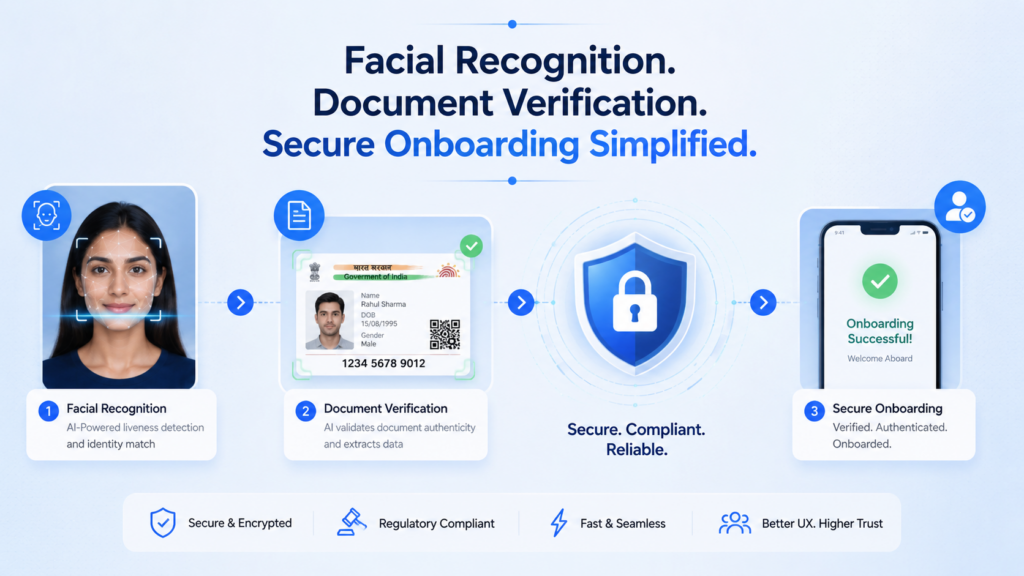
Computer vision systems validate these elements to detect fake IDs. Document verification ensures that the uploaded ID is real. Facial recognition ensures the user is the rightful owner. Together, they create a highly secure onboarding pipeline.
How AI-Powered Facial Recognition and Document Verification Work Together
Secure onboarding becomes significantly more effective when biometric verification and document intelligence operate as a single AI pipeline.
The workflow typically follows this sequence.
Step 1: Document Upload
The user uploads an identity document. AI immediately checks image quality. Blurred or incomplete documents are rejected. This improves verification accuracy.
Step 2: OCR and Validation
The system extracts document information.
Validation rules check:
- Format correctness
- Expiry status
- Country-specific compliance
- Security features
Suspicious documents are flagged.
Step 3: Live Face Capture
The user takes a selfie or short video. The system requests liveness actions such as:
- Blink
- Turn head
- Smile
- Follow moving object
These actions prove the user is physically present.
Step 4: Face Matching
AI compares the live biometric scan with the document photo. A similarity score is generated. If the confidence threshold passes, verification succeeds.
Step 5: Risk Scoring Engine
An AI fraud engine calculates risk scores using behavioral and biometric signals.
Low-risk users are approved instantly. High-risk users are escalated for manual review. This combination dramatically reduces fraud. At the same time, it improves onboarding speed.
AI Models Behind Modern Verification Systems
Advanced onboarding platforms rely on multiple AI models working together. This is where intelligent automation delivers massive value.
Convolutional Neural Networks (CNNs)
CNNs are heavily used in image recognition. They identify facial landmarks and detect document anomalies. These models excel at pattern recognition in visual data. For facial verification, CNN embeddings represent unique biometric signatures.
Siamese Neural Networks
Siamese networks compare two images and determine similarity. These models are ideal for face matching. They calculate whether a selfie matches an ID photo. This architecture is widely used in biometric verification.
OCR Transformer Models
Traditional OCR has limitations with noisy images. Transformer-based OCR models improve extraction from:
- Low-quality scans
- Tilted documents
- Multiple languages
- Partial captures
This improves onboarding success rates.
Liveness Detection Models
Liveness detection is essential against spoof attacks. AI models analyze:
- Micro facial movement
- Texture consistency
- Light reflections
- Depth perception
- Motion dynamics
These features differentiate real humans from fake media.
Fraud Detection Models
Machine learning risk engines continuously learn from attack patterns.
They identify anomalies such as:
- Multiple accounts using same document
- Suspicious device behavior
- Unusual geolocation patterns
- Bot-like interactions
As fraud evolves, these AI models become smarter. That gives businesses adaptive security.
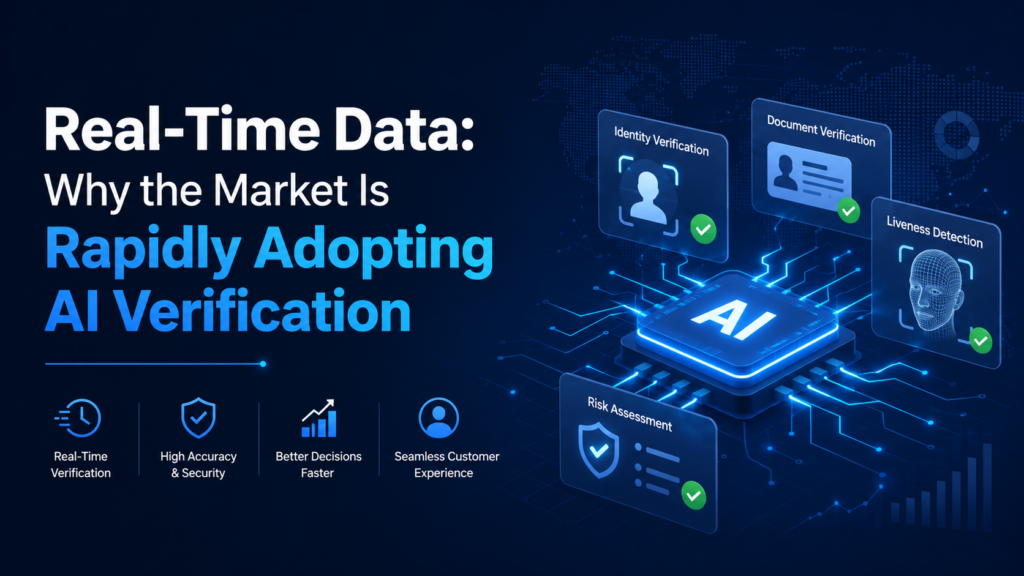
Real-Time Data: Why the Market Is Rapidly Adopting AI Verification
The digital identity verification market has grown rapidly because fraud losses continue increasing globally. Recent market intelligence reports indicate strong growth in biometric verification adoption across banking, fintech, healthcare, and e-commerce sectors.
Key reasons include:
Explosion of Remote Services
Customers now expect fully remote onboarding. Physical verification is no longer scalable.
AI-Driven Fraud Growth
Generative AI has lowered barriers for identity fraud. Deepfake attacks are becoming more sophisticated.
Regulatory Expansion
Compliance frameworks continue tightening. Organizations need automated verification to stay compliant. The market is shifting from optional verification to mandatory intelligent identity validation. Businesses that delay adoption face growing risk.
Conclusion
Secure digital onboarding has become essential for businesses looking to prevent fraud, maintain compliance, and build customer trust. As identity fraud grows more advanced, traditional verification methods are no longer enough.
AI-powered facial recognition and document verification help businesses verify users faster, improve security, and deliver seamless onboarding experiences. By combining speed, accuracy, and fraud prevention, these technologies enable businesses to onboard customers with confidence while reducing operational risks.
The future belongs to businesses that can offer secure, frictionless, and intelligent onboarding without compromising user experience.