Facial recognition has moved far beyond simple identity verification. Businesses are now using it to create personalized customer experiences, strengthen security, reduce fraud, and improve operational efficiency. The technology is no longer limited to government surveillance or smartphone unlocking. Instead, it has become a business-critical AI solution that directly impacts revenue, trust, and customer retention.
Companies across retail, banking, healthcare, hospitality, aviation, and smart infrastructure are actively investing in facial recognition systems because traditional engagement and security models are becoming less effective. Customers expect faster service, personalized interactions, and frictionless experiences. At the same time, organizations face growing threats from fraud, identity theft, unauthorized access, and physical security breaches.
This creates a major challenge. Businesses must improve customer engagement while maintaining strong safety standards. Achieving both simultaneously has become difficult with conventional systems.
Facial recognition solves this problem by combining computer vision, deep learning, and biometric intelligence. It enables businesses to recognize individuals in real time, understand behavior patterns, and make intelligent decisions instantly.
According to MarketsandMarkets, the global facial recognition market is projected to surpass $14 billion by 2028, driven by increased adoption in security, retail analytics, and customer experience platforms. Meanwhile, AI-powered computer vision systems continue to achieve accuracy levels above 99% in controlled environments, making facial recognition one of the most reliable biometric technologies available.
The real transformation lies in how businesses use this technology—not merely to identify faces, but to understand customers, anticipate needs, and solve modern operational challenges.
Why Traditional Customer Engagement and Security Models Are Failing
Businesses have relied on conventional engagement systems for decades. These include loyalty cards, manual verification, passwords, physical ID checks, and rule-based security systems. Although these methods served their purpose, they now create significant friction.
Customers dislike repetitive verification processes. Long queues at checkouts reduce satisfaction. Manual identity checks slow onboarding. Password-based systems create login fatigue. Security personnel cannot monitor every threat in real time. These issues lead to measurable business losses.
A retail customer waiting too long at checkout may abandon the purchase. A banking customer facing complicated verification may leave the application process. A hospital relying on manual patient verification may experience delays during critical situations. The core pain points include:
Slow Customer Identification
Many businesses find it difficult to identify returning customers instantly. Without real-time recognition, delivering personalized experiences becomes a challenge. As a result, customer engagement often feels generic and less effective.
Poor Personalization
Generic customer interactions often fail to create meaningful engagement. Modern customers expect businesses to understand their preferences, behavior, and purchasing patterns. Without personalization, customer experiences can feel disconnected and less impactful.
Security Gaps
Traditional surveillance systems can record video continuously. However, they often lack the intelligence to detect suspicious individuals in real time. As a result, potential threats may go unnoticed until it is too late.
Fraud and Identity Theft
Fake identities and account takeovers cost businesses billions annually. Facial recognition addresses all these problems by turning passive camera systems into intelligent AI-powered decision engines.
What Is Facial Recognition Technology?
Facial recognition is an AI-based biometric technology that identifies or verifies individuals by analyzing facial features from images or video. The system captures a face, extracts unique biometric markers, converts them into numerical embeddings, and compares them with stored records. Unlike passwords or access cards, facial biometrics cannot be forgotten or easily replicated. The recognition process usually involves several stages.
Face Detection
The system identifies the presence of a face in an image or video stream. AI models such as MTCNN (Multi-task Cascaded Convolutional Networks) and YOLO-based detectors are commonly used for accurate detection.
Feature Extraction
After detecting the face, AI extracts key landmarks such as:
- Distance between eyes
- Nose shape
- Jawline geometry
- Facial contour
- Skin texture patterns
These features are transformed into numerical vectors.
Face Matching
The extracted biometric data is matched with records stored in secure databases. Advanced algorithms then analyze similarity scores to verify the identity. This process helps determine whether the face belongs to a recognized individual.
Decision Making
The AI system can verify identity, detect potential risks, or initiate automated business actions. Based on the analysis, it makes intelligent decisions in real time. This entire process is typically completed within milliseconds.
AI Models and Algorithms Powering Facial Recognition
Facial recognition systems depend heavily on deep learning models. Modern enterprise-grade systems use advanced neural architectures to improve accuracy under difficult conditions such as poor lighting, masks, aging, and angle variations.
Convolutional Neural Networks (CNN)
CNNs form the backbone of facial recognition. They learn hierarchical visual features directly from pixel data, enabling highly accurate face representation. Popular CNN-based architectures include:
- VGG-Face
- FaceNet
- DeepFace
- ArcFace
- SphereFace
Among these, FaceNet introduced embedding-based recognition, dramatically improving performance.
FaceNet
Developed by Google, FaceNet maps faces into a Euclidean embedding space where similar faces cluster together. This approach significantly improved verification accuracy.
ArcFace
ArcFace improves recognition by using angular margin loss. This enhances feature discrimination and reduces false matches. Many enterprise systems now prefer ArcFace because of its robustness.
Transformer-Based Vision Models
Newer facial recognition systems increasingly adopt Vision Transformers (ViT). These models improve contextual understanding and handle complex visual environments better than traditional CNNs.
Liveness Detection Models
A major challenge is spoofing. Fraudsters may attempt authentication using photos, videos, or masks. Liveness detection models prevent such attacks using:
- Blink detection
- Depth estimation
- Infrared analysis
- Skin reflectance patterns
This ensures the system interacts with a real person.
How Facial Recognition Is Transforming Customer Engagement
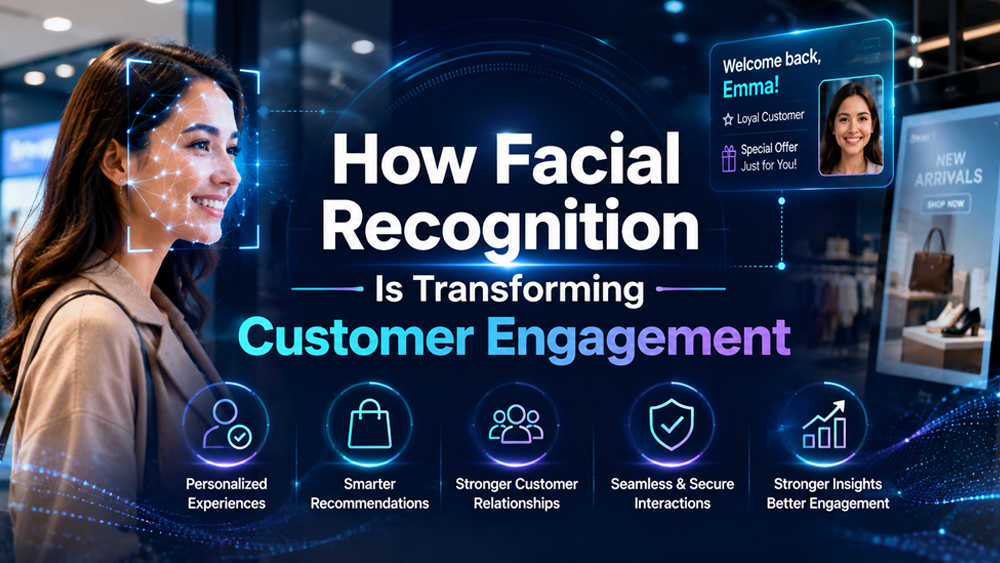
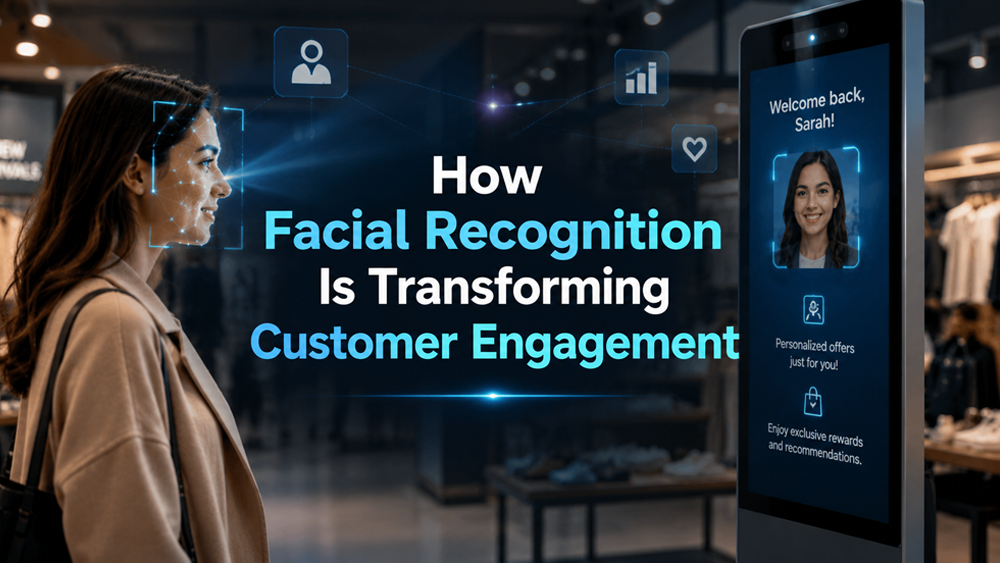
Customer engagement becomes stronger when businesses eliminate friction from interactions. Smooth and seamless experiences help improve customer satisfaction. At the same time, personalized interactions create deeper connections with customers. Facial recognition makes this possible by enabling real-time intelligent engagement.
Personalized Customer Experiences in Retail
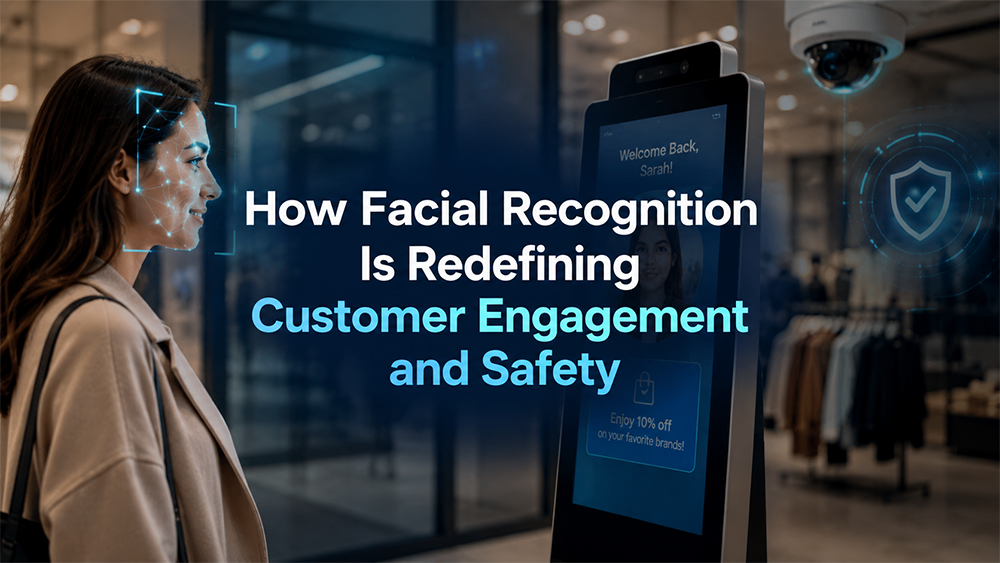
Retail businesses compete heavily on customer experience. A returning customer entering a store presents an opportunity. However, traditional systems cannot identify them instantly. Facial recognition changes this.
The system identifies loyal customers upon entry and connects with CRM databases. This enables:
Personalized Recommendations
AI analyzes purchase history and preferences. Sales staff can offer highly relevant products immediately. For example, if a customer frequently buys premium skincare products, the system can trigger tailored recommendations. This increases conversion rates.
VIP Recognition
High-value customers expect premium service. Facial recognition allows staff to identify VIP customers instantly and deliver white-glove service. This strengthens loyalty.
Frictionless Checkout
Checkout delays remain one of the biggest retail pain points. Facial recognition enables cashier-less or rapid checkout systems. Customers simply walk out after purchase verification. This improves satisfaction and reduces cart abandonment.
Revolutionizing Banking and Financial Services
Financial institutions face constant pressure to balance convenience with security. Traditional KYC processes are slow and frustrating. Facial recognition improves both onboarding and fraud prevention.
Faster Customer Onboarding
Instead of submitting multiple identity documents manually, customers can verify identity using facial biometrics. This reduces onboarding time dramatically.
Secure Authentication
Passwords are vulnerable. Biometric login offers stronger security with better convenience. Banks use facial verification for:
- Account access
- Transaction approvals
- Loan verification
- Remote KYC
Fraud Detection
Synthetic identities and deepfake-based fraud are becoming major security threats. These advanced attacks make traditional verification methods less reliable. AI-powered facial recognition can detect anomalies and suspicious login attempts in real time. As a result, businesses can significantly reduce fraud-related losses.
Improving Safety in Airports and Transportation
Transportation systems must maintain both speed and high-level security. However, long security checks often lead to delays and poor passenger experiences. These bottlenecks can reduce operational efficiency and customer satisfaction. Facial recognition helps eliminate friction by enabling faster and seamless verification.
Seamless Passenger Verification
Passengers can move through:
- Check-in
- Security screening
- Boarding
using face verification alone. This reduces wait times significantly.
Watchlist Matching
AI-powered systems can match faces against watchlists in real time. This enables faster identification of suspicious or unauthorized individuals. Potential threats can be detected before they escalate into serious incidents. As a result, overall security and threat detection improve significantly.
Crowd Monitoring
Computer vision systems can analyze movement patterns in real time. They help identify unusual or suspicious behavior within crowded environments. This enables faster response to potential security risks. As a result, public safety and situational awareness are significantly improved.
Facial Recognition in Healthcare
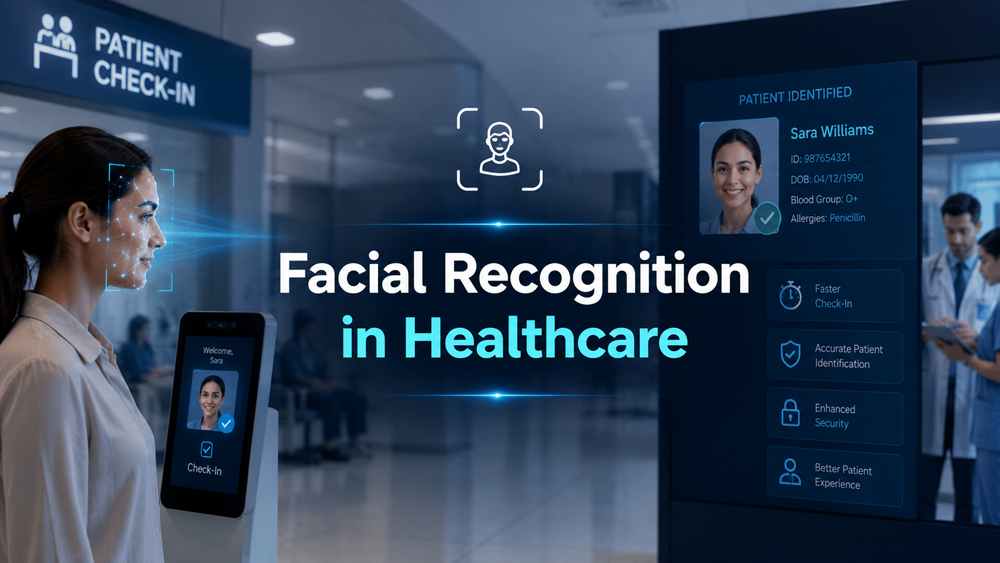
Healthcare providers face serious identity verification issues. Patient misidentification can lead to severe consequences. Facial recognition reduces such risks.
Patient Identification
The system ensures healthcare providers access the correct patient records instantly. This minimizes the risk of patient misidentification during treatment. Accurate record matching improves clinical decision-making and workflow efficiency. As a result, medical errors can be significantly reduced.
Contactless Check-In
Hospitals can streamline patient registration through automated systems. This eliminates manual paperwork and reduces administrative delays. Patients experience shorter waiting times during check-in. As a result, overall operational efficiency and workflow improve significantly.
Restricted Area Security
Sensitive areas such as laboratories and medicine storage need strict access control. Unauthorized entry into these zones can create serious security risks. Facial recognition ensures that only authorized personnel can gain access. This significantly strengthens overall security and protection.
How Facial Recognition Improves Workplace Safety
Corporate security has evolved beyond traditional badge-based access systems. Modern physical access control requires smarter and more intelligent solutions. Conventional methods often fail to prevent unauthorized entry effectively. Facial recognition enhances security by enabling accurate, real-time access verification.
Access Management
Access to restricted zones is granted only to authorized employees. This helps maintain strict control over sensitive areas. If an unauthorized person attempts entry, the system instantly detects it. Real-time alerts are then triggered to prevent security breaches.
Attendance Automation
Manual attendance tracking often leads to delays and inefficiencies. It can also result in errors, proxy attendance, or inaccurate records. Face-based attendance systems automate the entire process seamlessly. This improves accuracy, saves time, and enhances workforce management.
Insider Threat Prevention
Not every security threat originates from external sources. In many cases, risks can also arise from within the organization. AI systems can monitor and identify unusual employee access patterns. This helps detect potential insider threats before they escalate.
The Biggest Challenges Businesses Face with Facial Recognition
Although facial recognition offers significant benefits, it also comes with challenges. Issues such as privacy, bias, and data security require careful attention. Ignoring these concerns can affect trust and system reliability. Therefore, businesses must address them with responsible implementation strategies.
Privacy Concerns
Customers care deeply about biometric privacy. Improper data handling damages trust. Businesses must ensure transparent consent and secure storage. Privacy-first architecture is essential. Solutions include:
- Data encryption
- Consent management
- Minimal retention policies
- Edge AI processing
Bias in AI Models
Bias in AI models remains one of the most critical challenges in facial recognition systems. When AI models are trained on limited or poorly balanced datasets, their performance can vary significantly across different demographic groups such as age, gender, and skin tone. As a result, the system may identify certain groups more accurately than others, leading to unfair outcomes and reduced reliability. In business environments, this can create serious concerns related to trust, compliance, and customer experience. For example, if a facial recognition system frequently misidentifies specific user groups, it may result in denied access, poor service experiences, or inaccurate security alerts. Therefore, addressing AI bias is essential for building fair and dependable facial recognition solutions.
Better Training Data
The foundation of an accurate AI model lies in the quality of its training data. Bias often originates when datasets lack diversity and fail to represent real-world populations. If the training data contains more samples from specific demographics while underrepresenting others, the AI model naturally becomes less effective for those missing groups. To overcome this challenge, organizations must use diverse and inclusive datasets that cover various ethnicities, age groups, facial structures, lighting conditions, and environmental scenarios. A well-balanced dataset helps the AI learn broader facial variations, ultimately improving fairness and recognition accuracy across all users.
Continuous Model Auditing
Even well-trained AI systems require ongoing evaluation to maintain fairness and performance. Over time, changes in user behavior, environmental conditions, and operational settings can affect model accuracy. Continuous model auditing helps organizations identify performance gaps before they become serious issues. Through regular testing, bias detection, and performance benchmarking, businesses can measure how the system behaves across different demographics. This proactive monitoring enables teams to retrain or fine-tune models whenever inconsistencies appear. As a result, continuous auditing ensures the facial recognition system remains reliable, accurate, and fair in real-world deployments.
Ethical AI Governance
Technology alone cannot solve bias without responsible governance. Organizations need strong ethical AI policies to ensure facial recognition systems are developed and deployed responsibly. Ethical AI governance includes setting clear guidelines for data collection, privacy protection, model evaluation, transparency, and accountability. It also involves creating oversight mechanisms to prevent misuse and ensure fairness in decision-making. By adopting responsible AI frameworks, businesses can reduce bias-related risks while strengthening customer trust. In the long term, ethical governance ensures facial recognition technology supports both innovation and fairness without compromising user rights.
Deepfake Threats
AI-generated faces and synthetic media create serious risks. Deepfake attacks are increasing. Businesses need advanced anti-spoofing systems. Solutions include:
- Liveness detection
- Behavioral biometrics
- Multi-factor authentication
- 3D face verification
Real-Time Data and Business Intelligence from Facial Recognition
Facial recognition is not only about identity. It also provides valuable analytics. Businesses can analyze:
- Foot traffic
- Dwell time
- Emotional response
- Customer sentiment
- Peak engagement periods
This helps companies optimize operations. For example, retailers can identify which store zones attract the most engagement. That leads to better merchandising decisions. Hotels can identify returning guests and personalize services. Airports can predict congestion. This transforms facial recognition into a strategic business intelligence asset.
SEO and Business Value: Why Companies Are Investing Now
Businesses across industries are rapidly investing in AI-powered technologies to gain a stronger competitive edge, and facial recognition has become one of the most impactful innovations in this transformation. Beyond being a security tool, facial recognition now plays a major role in improving operational efficiency, customer experience, and business intelligence. Companies are no longer adopting this technology solely for identity verification; instead, they are leveraging it to drive measurable business outcomes. As market competition becomes more intense, organizations that embrace intelligent automation can respond faster to customer expectations, optimize resources, and improve decision-making. Facial recognition directly influences several key business KPIs, making it a strategic investment rather than just a technological upgrade.
Increased Revenue
One of the biggest reasons companies invest in facial recognition is its ability to increase revenue through personalization. Modern consumers expect personalized interactions at every touchpoint. Businesses that understand customer preferences can deliver more relevant products, services, and recommendations. Facial recognition enables real-time customer identification, allowing businesses to instantly access purchase history, preferences, and behavioral insights. This creates opportunities for highly targeted engagement, personalized promotions, and better upselling strategies. In retail, for example, recognizing repeat customers can help sales teams provide tailored recommendations that improve conversion rates. When customers feel understood and valued, they are more likely to make purchases, resulting in higher revenue generation.
Reduced Operational Cost
Operational efficiency is another major business driver behind facial recognition adoption. Many organizations still rely on manual processes for identity verification, access control, attendance tracking, and customer onboarding. These processes require significant human involvement, which increases labor costs and slows operations. Facial recognition automates these workflows, reducing dependency on manual intervention. Automated verification systems can process users in seconds, minimizing administrative workload and improving productivity. In sectors such as healthcare, banking, and corporate security, automation reduces repetitive tasks and allows employees to focus on higher-value responsibilities. As a result, businesses can lower operational expenses while improving overall efficiency.
Better Customer Retention
Customer retention has become increasingly difficult in highly competitive markets. Customers expect seamless, fast, and convenient experiences. Even minor friction during interactions can negatively impact satisfaction and loyalty. Facial recognition helps businesses remove friction from customer journeys by enabling faster check-ins, contactless authentication, and personalized service delivery. For example, hotels can recognize returning guests and offer customized services instantly. Similarly, airports can reduce verification delays through biometric boarding. These frictionless experiences improve customer satisfaction and create stronger emotional connections with brands. When businesses consistently deliver convenience and personalization, customer loyalty improves significantly, leading to higher retention rates and long-term profitability.
Stronger Security
Security remains one of the strongest business cases for facial recognition. Organizations face increasing threats from fraud, unauthorized access, identity theft, and cyber-physical security breaches. Traditional security systems often struggle to identify threats proactively. Facial recognition enhances security by enabling real-time identity verification and anomaly detection. AI-powered systems can detect suspicious access attempts, flag high-risk individuals, and prevent fraudulent activities before they cause damage. In financial institutions, facial recognition reduces account takeover risks. In corporate environments, it prevents unauthorized entry into restricted zones. Stronger security reduces financial losses, protects business assets, and strengthens customer trust. Companies that invest in advanced security technologies are better positioned to safeguard operations in an increasingly complex threat landscape.
Organizations that delay adopting facial recognition risk falling behind competitors that are already leveraging AI to improve efficiency, engagement, and security. In a fast-moving digital economy, agility often determines market leadership.
Future Trends in Facial Recognition
The future of facial recognition is evolving rapidly as AI technologies become more advanced. Innovations in deep learning, computer vision, and biometric intelligence are pushing facial recognition beyond traditional use cases. The next generation of systems will focus on improving speed, privacy, accuracy, and resilience against sophisticated threats. Several major trends are expected to shape the future of this technology.
Edge AI
Edge AI is becoming a major trend in facial recognition systems. Traditionally, facial recognition data is processed in centralized cloud servers. While cloud-based systems offer scalability, they can introduce latency and privacy concerns. Edge AI changes this model by processing facial recognition data locally on devices such as cameras, smartphones, or edge servers. This reduces dependence on cloud infrastructure and enables faster decision-making.
Local processing offers several advantages. First, it significantly reduces latency, enabling real-time responses for security-critical applications such as access control and surveillance. Second, it improves privacy because sensitive biometric data does not need to travel across networks or remain stored in centralized databases. Third, edge processing reduces bandwidth usage and infrastructure costs. As privacy regulations become stricter, Edge AI will become increasingly important for organizations seeking secure and compliant facial recognition deployments.
Multimodal Biometrics
Relying on a single biometric factor can create limitations, especially in high-security environments. This is why multimodal biometrics is emerging as a powerful trend. Instead of depending solely on facial recognition, advanced systems combine multiple biometric identifiers to improve reliability and reduce false positives.
These systems may combine facial recognition with:
Voice Recognition
Voice biometrics analyzes vocal patterns and speech characteristics to verify identity. Combining voice and face recognition improves authentication accuracy.
Iris Recognition
The iris contains highly unique patterns that remain stable over time. Iris verification provides an additional layer of security, especially in sensitive environments.
Behavioral Signals
Behavioral biometrics analyzes user-specific patterns such as walking style, typing rhythm, or device interaction behavior. These signals help detect suspicious activity even after authentication.
By combining multiple biometric signals, multimodal systems become more resilient against spoofing attacks and identity fraud. This layered approach significantly improves security while maintaining user convenience.
Emotion AI
Facial recognition is expanding beyond identity verification into emotional intelligence. Emotion AI uses computer vision and machine learning to analyze facial expressions and detect emotional states such as happiness, frustration, confusion, or engagement. This capability opens new possibilities for customer experience optimization.
Businesses can use emotion AI to understand customer sentiment during interactions. For example, retailers can analyze emotional responses to products or store layouts. Customer service platforms can detect frustration during support interactions and trigger escalation when necessary. Digital marketing teams can assess audience reactions to campaigns more effectively.
Emotion AI allows businesses to move beyond simply identifying customers toward understanding how customers feel. This creates opportunities for more empathetic and personalized engagement strategies. As customer experience becomes a major differentiator, emotion-aware AI systems will play a growing role in business intelligence.
Generative AI Defense
As AI capabilities advance, so do AI-powered threats. Deepfakes and synthetic identities have become major security concerns for businesses. Fraudsters can now generate highly realistic fake faces, manipulated videos, and synthetic biometric data to bypass traditional verification systems. This makes generative AI defense one of the most critical future trends in facial recognition.
AI is increasingly being used to fight AI-generated threats. Advanced facial recognition systems now incorporate anti-spoofing models trained specifically to detect deepfakes and synthetic media. These models analyze subtle inconsistencies such as abnormal blinking patterns, unnatural skin textures, lighting mismatches, and motion artifacts that humans may miss.
Generative AI defense will become essential for sectors such as banking, fintech, e-commerce, and digital identity verification. As synthetic fraud grows more sophisticated, businesses will require AI-driven defense mechanisms capable of continuously adapting to emerging attack methods.
The future of facial recognition will be defined not just by better recognition accuracy, but by smarter, safer, and more ethical AI systems. Organizations that stay ahead of these trends will be better equipped to deliver secure, intelligent, and customer-centric experiences.
How Businesses Can Implement Facial Recognition Successfully
Adopting facial recognition requires strategic planning. Success depends on solving real business pain points. Companies should begin by identifying where friction exists. Ask critical questions:
Where are customers experiencing delays? security vulnerabilities highest? Where does fraud occur most frequently? Once pain points are clear, implementation becomes easier. Choose enterprise-grade AI platforms with:
- High accuracy
- Low latency
- Strong privacy controls
- Anti-spoofing capabilities
- Regulatory compliance
Most importantly, communicate value to customers. People adopt technology faster when they understand its benefits. Trust is the foundation of adoption.
Final Thoughts
Facial recognition is redefining how businesses engage customers and maintain safety. Its impact extends far beyond identification. It enables intelligent personalization, frictionless experiences, proactive security, and real-time decision-making.
The biggest challenge businesses face is balancing convenience with trust. Customers want fast and seamless experiences, yet they also demand privacy and security. AI-powered facial recognition solves this by combining advanced biometric intelligence with ethical deployment strategies.
Businesses that embrace this technology responsibly will gain stronger customer relationships, lower fraud risk, better operational efficiency, and sustainable competitive advantage. The future belongs to organizations that can recognize not only faces—but also customer expectations. When implemented correctly, facial recognition becomes more than a security tool. It becomes a powerful engine for engagement, safety, and long-term growth.