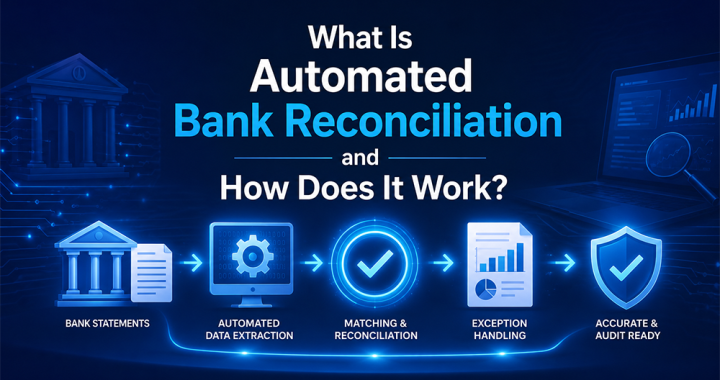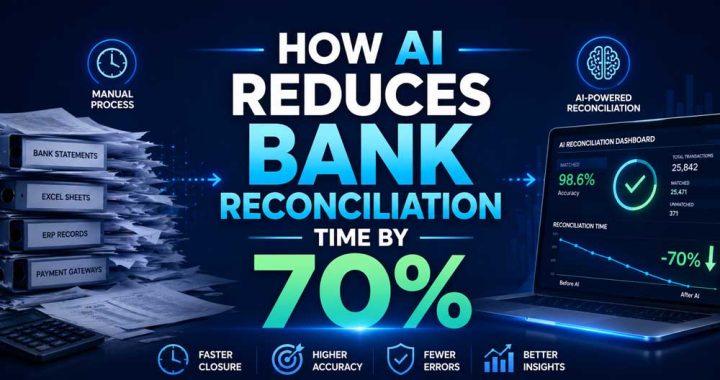
Financial reconciliation is supposed to confirm that the numbers recorded across a company’s systems agree. However, for many finance teams, the process still involves downloading bank statements, exporting ERP data, opening spreadsheets, matching transactions manually, investigating differences, sending emails, and preparing evidence for auditors.
That workflow becomes increasingly difficult as transaction volumes grow. A company may have thousands of bank transactions, multiple payment gateways, several ERP modules, intercompany accounts, foreign currencies, and different sources of financial data. As a result, even a small mismatch can create hours of investigation.
Robotic Process Automation (RPA) changes this process by allowing software bots to perform repetitive reconciliation activities consistently across applications. More importantly, when RPA is combined with AI, machine learning, OCR, intelligent document processing, and exception-based workflows, reconciliation can move from a periodic manual activity toward a more continuous and intelligent process.
Recent finance-automation platforms are already combining RPA, AI, intelligent document processing, machine learning, and orchestration across ERP and financial systems.
This guide explains how RPA automates financial reconciliation from start to finish, where businesses usually face problems, how intelligent matching works, where AI adds value, and how organizations can build a reliable automation workflow without losing financial controls.
What Is Financial Reconciliation?
Financial reconciliation is the process of comparing financial records from two or more sources to verify that transactions, balances, and accounting entries agree. For example, a business may compare its bank statement with its ERP ledger. Ideally, every deposit, withdrawal, payment, bank charge, refund, and transfer should correspond to a transaction recorded internally.
However, the records rarely align perfectly. A payment may appear in the bank today but be recorded in the ERP tomorrow. A transaction may have a different reference number. A bank fee may not have a corresponding journal entry. A customer may make a single payment against multiple invoices.
Therefore, reconciliation is not simply about finding identical numbers. It is about determining whether transactions represent the same underlying financial event. That is precisely where automation becomes valuable.
Why Manual Financial Reconciliation Becomes a Business Problem
Manual reconciliation often begins with a familiar process: an employee downloads statements, exports ERP records, combines files in Excel, applies formulas, searches for matching transactions, and manually investigates exceptions.
Initially, this may appear manageable.
However, transaction volumes eventually make the process expensive and difficult to control. Finance employees spend time performing repetitive comparisons instead of investigating meaningful exceptions. At the same time, manual spreadsheet manipulation can introduce formula errors, duplicated records, incorrect mappings, and missed transactions.
Furthermore, reconciliation delays can affect month-end close. If the accounting team cannot confidently reconcile bank accounts, payment processors, receivables, payables, or intercompany balances, financial reporting may have to wait.
The problem therefore extends beyond productivity. It can affect financial accuracy, cash visibility, audit readiness, internal controls, and management decision-making.
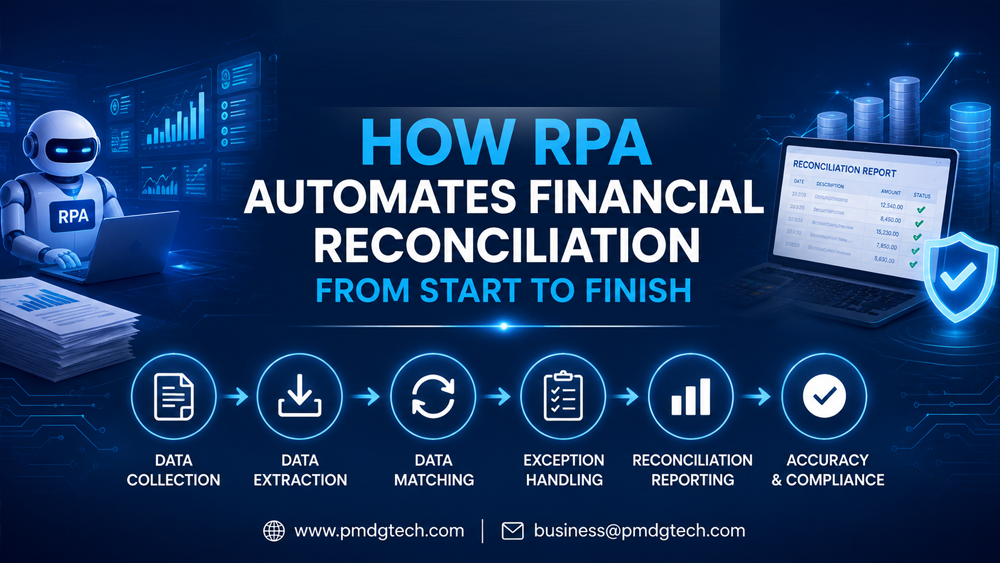
How RPA Automates Financial Reconciliation From Start to Finish
A well-designed RPA reconciliation solution does not simply automate one Excel comparison. Instead, it connects the complete workflow—from data collection through matching, exception handling, validation, reporting, and audit evidence.
Step 1: RPA Collects Financial Data From Multiple Systems
The first challenge is gathering reliable data. Financial information may exist inside an ERP, banking portal, payment gateway, accounting application, CRM, billing platform, Excel file, CSV export, or document repository. RPA bots can log into authorized systems, retrieve required reports, download statements, extract files, and move the information into a controlled reconciliation environment.
For example, a reconciliation bot can collect bank statements from multiple accounts while simultaneously retrieving corresponding ledger transactions from an ERP. Consequently, finance employees no longer need to repeatedly perform the same data-download routine.
Step 2: The Automation Validates and Standardizes the Data
Collecting data is not enough. Different systems often use different date formats, transaction descriptions, currency formats, reference numbers, and account identifiers. Therefore, the next stage standardizes the information before matching begins.
An automation workflow can normalize dates, remove unnecessary characters, standardize transaction identifiers, convert supported currencies according to defined rules, and validate mandatory fields. This step is important because poor-quality input data can create false exceptions. In other words, automation should not simply make bad data move faster. It should identify and control data-quality problems before reconciliation.
Step 3: RPA Performs Rule-Based Transaction Matching
Once the data has been standardized, RPA can perform deterministic matching. For example, the system may compare transactions using combinations of:
- Transaction amount
- Transaction date
- Reference number
- Invoice number
- Customer or vendor identifier
- Bank transaction ID
- Payment ID
- Account number
A simple match might require the amount and transaction reference to be identical. However, real-world financial reconciliation is rarely that simple. A transaction could have the same amount but a different posting date. A payment could contain several invoices. A bank statement might shorten the reference number.
Therefore, modern reconciliation workflows use multiple matching rules rather than relying on a single exact comparison.
Where AI Makes RPA-Based Reconciliation More Intelligent
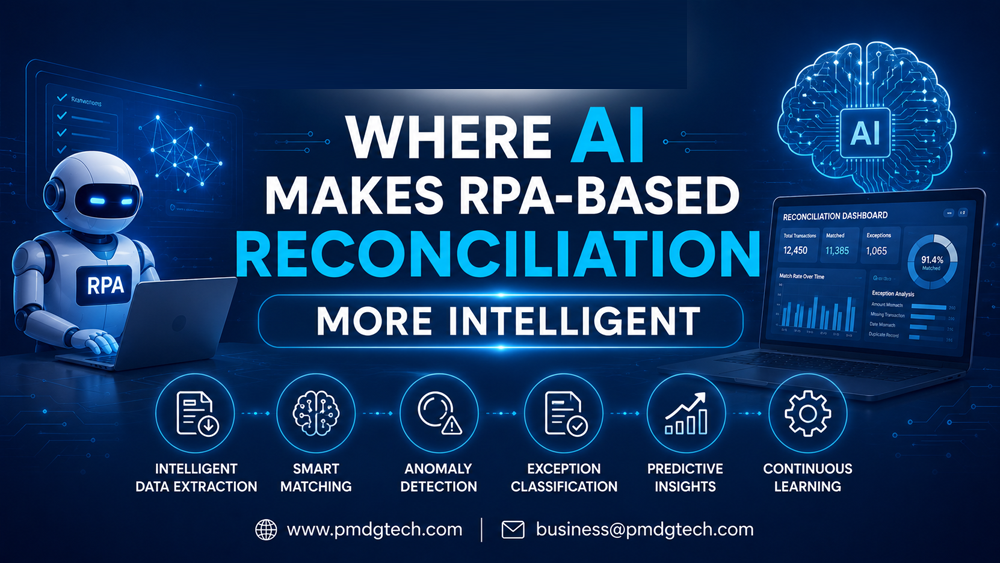
Traditional RPA is excellent at repetitive, rule-based tasks. However, financial reconciliation frequently contains exceptions that require interpretation. That is where AI and machine learning can extend RPA. Instead of asking a bot only, “Do these two values match?”, an AI-assisted workflow can evaluate whether two transactions are likely to represent the same financial event.
For example, suppose an ERP contains:
Payment Ref: INV-20458
Amount: ₹48,750
Date: 12 August
while the bank statement contains:
Reference: 20458
Amount: ₹48,750
Date: 13 August
A strict rule may classify these as unmatched. An intelligent matching model, however, can recognize that the reference is highly similar, the amount is identical, and the one-day difference is consistent with normal posting behavior. The transaction can therefore receive a confidence score and potentially be automatically reconciled according to the organization’s approved thresholds.
Recent research also demonstrates why financial AI requires strong controls: a 2026 accounting-reconciliation benchmark found that contemporary LLMs could produce plausible results while still failing to consistently bind accounting outputs to supporting documents. Therefore, AI should assist reconciliation rather than bypass financial controls.
How an AI-Based Reconciliation Matching Algorithm Works
A practical intelligent reconciliation engine can combine deterministic rules, similarity scoring, historical patterns, and anomaly detection. Conceptually, the matching score can be calculated using weighted signals such as:
Match Score = Amount Similarity + Reference Similarity + Date Similarity + Entity Similarity + Historical Pattern
The weights should be determined according to the organization’s reconciliation policy and validated against historical transactions. For example, an organization could give greater importance to exact transaction amounts while treating posting-date differences as acceptable within a defined window. Machine learning can then learn from previously approved matches and exceptions.
However, the model should not automatically learn without governance. Finance teams should control which historical decisions are considered valid training signals, because an incorrect manual decision could otherwise be repeated at scale.
Step 4: RPA Handles One-to-Many and Many-to-One Reconciliation
Another major pain point is complex matching. A customer may pay five invoices through one bank transfer. Conversely, one invoice may be settled through multiple payments. Traditional spreadsheet-based reconciliation can require considerable manual investigation in these situations.
An intelligent automation workflow can search combinations of transactions and compare them against defined reconciliation rules. For example, the system can determine whether:
Invoice A + Invoice B + Invoice C = Bank Payment
within an approved tolerance. Similarly, it can identify whether several partial payments collectively settle one outstanding invoice. This capability becomes particularly valuable for businesses with high transaction volumes.
Step 5: RPA Identifies Exceptions Instead of Making Employees Search for Them
Automation becomes much more useful when it separates matched transactions from exceptions. Instead of asking employees to review thousands of transactions, the system automatically reconciles transactions that meet approved rules and sends only exceptions to the finance team.
Common exceptions include timing differences, duplicate payments, unidentified receipts, bank charges, partial payments, incorrect references, foreign exchange differences, and missing ledger entries. As a result, accountants spend less time checking transactions that are already correct. They can instead focus on transactions that genuinely require financial judgment.
Step 6: AI Helps Classify and Prioritize Exceptions
Not every exception deserves the same level of attention. A ₹100 bank charge and a ₹10 million unexplained payment should not appear in the same priority queue. AI can analyze historical patterns and transaction characteristics to classify exceptions by risk and probable cause.
For example, an exception may be categorized as:
Timing difference → Low risk
Known bank charge → Low risk
Unidentified payment → Medium risk
Duplicate high-value transaction → High risk
Unexpected intercompany variance → High risk
This approach creates a risk-based reconciliation process rather than a simple exception list.
Step 7: RPA Routes Exceptions to the Right Person
Once an exception is identified, automation can route it automatically. A bank-fee discrepancy can go to the treasury team. An invoice mismatch can go to accounts payable. An unidentified customer receipt can go to accounts receivable. An intercompany discrepancy can go to the relevant controller. Consequently, employees do not have to monitor multiple inboxes or spreadsheets to determine what requires attention.
The workflow can also attach the supporting transaction details, source records, and matching logic so the reviewer can make a decision faster.
Step 8: Human Review Remains Part of the Process
Financial automation should not mean removing humans from every decision. Instead, the strongest model is human-in-the-loop automation. Low-risk, high-confidence matches can be processed automatically. Ambiguous or high-risk transactions should be sent to authorized finance professionals.
This approach is especially important because finance teams must maintain accountability, segregation of duties, approval controls, and auditability. Current enterprise finance automation approaches similarly emphasize combining automation with governed workflows and human oversight for decisions outside predefined guardrails.
Step 9: RPA Updates the ERP and Accounting Records
After an exception has been approved, RPA can continue the workflow. Depending on the organization’s controls, the bot can update reconciliation status, create journal entries, record bank charges, apply payments to invoices, update accounting records, or prepare transactions for approval. Importantly, the ERP remains the financial system of record.
The automation layer should operate according to approved business rules rather than creating uncontrolled accounting changes.
Step 10: Automated Reporting and Audit Trails Complete the Process
The final stage is reporting. A properly designed RPA reconciliation workflow should record what happened at every important stage. The audit trail can capture the source transaction, matching rule, automation decision, exception reason, reviewer action, timestamp, and resulting accounting action.
Consequently, finance teams can answer important audit questions without reconstructing the entire process manually. The result is not merely faster reconciliation. It is a more traceable and controlled reconciliation process.
What Businesses Gain From Automated Financial Reconciliation
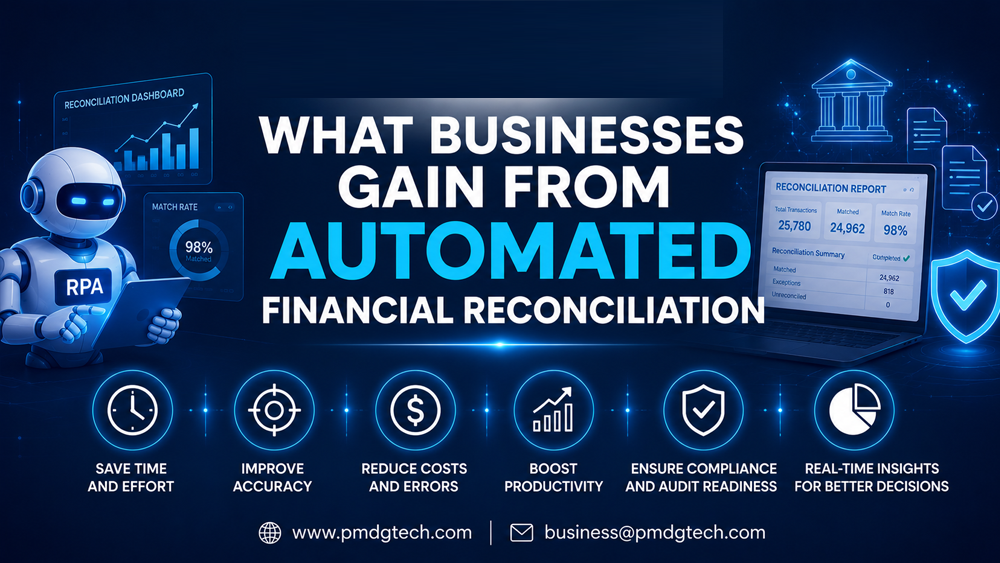
The biggest benefit is not simply that a software bot works faster than a person. The real benefit is that automation changes where finance employees spend their time. Instead of manually checking every transaction, employees can investigate exceptions. Instead of repeatedly downloading reports, they can review consolidated information.
Instead of searching through spreadsheets before an audit, they can access structured reconciliation evidence. Industry automation examples demonstrate that finance automation can produce substantial time savings. For example, UiPath has reported a customer finance organization using hundreds of automations to save more than 115,000 hours annually and reduce its close process from 30 days to five. Such figures are customer-specific rather than universal benchmarks, but they illustrate the potential of end-to-end automation.
RPA vs AI for Financial Reconciliation: Which One Should Businesses Use?
The answer is usually not RPA or AI. Businesses can get stronger results by using both technologies for the tasks they handle best. RPA is highly effective for structured, repetitive activities such as logging into applications, downloading reports, moving data, applying deterministic rules, updating systems, and generating reports.
AI becomes more useful when the workflow requires pattern recognition, document understanding, anomaly detection, intelligent matching, classification, or prediction. Therefore, an effective architecture can use RPA as the execution layer and AI as the intelligence layer.
This combination creates a practical path toward intelligent financial reconciliation without requiring companies to replace their existing ERP infrastructure.
Common Challenges When Implementing RPA Reconciliation
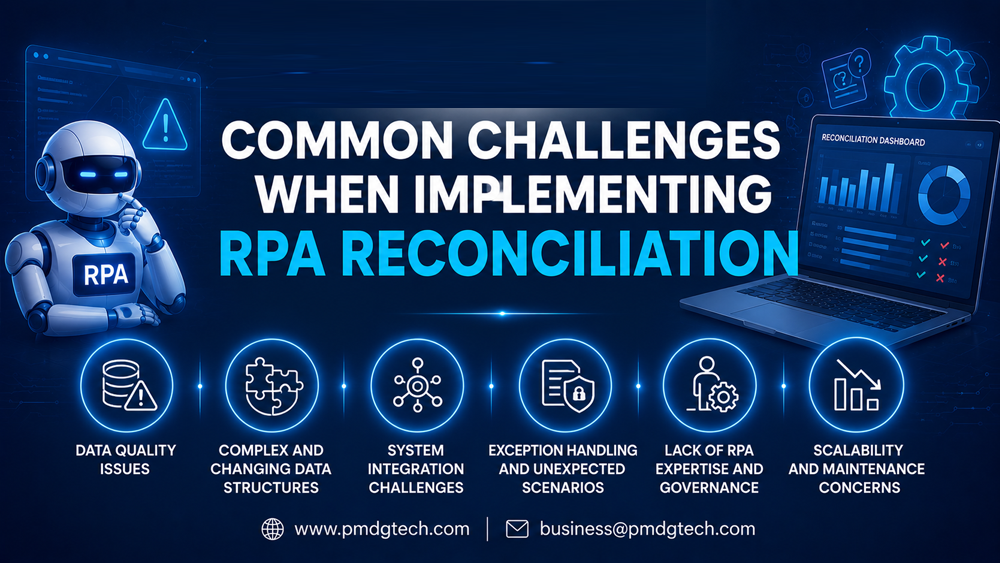
Automation does not automatically solve every reconciliation problem. Poor source data can still create exceptions. Unclear accounting rules can make automation unreliable. Weak access controls can create security risks. Overly aggressive automation can also create financial errors if exceptions are not properly governed.
Therefore, businesses should begin by mapping the existing reconciliation process, identifying repetitive tasks, defining matching rules, establishing exception thresholds, and determining which decisions require human approval.
Only then should automation be scaled. This approach also aligns with Google’s current people-first guidance: strong content should demonstrate expertise, provide original value, be accurate and comprehensive, and clearly establish who created or reviewed it.
How PMDG Technologies Can Help Automate Financial Reconciliation
For companies struggling with spreadsheet-heavy reconciliation, disconnected financial systems, repetitive ERP work, and growing transaction volumes, the opportunity is to automate the workflow around the existing finance environment rather than disrupt it.
PMDG Technologies can design automation workflows that connect ERP systems, banking data, documents, spreadsheets, APIs, and business applications while combining RPA with AI-based processing where appropriate.
The practical objective is straightforward: automate the repetitive work, surface the exceptions, keep humans responsible for important decisions, and create an auditable financial process. If your finance team is spending hours every month matching transactions manually, that process is a strong candidate for automation.
Talk to PMDG Technologies about building an RPA-powered financial reconciliation workflow tailored to your existing systems and accounting process.
Frequently Asked Questions About RPA Financial Reconciliation
What is RPA in financial reconciliation?
RPA in financial reconciliation uses software robots to collect financial data, compare transactions, apply reconciliation rules, identify mismatches, update systems, generate reports, and maintain workflow records.
Can RPA automatically reconcile bank transactions?
Yes. RPA can automatically reconcile bank transactions when the required data and matching rules are structured and reliable. For complex transactions, AI-based matching can complement deterministic RPA rules.
Can AI improve RPA financial reconciliation?
Yes. AI can improve reconciliation by identifying transaction patterns, classifying exceptions, extracting information from documents, detecting anomalies, and supporting intelligent transaction matching. However, high-risk financial decisions should remain subject to appropriate human controls.
Does RPA replace accountants?
No. RPA primarily removes repetitive administrative work. Accountants can therefore spend more time investigating exceptions, reviewing financial risks, analyzing performance, and making decisions that require professional judgment.
How long does financial reconciliation automation take to implement?
Implementation time depends on transaction volume, source systems, ERP complexity, data quality, reconciliation rules, and required controls. A focused reconciliation process can generally be automated faster than a complex multi-entity environment with multiple financial systems.
Is RPA suitable for SAP and Oracle ERP reconciliation?
Yes. RPA can interact with enterprise applications such as SAP and Oracle through available interfaces, APIs, files, or user interfaces, depending on the architecture and security requirements. Modern finance automation platforms are also increasingly designed to operate above existing ERP systems rather than requiring an ERP replacement.
What happens to transactions that cannot be reconciled automatically?
They should move into an exception workflow. The system can provide the transaction details, matching attempts, supporting documents, and recommended action to an authorized finance employee for review.
How does automated reconciliation improve audit readiness?
Automated reconciliation can create consistent records of source data, matching decisions, exception handling, approvals, timestamps, and accounting actions. This makes it easier to demonstrate how reconciliation decisions were made.
The Future of Financial Reconciliation Is Moving From Manual Matching to Intelligent Exception Management
Financial reconciliation does not need to remain a monthly spreadsheet exercise. RPA can collect the data, standardize it, apply rules, perform matching, update systems, and generate reports. AI can then extend that capability by identifying patterns, scoring matches, detecting anomalies, and helping finance teams understand exceptions.
However, the strongest implementations do not attempt to automate judgment blindly. Instead, they create a controlled workflow where automation handles volume, AI supports intelligence, and finance professionals retain control over important decisions.
That is the real opportunity for businesses: not simply reconciling transactions faster, but creating a financial operation that is more consistent, transparent, scalable, and easier to control.