A delayed customer payment can create a problem far beyond the finance department. When a manufacturer cannot predict an upcoming cash shortage, it may struggle to pay raw material suppliers, release purchase orders, maintain production schedules, or deliver finished goods on time. By the time the issue appears in a monthly financial report, the operational damage may already be underway.
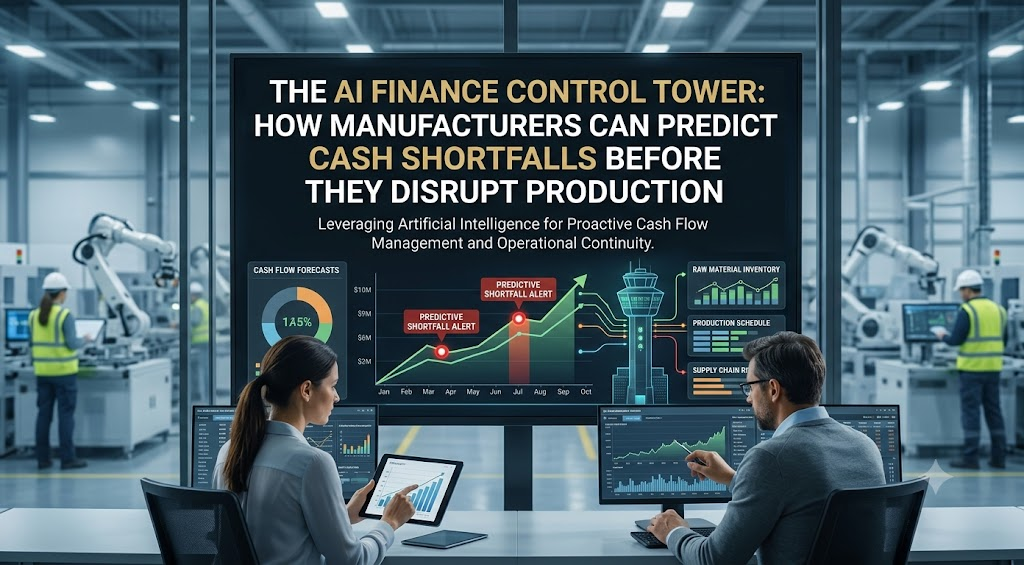
The solution is to connect financial forecasting with actual manufacturing operations. An AI finance control tower for manufacturing brings together cash positions, accounts payable, accounts receivable, inventory commitments, supplier payment schedules, and production requirements to identify potential liquidity problems before they interrupt operations.
For manufacturers dealing with fluctuating material costs, delayed receivables, rising inventory expenses, and complex supplier networks, this approach offers a more proactive way to manage working capital. Instead of asking how much cash the company has today, finance leaders can begin asking a more valuable question: Will we have enough available cash to keep production running when our next major payments fall due?
What Is an AI Finance Control Tower in Manufacturing?
An AI finance control tower is an intelligent financial monitoring system that combines real-time or frequently refreshed financial and operational data with predictive analytics. It helps manufacturers understand their current liquidity position, anticipate future cash requirements, and evaluate how financial changes could affect production.
Traditional accounting systems primarily record transactions and generate reports. Although these records are essential, they may not reveal the operational consequences of a cash shortfall until finance teams manually connect invoices, purchase orders, inventory levels, and production plans.
An AI-powered control tower connects these separate information sources. For example, it can detect that a customer has delayed a payment expected next week, identify an upcoming critical supplier invoice, and determine whether a production line needs additional raw materials before the next scheduled delivery. Consequently, the system can alert finance and procurement teams to a potential funding gap while there is still time to respond.
Why Traditional Cash-Flow Forecasting Often Fails Manufacturers
Many manufacturers still rely on spreadsheets, historical averages, and periodic finance reviews to estimate future cash positions. However, these methods can struggle when actual business conditions change quickly. A forecast may assume that customers will pay according to their agreed credit terms. In practice, a large customer might delay payment because of an invoice dispute, an approval backlog, or its own liquidity constraints. At the same time, a raw material supplier may require an advance payment because market prices have increased.
Moreover, manufacturers frequently hold cash in inventory long before they receive payment for the finished product. Consequently, rising sales do not automatically translate into stronger liquidity. The central problem is that traditional forecasting often treats finance as a separate function. An AI finance control tower instead connects cash-flow projections with the purchasing, inventory, and production decisions that determine when money must be available.
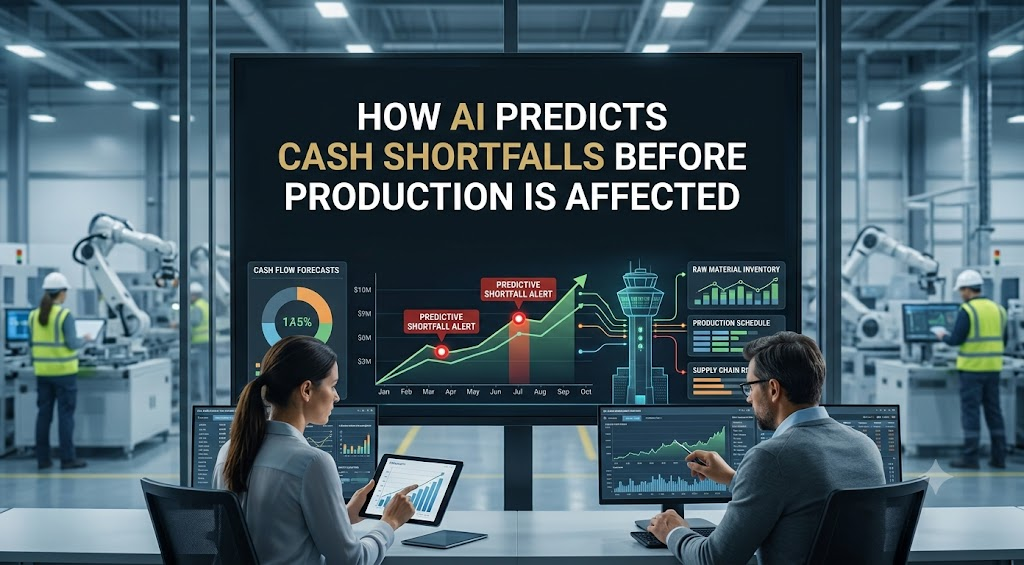
How AI Predicts Cash Shortfalls Before Production Is Affected
The value of AI cash-flow forecasting lies in its ability to identify patterns, combine different data sources, and continually revise predictions as new information becomes available.
1. Live Financial Visibility Across Business Systems
First, the control tower consolidates relevant information from ERP software, accounting platforms, bank feeds, accounts payable, accounts receivable, procurement systems, and production planning tools. This creates a unified view of available cash, expected customer collections, supplier obligations, outstanding purchase orders, payroll, operating expenses, and upcoming capital expenditure.
However, live visibility does not necessarily mean every source updates instantly. The quality of the dashboard depends on integration capabilities, refresh frequency, transaction processing, and data accuracy. Once the information is consolidated, finance leaders can compare current liquidity against upcoming production commitments. Therefore, they can distinguish between cash that is available for discretionary spending and cash that is already needed to maintain essential operations.
2. Predictive Cash-Flow Forecasting Using AI Models
Next, machine learning models analyze historical transactions and current business conditions to estimate when cash is likely to enter or leave the business. For example, a forecasting model can examine a customer’s previous payment behaviour, invoice values, overdue balances, seasonality, and dispute history. Rather than assuming that every invoice will be paid on its contractual due date, it estimates a more realistic collection window.
Similarly, the model can examine supplier payment patterns, purchase order schedules, planned production volumes, and historical material consumption to estimate upcoming cash requirements.
Time-series forecasting models can help identify trends and recurring patterns, while supervised machine learning models can estimate payment delays or the probability of a liquidity shortfall. In more advanced implementations, scenario analysis combines these predictions to show how different events could affect future cash balances. Nevertheless, AI predictions are estimates rather than guarantees. Manufacturers should validate model accuracy against actual outcomes and maintain finance-team oversight for material decisions.
3. Production-Linked Cash-Flow Risk Detection
Most importantly, an AI finance control tower connects a financial warning to its operational consequences. Consider a manufacturer that depends on a specialist supplier for an essential component. The supplier’s invoice is due in five days, but a major customer payment has become uncertain. Without an integrated view, the finance team might identify the shortage only when the payment is about to be processed.
An AI-powered system can detect the mismatch earlier by comparing projected cash availability with the supplier payment schedule and production requirements. It can then flag the potential impact on purchase-order release, material availability, and production continuity. As a result, the manufacturer has an opportunity to investigate delayed receivables, review non-critical expenditure, negotiate an approved payment arrangement, or arrange suitable short-term financing.
The system should not automatically delay every supplier payment. Instead, it should help decision-makers distinguish between flexible obligations and payments that protect critical production activities.
Supplier Payment Forecasting: Preventing Financial Pressure From Becoming a Production Delay
Supplier payment forecasting is particularly important for manufacturers operating with tight production schedules and multiple supplier dependencies. A missed payment can affect more than the supplier relationship. Depending on the contract and supplier policy, it may delay the release of materials, affect credit limits, or prevent a new purchase order from being fulfilled.
Traditional accounts payable processes often prioritize invoices by due date alone. However, the invoice due date does not reveal the full operational importance of a payment. An AI finance control tower can assess supplier criticality alongside payment dates, contractual terms, available inventory, alternative sourcing options, and production schedules. For example, a payment to a sole-source component supplier may deserve more urgent attention than a payment associated with a readily replaceable office supply.
Furthermore, predictive analytics can help finance teams estimate which supplier payments are likely to coincide with delayed customer collections. This makes it easier to prepare for periods when several significant obligations fall due together. As a result, manufacturers can improve payment planning, reduce last-minute cash transfers, and protect supplier relationships without unnecessarily sacrificing working capital.
Working Capital Optimization Without Starving Production
Working capital management is not simply about keeping cash in the bank or delaying payments. Instead, it involves balancing receivables, inventory, payables, and production requirements so that the business can meet its obligations while operating efficiently.
Reducing Cash Trapped in Excess Inventory
Excess inventory ties up cash that could otherwise support supplier payments, maintenance, or production expansion. However, reducing stock indiscriminately can create shortages and expensive production stoppages. AI-driven inventory and finance analytics can combine demand forecasts, supplier lead times, minimum order quantities, current stock levels, and production schedules to identify where inventory investment may be unnecessarily high.
For example, a manufacturer may discover that certain slow-moving components are being reordered using outdated demand assumptions, while critical production materials require more reliable replenishment planning. By aligning purchasing decisions with actual production needs, the company can work toward reducing unnecessary inventory investment without compromising material availability.
Improving Receivables and Payment Collection
Late customer payments are another major source of liquidity pressure. Even a profitable manufacturing order can create financial strain when the company must pay for materials, labour, and freight before receiving the customer’s money.
AI-assisted receivables management can prioritize invoices by value, overdue status, customer payment behaviour, and the potential impact of delayed collection on liquidity. Additionally, intelligent document processing and automated invoice matching can help identify missing purchase-order references, discrepancies, or approval issues that delay payment.
Consequently, finance teams can resolve preventable billing problems earlier and focus collection efforts on the receivables that matter most to the cash forecast.
Balancing Supplier Terms With Cash Availability
Extending payment terms may appear attractive because it preserves cash temporarily. However, aggressive payment delays can weaken supplier relationships and create supply-chain risks. Instead, manufacturers should evaluate contractual terms, supplier importance, early-payment discounts, financing costs, and future cash requirements together.
An AI finance control tower can help compare alternative payment schedules and highlight potential consequences. Finance teams can then negotiate commercially reasonable arrangements while protecting the suppliers essential to production.
A Practical Example: How AI Can Identify a Cash Shortfall Early
Imagine a mid-sized manufacturer with ₹50 lakh in available cash. It expects ₹30 lakh from a customer in seven days, while ₹35 lakh in supplier payments and ₹15 lakh in operating expenses are due within the same period. If the customer pays on time, the projected position may appear manageable. However, if the customer payment is delayed by two weeks, the manufacturer faces a potential funding gap.
An AI forecasting system can identify the delayed collection risk and estimate its effect on the cash balance. It can also highlight which supplier payments are linked to production-critical materials and which expenses may be rescheduled without disrupting operations.
Finance leaders can then take action before the shortage becomes an emergency. These figures are illustrative, not a reported company case study. Actual forecasts must account for opening cash, other receipts and payments, payment timing, restricted funds, credit facilities, and any applicable taxes or financing costs.
The important lesson is that early warning creates more options than emergency response. When the risk becomes visible sooner, the business has more time to coordinate finance, procurement, and production decisions.
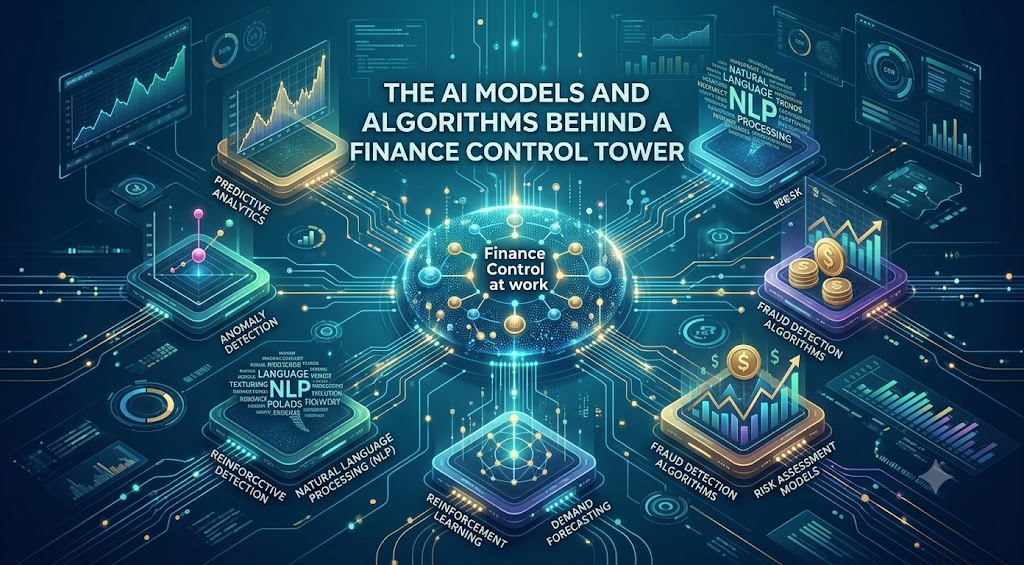
The AI Models and Algorithms Behind a Finance Control Tower
An effective manufacturing finance control tower does not depend on a single AI algorithm. Instead, it combines complementary models according to the data available and the business decision being supported.
Time-series models can estimate future cash balances using historical cash movements and recurring patterns. Gradient-boosting models or other supervised learning approaches can estimate customer payment delays, invoice exceptions, and the likelihood of short-term liquidity stress. Anomaly detection can highlight unusual expenses, duplicate invoices, unexpected supplier payment changes, or deviations from established cash-flow patterns.
In addition, a scenario engine can test events such as a 10-day customer payment delay, an unexpected increase in raw material prices, or a production-volume change. Optimization techniques can then help compare feasible payment schedules, subject to cash limits, contractual terms, and operational priorities.
For practical implementation, the system needs reliable source data, consistent transaction identifiers, clear business rules, and ongoing model monitoring. Finance teams should also be able to understand why an alert was generated, which assumptions influenced the prediction, and what uncertainty remains.
This combination of predictive analytics, business rules, and human approval creates a more dependable decision-support process than relying on an opaque AI-generated recommendation alone.
Implementation Challenges Manufacturers Must Address
Although AI-powered forecasting can improve financial visibility, its results depend on implementation quality. Inconsistent ERP records, missing payment dates, duplicate invoices, and disconnected production systems can produce misleading forecasts.
Therefore, manufacturers should begin by identifying their most important cash-flow risks and connecting the data needed to measure them. They should establish clear ownership for data quality, integrate priority systems, and compare predicted cash movements with actual results.
Moreover, financial forecasts should include confidence ranges and scenario-based warnings rather than presenting every prediction as certain. Access controls, audit trails, data privacy, and approval workflows are equally important because financial information is sensitive and payment decisions have real operational consequences.
A phased implementation can reduce complexity. Manufacturers can initially focus on cash-flow visibility and customer payment prediction before expanding into supplier risk scoring, inventory-linked forecasting, and automated decision support.
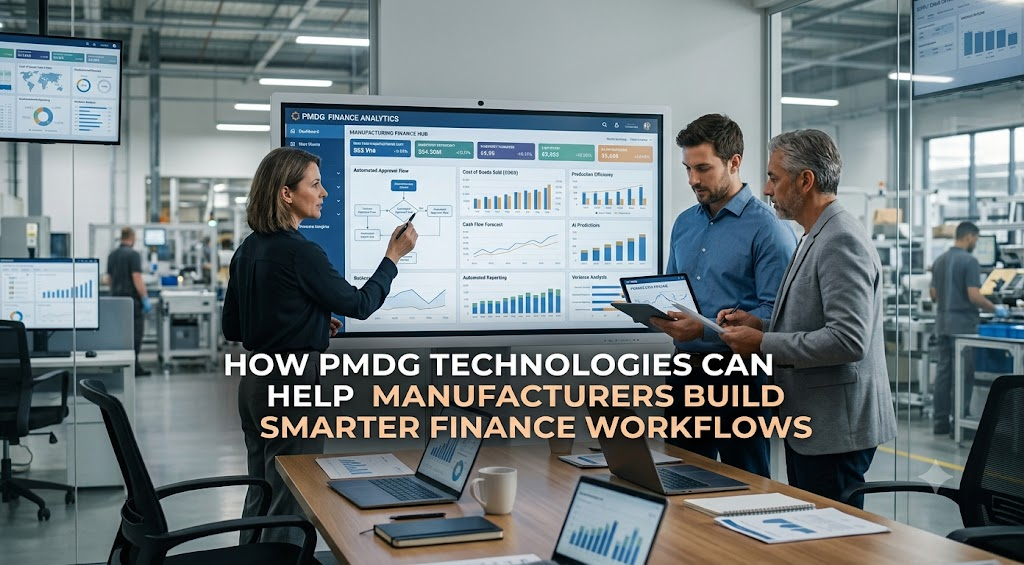
How PMDG Technologies Can Help Manufacturers Build Smarter Finance Workflows
Manufacturers need more than financial dashboards. They need connected systems that turn financial data into timely, actionable decisions. PMDG Technologies provides digital transformation services across AI, automation, ERP solutions, and software development. These capabilities can support the design of integrated financial workflows that connect invoice processing, payment reminders, reconciliation, approval processes, and predictive analytics.
For manufacturers, a tailored implementation can focus on improving financial data visibility, identifying payment exceptions earlier, forecasting cash requirements, and connecting finance processes with procurement and production information. The appropriate solution depends on the manufacturer’s existing ERP platform, accounting processes, data quality, integration requirements, and security policies. Accordingly, the first step should be to assess the current workflow and identify the financial risks that cause the greatest operational disruption.
Explore PMDG Technologies to discuss AI-powered finance automation and intelligent business workflows for manufacturing.
Frequently Asked Questions
What is an AI finance control tower?
An AI finance control tower is a connected financial monitoring and forecasting system that combines cash balances, receivables, payables, supplier commitments, and relevant operational data. It helps manufacturers anticipate liquidity risks and make better-informed financial decisions.
How can AI predict cash-flow problems in manufacturing?
AI models analyze historical transactions, customer payment behaviour, supplier obligations, inventory requirements, and production schedules to estimate future cash movements. When projected cash availability falls below expected requirements, the system can generate an early warning for the finance team.
Can AI cash-flow forecasting prevent production stoppages?
AI cannot guarantee that production stoppages will be prevented. However, it can identify potential funding gaps earlier, allowing manufacturers to investigate delayed collections, coordinate supplier payments, and arrange appropriate financing before critical materials are affected.
How does AI improve supplier payment forecasting?
AI evaluates payment histories, invoice due dates, supplier criticality, contractual terms, and expected cash inflows. This helps finance teams anticipate payment pressure and prioritize obligations according to both financial exposure and production requirements.
Which AI algorithms are useful for manufacturing finance?
Time-series forecasting, supervised machine learning, anomaly detection, and scenario optimization can support cash forecasting, payment prediction, exception detection, and liquidity planning. The best combination depends on available data, forecast horizons, and business requirements.
How does an AI finance control tower improve working capital?
It helps manufacturers identify delayed receivables, unnecessary inventory investment, overlapping payment commitments, and potential cash shortages. By connecting these insights, businesses can improve liquidity planning without compromising essential production needs.
Turn Financial Visibility Into Production Confidence
A manufacturer should not have to wait for a missed supplier payment or an unexpected cash shortage to discover that its financial planning is disconnected from production reality.
An AI finance control tower offers a more proactive approach by connecting financial forecasting, supplier payment planning, receivables management, and production-linked risk detection. When implemented with reliable data and appropriate human oversight, it can help manufacturers identify emerging liquidity problems earlier and respond with greater confidence.
Ready to connect finance, AI, and manufacturing operations? Contact PMDG Technologies to explore how intelligent automation and integrated business systems can support your financial visibility and operational efficiency.
For a practical first step, request a Manufacturing Cash-Flow Risk Assessment to identify forecasting gaps, payment bottlenecks, and opportunities for finance workflow automation.