Introduction
Every business leader today faces the same challenge: operational costs continue to rise while customer expectations grow faster than ever. Labor expenses are increasing, manual processes are slowing productivity, and market competition is forcing organizations to deliver more value with fewer resources.
Consequently, businesses that continue relying on traditional workflows are finding it increasingly difficult to maintain profitability. Meanwhile, companies that embrace Artificial Intelligence (AI) automation are discovering a completely different reality. They are reducing operational expenses, increasing efficiency, minimizing human errors, and creating scalable business models capable of handling rapid growth.
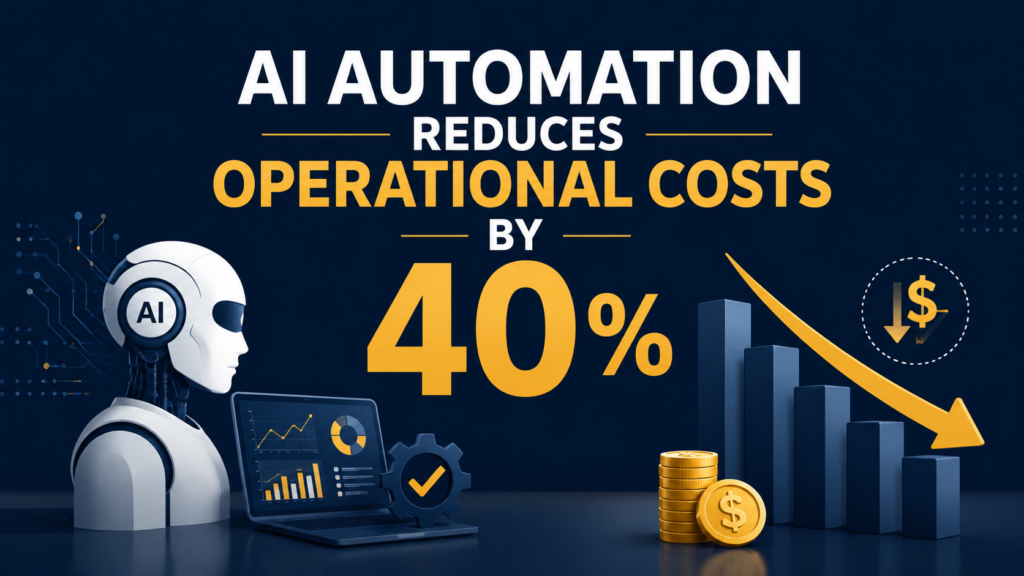
According to recent industry reports, organizations implementing AI-powered automation across core business functions are achieving operational cost reductions ranging between 25% and 40%, depending on industry and implementation maturity. Furthermore, businesses adopting AI-driven process optimization are experiencing significant improvements in productivity, customer satisfaction, and revenue generation.
However, many organizations still struggle with a critical question:
How exactly does AI automation reduce operational costs by up to 40%?
More importantly, how can businesses implement AI successfully without disrupting existing operations?
This comprehensive guide explains the real-world mechanisms behind AI cost reduction, the latest AI models driving automation in 2026, practical implementation frameworks, and proven strategies that modern enterprises use to achieve measurable ROI.
Understanding the Rising Cost Challenges Modern Businesses Face
Why Traditional Business Operations Are Becoming Unsustainable
Most organizations still rely heavily on manual processes. Although these processes may have worked in the past, they are becoming increasingly inefficient in today’s digital economy.
For example, customer service teams spend countless hours answering repetitive inquiries. Finance departments manually process invoices and reconcile transactions. HR teams review thousands of resumes manually. Sales teams spend excessive time updating CRM systems instead of building customer relationships.
As a result, businesses face several costly challenges:
Employee productivity declines because staff spend significant time on repetitive tasks.
Human errors increase operational risks and compliance issues.
Customer response times become slower.
Operational scalability becomes expensive.
Decision-making processes become delayed due to fragmented data.
Consequently, organizations often find themselves hiring additional employees simply to maintain operational efficiency. Unfortunately, this approach increases costs without fundamentally solving the underlying inefficiencies.
This is precisely where AI automation creates transformational value.
What Is AI Automation and Why Is It Different from Traditional Automation?
Understanding the Evolution from RPA to Intelligent AI Systems
Traditional automation systems operate based on predefined rules. They perform repetitive tasks exactly as programmed. However, they cannot adapt, learn, or make intelligent decisions.
AI automation introduces a completely different paradigm.
Instead of simply following rules, AI-powered systems analyze data, recognize patterns, predict outcomes, and continuously improve performance through machine learning algorithms.
In 2026, advanced AI automation combines multiple technologies, including:
Machine Learning (ML), Natural Language Processing (NLP), Generative AI, Computer Vision, Predictive Analytics, Agentic AI Systems
Large Language Models (LLMs)
As a result, businesses can automate not only repetitive tasks but also complex decision-making processes that previously required human intervention.
For example, an AI-powered customer support system can understand customer intent, analyze historical interactions, generate personalized responses, and escalate only complex cases to human agents.
Therefore, organizations achieve significantly greater cost savings compared to traditional automation approaches.
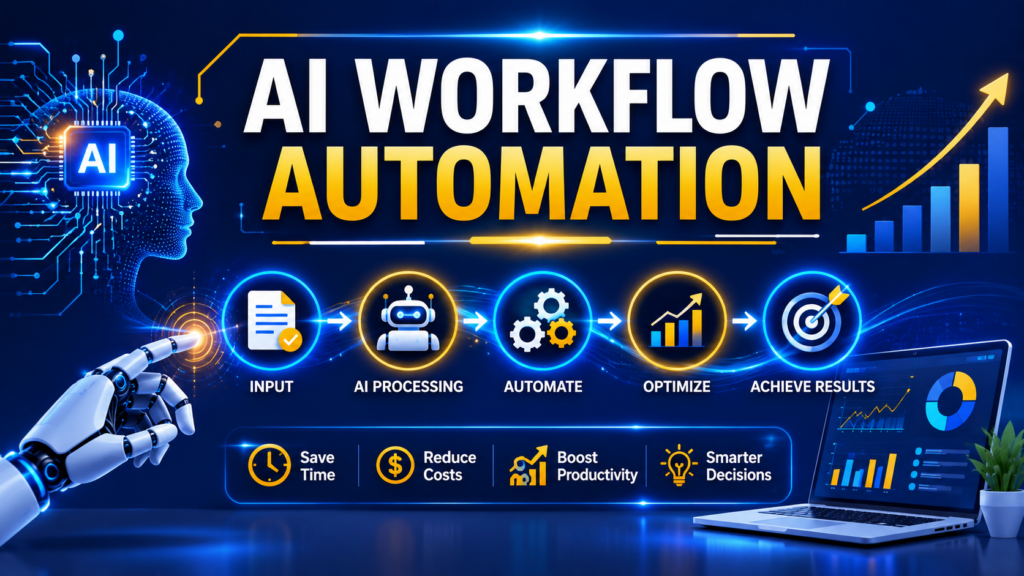
The AI Cost Reduction Framework: How Businesses Save Up to 40%
The Four Core Cost Drivers AI Automation Eliminates
AI automation reduces operational expenses through four primary mechanisms.
Workforce Optimization Without Workforce Reduction
One of the biggest misconceptions about AI is that it replaces employees.
In reality, successful businesses use AI to augment human capabilities rather than eliminate jobs.
For instance, AI assistants can handle repetitive administrative tasks, allowing employees to focus on strategic activities that generate higher business value.
As a result:
Customer service agents manage more conversations.
Sales representatives spend more time closing deals.
Finance teams process transactions faster.
HR departments improve hiring efficiency.
Consequently, businesses increase output without proportionally increasing labor costs.
Error Reduction and Quality Improvement
Human errors create substantial hidden costs.
Incorrect invoices, compliance violations, inventory mismanagement, and customer service mistakes often lead to financial losses that organizations underestimate.
AI systems significantly reduce these errors by maintaining consistency and accuracy across processes.
For example, AI-powered invoice processing solutions can achieve accuracy rates exceeding 95%, compared to significantly lower rates associated with manual processing.
Therefore, businesses save money not only through automation but also through reduced error correction expenses.
Faster Process Execution
Time directly impacts operational costs.
The longer a process takes, the more resources it consumes.
AI dramatically accelerates workflows.
Document processing that previously required several hours can now be completed within minutes.
Customer inquiries that once waited in support queues can be resolved instantly.
Financial reporting processes that took days can be generated automatically in real time.
Consequently, organizations reduce operational bottlenecks and improve overall productivity.
Predictive Decision Making
Traditional business decisions often rely on historical reporting.
Unfortunately, historical data only explains what happened in the past.
AI introduces predictive capabilities that forecast future outcomes.
Businesses can predict:
Customer churn, Equipment failures, Demand fluctuations, Supply chain disruptions, Revenue opportunities
As a result, organizations prevent costly problems before they occur, creating substantial long-term savings.
AI Models Powering Cost Reduction in 2026
Machine Learning Models
Machine Learning algorithms analyze historical data to identify patterns and optimize processes automatically.
These models improve forecasting accuracy, inventory management, customer segmentation, and resource allocation.
Consequently, businesses reduce waste and improve operational efficiency.
Natural Language Processing (NLP)
NLP enables computers to understand and process human language.
Organizations use NLP for:
Customer support automation, Document analysis, Email classification, Sentiment analysis, Knowledge management
As a result, companies significantly reduce manual communication workloads.
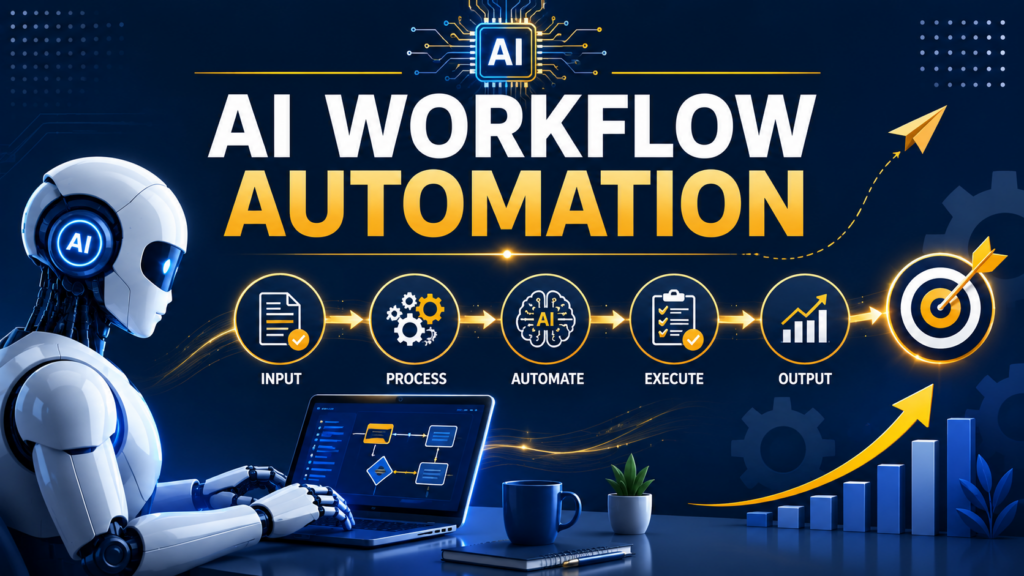
Generative AI Models
Generative AI systems create content, reports, documentation, marketing materials, and customer responses.
These systems dramatically reduce content production costs while maintaining quality and consistency.
Agentic AI Systems
Agentic AI represents one of the most significant technological advancements of 2026.
Unlike traditional AI systems that perform isolated tasks, Agentic AI systems execute complete workflows autonomously.
For example, an Agentic AI sales assistant can:
Identify leads, Conduct research, Generate outreach messages, Schedule meetings, Update CRM systems, Analyze conversion metrics
Therefore, businesses achieve end-to-end automation rather than task-level automation.
AI-Based Operational Cost Reduction Algorithm
Modern organizations increasingly implement a five-stage AI optimization model:
Stage 1: Data Collection
The AI system gathers information from ERP systems, CRM platforms, customer interactions, operational databases, and business applications.
Stage 2: Pattern Recognition
Machine learning algorithms identify inefficiencies, bottlenecks, recurring issues, and optimization opportunities.
Stage 3: Predictive Analysis
AI models forecast future operational outcomes based on historical and real-time data.
Stage 4: Automated Decision Execution
The system executes predefined business actions automatically.
Stage 5: Continuous Learning
Performance data feeds back into the model, allowing continuous optimization and improved accuracy.
This closed-loop AI optimization framework creates compounding operational savings over time.
Real-World Business Areas Where AI Delivers Immediate Cost Savings
Customer Support Automation
Many businesses spend substantial resources managing customer inquiries.
AI-powered chatbots and virtual assistants now resolve a majority of common support requests instantly.
Consequently, organizations reduce support costs while improving customer satisfaction.
Finance and Accounting Automation
Finance departments benefit significantly from AI-powered invoice processing, expense management, reconciliation, and fraud detection.
As a result, businesses reduce processing costs and improve financial accuracy.
Human Resources Automation
Recruitment processes often consume considerable time and resources.
AI accelerates candidate screening, interview scheduling, skills matching, and onboarding workflows.
Therefore, HR teams improve hiring efficiency while lowering recruitment expenses.
Supply Chain Optimization
AI predicts inventory requirements, demand fluctuations, and supply chain risks.
Consequently, organizations reduce excess inventory costs while preventing stock shortages.
Measuring ROI from AI Automation
Businesses should track:
Operational cost reduction percentage, Process completion time, Employee productivity improvement, Customer satisfaction scores, Error reduction rates, Revenue growth impact
Organizations that monitor these metrics consistently achieve stronger AI adoption outcomes and faster ROI realization.
Conclusion
The question is no longer whether businesses should adopt AI automation. Instead, the real question is how quickly organizations can implement AI before competitors gain a significant advantage.
Companies leveraging AI automation in 2026 are reducing operational costs by up to 40%, improving customer experiences, accelerating growth, and creating scalable business models capable of adapting to future market demands.
Most importantly, AI is no longer a technology reserved for large enterprises. Today, businesses of all sizes can implement intelligent automation solutions that deliver measurable ROI within months rather than years.
Organizations that act now will position themselves for sustainable growth, operational excellence, and long-term competitive advantage. Meanwhile, businesses that delay adoption risk increasing costs, declining efficiency, and reduced market relevance in an increasingly AI-driven economy.
Ready to reduce operational costs and accelerate business growth? The most successful companies are already transforming their operations with AI automation. The next competitive advantage could be yours.