Digital transformation is no longer a competitive advantage. Instead, it has become a business necessity. Across healthcare, finance, manufacturing, retail, logistics, and professional services, organizations are facing increasing pressure to reduce operational costs, improve customer experiences, eliminate repetitive work, and make faster decisions.
However, many business leaders are asking the same question:
Should we invest in Artificial Intelligence (AI), Robotic Process Automation (RPA), or Intelligent Automation (IA)?
At first glance, these technologies may appear similar because all of them automate tasks. Nevertheless, they solve different business problems and deliver different outcomes.
Consequently, choosing the wrong technology can lead to wasted investments, failed automation initiatives, and frustrated teams. On the other hand, selecting the right automation strategy can dramatically improve efficiency, increase profitability, and create scalable growth opportunities.
In this comprehensive guide, we will explore AI, RPA, and Intelligent Automation in detail. Furthermore, we will examine real-world use cases, implementation strategies, business challenges, ROI considerations, and future trends to help you determine which solution aligns best with your organizational goals.
Why Businesses Are Accelerating Automation Investments in 2026
Organizations worldwide are dealing with rising operational costs, talent shortages, increasing customer expectations, and growing competition.
According to recent industry reports, enterprise automation spending continues to grow significantly because organizations are seeking ways to:
- Reduce operational expenses
- Increase workforce productivity
- Minimize human errors
- Improve customer satisfaction
- Accelerate decision-making
- Scale operations efficiently
Nevertheless, many companies struggle because they automate processes without understanding which technology best fits their requirements.
As a result, businesses often implement AI when RPA would have been sufficient or deploy RPA when Intelligent Automation could have delivered significantly greater value.
Therefore, understanding the differences between these technologies is critical.
Understanding Robotic Process Automation (RPA)
What Is RPA?
Robotic Process Automation is a technology that uses software bots to mimic human actions within digital systems.
These bots interact with applications exactly as employees do. They click buttons, copy information, enter data, generate reports, move files, and perform repetitive rule-based tasks.
In other words, RPA follows predefined instructions.
If a process follows clear rules and structured workflows, RPA can automate it effectively.
The Biggest Problem Businesses Face Without RPA
Many organizations still rely on employees to perform repetitive administrative tasks.
Consequently, employees spend valuable hours:
- Copying information between systems
- Processing invoices
- Updating records
- Managing payroll entries
- Creating reports
- Handling compliance documentation
As a result, productivity decreases while operational costs increase.
Moreover, repetitive work often leads to human errors that impact customer satisfaction and regulatory compliance.
How RPA Solves These Challenges
RPA eliminates manual intervention in repetitive workflows.
Instead of assigning routine tasks to employees, software robots execute these activities around the clock without fatigue.
Therefore, organizations experience:
- Faster process execution
- Improved accuracy
- Lower operational costs
- Higher employee satisfaction
- Better compliance management
Real-World RPA Example
Consider an accounts payable department.
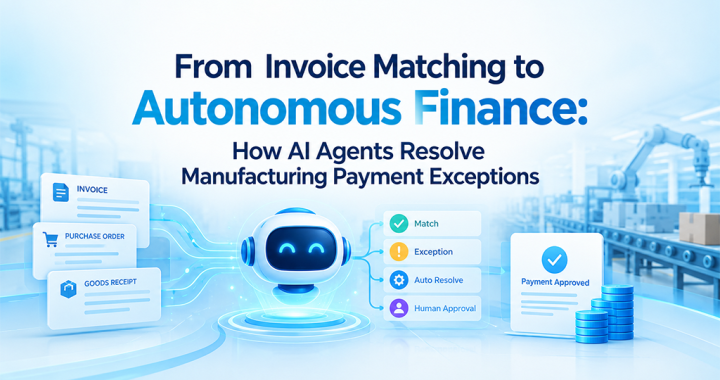
Traditionally, employees receive invoices, validate information, enter data into ERP systems, and process payments manually.
However, an RPA bot can automatically:
- Extract invoice details
- Verify purchase orders
- Enter data into ERP platforms
- Trigger approvals
- Process payments
As a result, invoice processing time can drop from several hours to a few minutes.
Understanding Artificial Intelligence (AI)
What Is AI?
Artificial Intelligence refers to systems capable of learning, reasoning, predicting, analyzing, and making decisions based on data.
Unlike RPA, AI does not simply follow predefined rules.
Instead, AI learns patterns, adapts to changing conditions, and improves performance over time.
Therefore, AI can handle complex tasks involving judgment and decision-making.
The Growing Business Challenge AI Solves
Modern organizations generate massive volumes of data every day.
Unfortunately, much of this data remains unused because traditional systems cannot interpret or analyze it effectively.
Consequently, businesses struggle with:
- Poor forecasting
- Delayed decision-making
- Customer churn
- Inefficient marketing
- Fraud detection challenges
- Inventory management issues
As competition increases, these problems become more costly.
How AI Addresses These Problems
AI transforms raw data into actionable insights.
By leveraging machine learning algorithms, deep learning models, predictive analytics, and natural language processing, AI enables organizations to make smarter decisions.
Consequently, businesses gain:
- Better demand forecasting
- Personalized customer experiences
- Predictive maintenance capabilities
- Fraud detection systems
- Intelligent recommendations
- Enhanced operational efficiency
AI Model-Based Algorithms Used by Businesses
Modern AI systems utilize various algorithms depending on business objectives.
Machine Learning Algorithms
These models learn from historical data and predict future outcomes.
Examples include:
- Random Forest
- XGBoost
- Gradient Boosting
- Logistic Regression
Deep Learning Models
These neural network-based systems process large datasets and identify complex patterns.
Examples include:
- Convolutional Neural Networks (CNNs)
- Recurrent Neural Networks (RNNs)
- Transformer Models
- Large Language Models (LLMs)
Natural Language Processing Models
These models understand human language.
Examples include:
- GPT Models
- BERT
- Claude
- LLaMA
As a result, businesses can automate customer support, document processing, and knowledge management.
Understanding Intelligent Automation (IA)
What Is Intelligent Automation?
Intelligent Automation combines:
- Artificial Intelligence
- Robotic Process Automation
- Machine Learning
- Workflow Automation
- Process Intelligence
Therefore, Intelligent Automation represents the next evolution of enterprise automation.
Rather than automating isolated tasks, IA automates entire business processes from start to finish.
Why RPA Alone Is No Longer Enough
Many businesses initially deploy RPA successfully.
However, problems arise when processes involve:
- Unstructured documents
- Customer emails
- Decision-making
- Exceptions
- Dynamic workflows
Since traditional RPA relies on fixed rules, it struggles with these scenarios.
Consequently, automation initiatives hit limitations.
How Intelligent Automation Solves Complex Business Problems
Intelligent Automation introduces AI capabilities into automated workflows.
For example:
An insurance company receives claims via email.
Traditional RPA cannot easily understand email content.
However, Intelligent Automation can:
- Read the email
- Understand customer intent
- Extract claim information
- Verify documentation
- Assess risk
- Route requests
- Process approvals
All with minimal human intervention.
Therefore, businesses achieve significantly higher automation rates.
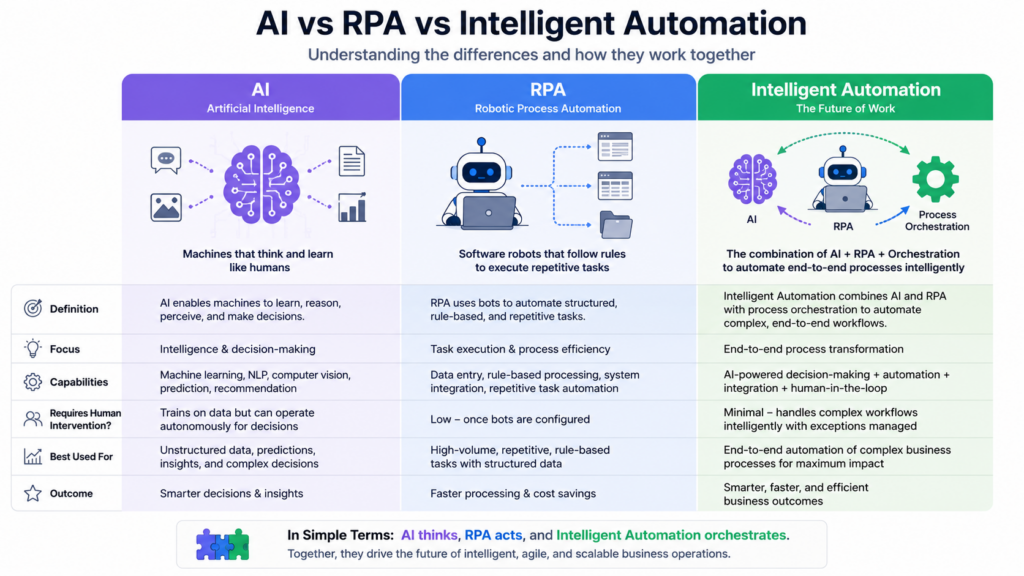
AI vs RPA vs Intelligent Automation: Detailed Comparison
Learning Capability
RPA follows predefined rules and does not learn.
AI continuously learns from data and improves predictions.
Intelligent Automation combines rule-based automation with learning capabilities.
Data Processing
RPA works best with structured data.
AI handles structured and unstructured data.
Intelligent Automation manages both while automating workflows.
Decision-Making
RPA cannot make intelligent decisions.
AI excels at decision-making based on patterns.
Intelligent Automation enables automated decision-making within business processes.
Scalability
Although RPA scales repetitive tasks effectively, AI and Intelligent Automation provide broader enterprise-wide scalability.
ROI Potential
RPA delivers quick ROI for simple processes.
AI delivers strategic value through improved decisions.
Intelligent Automation often delivers the highest long-term ROI because it combines efficiency and intelligence.
Which Technology Should Your Business Choose?
Choose RPA If
Your organization struggles with repetitive administrative tasks.
Additionally, your processes are rule-based and involve structured data.
Examples include:
- Payroll processing
- Data entry
- Invoice management
- Report generation
In these cases, RPA provides rapid results.
Choose AI If
Your primary challenge involves data analysis and decision-making.
Examples include:
- Predictive analytics
- Customer behavior analysis
- Recommendation engines
- Fraud detection
Here, AI becomes the optimal choice.
Choose Intelligent Automation If
Your organization wants end-to-end process transformation.
Examples include:
- Customer onboarding
- Claims processing
- Loan approvals
- Supply chain optimization
- Healthcare administration
In these situations, Intelligent Automation provides maximum business value.
The Rise of Agentic AI in Enterprise Automation
One of the most significant developments in 2026 is Agentic AI.
Unlike traditional AI systems, Agentic AI can:
- Plan actions
- Execute tasks
- Interact with systems
- Adapt strategies
- Achieve goals autonomously
Consequently, businesses are moving beyond simple automation toward autonomous operations.
For example, an AI agent can:
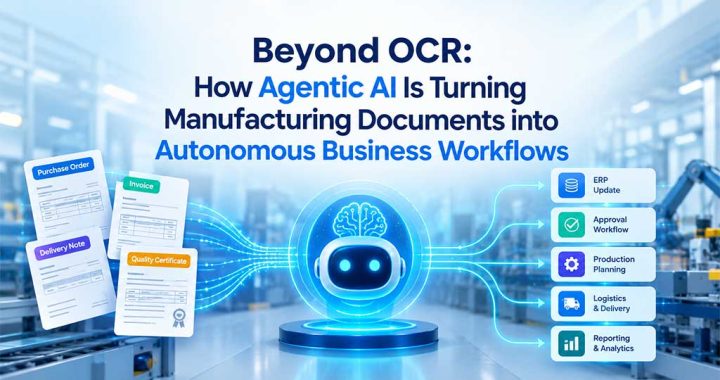
Analyze inventory levels, forecast demand, place supplier orders, monitor delivery schedules, and update ERP systems without human intervention.
Therefore, Agentic AI is becoming a major component of Intelligent Automation strategies.
Common Mistakes Businesses Make When Selecting Automation Technologies
Many organizations fail because they focus on technology rather than business problems.
As a result, they implement solutions that do not address operational bottlenecks.
Other common mistakes include:
Automating Broken Processes
If a process is inefficient, automating it simply accelerates inefficiency.
Therefore, process optimization should occur before automation.
Ignoring Change Management
Employees often resist automation initiatives.
Consequently, organizations must invest in training and communication.
Lack of Integration Planning
Automation solutions must integrate with ERP, CRM, HRMS, and enterprise applications.
Otherwise, automation silos emerge.
Measuring the Wrong Metrics
Instead of focusing solely on cost savings, businesses should measure:
- Customer satisfaction
- Processing speed
- Accuracy
- Employee productivity
- Revenue growth
Building a Future-Proof Automation Strategy
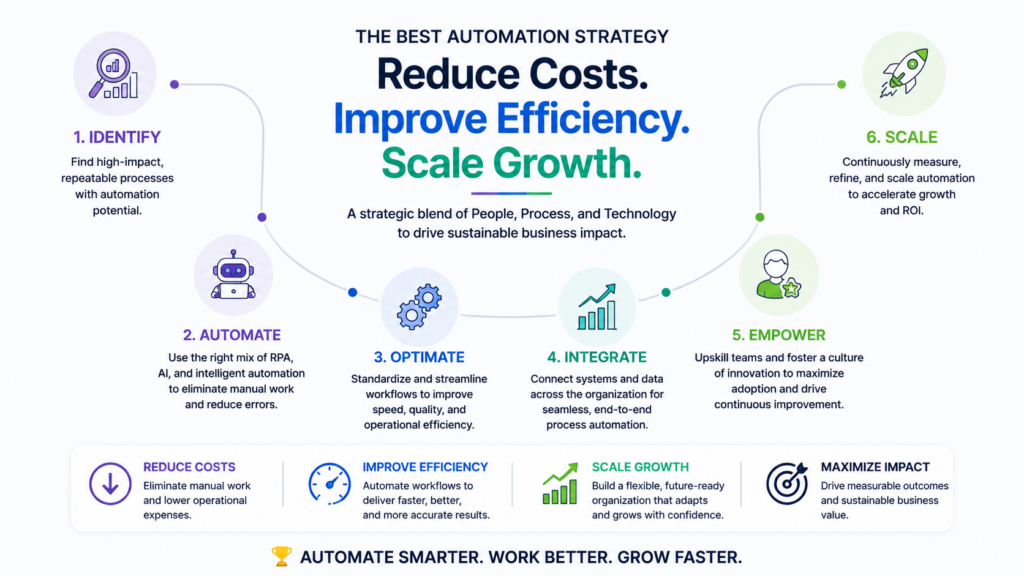
Successful automation initiatives begin with a clear roadmap.
Organizations should:
First, identify high-impact processes.
Next, assess automation opportunities.
Then, evaluate AI, RPA, and Intelligent Automation capabilities.
Afterward, develop pilot projects.
Finally, scale successful implementations across departments.
This structured approach minimizes risk while maximizing ROI.
The Future of Business Automation Beyond 2026
The automation landscape is evolving rapidly.
Over the next few years, organizations will increasingly adopt:
- Autonomous AI Agents
- Hyperautomation Platforms
- Intelligent Document Processing
- Predictive Decision Engines
- AI-Powered ERP Systems
- Self-Healing Workflows
- Generative AI Assistants
Consequently, businesses that embrace automation today will gain significant competitive advantages tomorrow.
Meanwhile, organizations that delay modernization may struggle with rising costs, slower operations, and declining customer satisfaction.
Conclusion
The debate between AI, RPA, and Intelligent Automation is not about determining which technology is superior. Instead, it is about understanding which solution aligns with your business objectives.
If your goal is eliminating repetitive tasks, RPA offers a cost-effective starting point.
If your organization needs intelligent insights and predictive capabilities, AI delivers substantial value.
However, if you want complete business process transformation, Intelligent Automation provides the most comprehensive solution.
As automation technologies continue to evolve, organizations that combine AI, RPA, workflow automation, and Agentic AI will be best positioned to improve efficiency, enhance customer experiences, reduce costs, and accelerate growth.
The future belongs to businesses that automate intelligently—not just automatically.