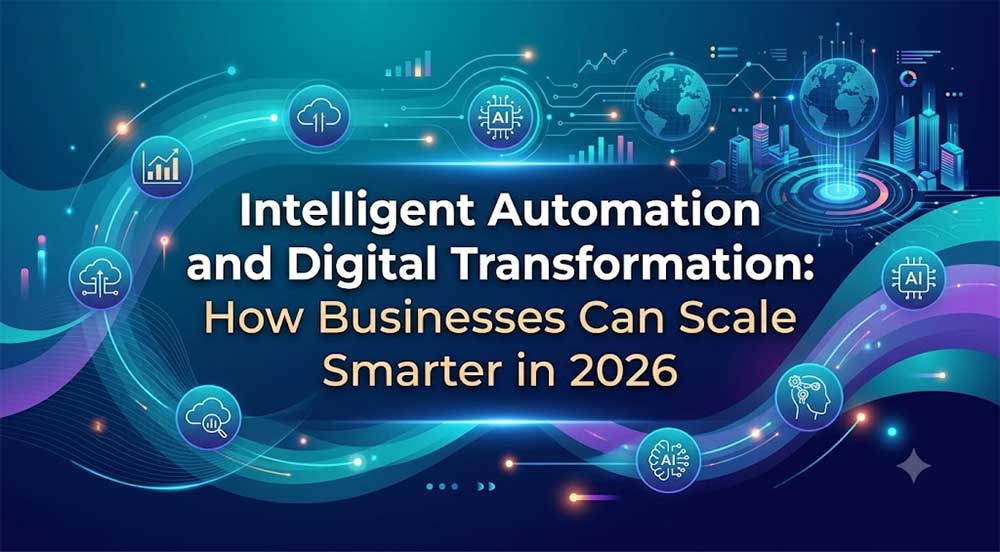
Businesses are no longer asking whether they should automate. The more important question is how they can automate intelligently without creating another layer of disconnected tools, rising technology costs, or operational complexity.
That distinction is becoming critical in 2026. McKinsey’s latest global AI survey found that 88% of respondents report regular AI use in at least one business function, yet only about one-third say their organizations have started scaling AI programs across the enterprise. At the same time, 62% report that their organizations are at least experimenting with AI agents.
Therefore, the opportunity is not simply to introduce another AI application. Instead, businesses need to connect artificial intelligence, automation, data, applications, people, and decision-making into a coordinated operating model. This is where intelligent automation and digital transformation come together.
What Is Intelligent Automation in 2026?
Intelligent automation combines artificial intelligence, machine learning, business rules, workflow automation, robotic process automation, natural language processing, intelligent document processing, and AI agents to execute business processes with less manual intervention.
Traditional automation generally follows predefined instructions. Intelligent automation goes further. It can interpret information, identify patterns, make context-aware decisions, trigger actions, and escalate exceptions when human judgment is required.
For example, a conventional workflow may simply move an invoice from one approval stage to another. An intelligent automation system can extract invoice information, compare it with purchase orders, identify anomalies, verify business rules, determine the appropriate approval path, update the ERP system, and notify the finance team when something requires attention.
Consequently, automation becomes more than task execution. It becomes an intelligent business capability.
Why Digital Transformation Is Moving From Automation to Intelligence
Many organizations have already invested in ERP platforms, CRM systems, RPA bots, cloud applications, analytics platforms, and workflow tools. However, these investments often operate in separate environments. As a result, employees still spend considerable time copying information between systems, checking spreadsheets, reconciling records, following up on approvals, and searching for information.
This creates an important digital transformation problem: the business may be digitally enabled without actually being digitally connected. McKinsey’s 2025 research found that workflow redesign is one of the strongest factors associated with achieving business value from generative AI.
Therefore, simply adding AI to an existing process may not solve the underlying problem. Businesses need to redesign the process itself.
The Biggest Business Pain Points Intelligent Automation Solves
One of the most common problems is repetitive manual work. Finance teams may manually process invoices and reconcile transactions. Operations teams may update multiple systems with the same information. Customer service teams may repeatedly search different applications before responding to customers.
Although each individual task appears manageable, the cumulative cost can be significant. Another problem is fragmented business data. Customer information may exist in the CRM, financial information in the ERP, operational information in another application, and documents in email or shared drives.
Consequently, employees become the integration layer. Intelligent automation addresses this problem by connecting systems through APIs, workflows, AI models, data pipelines, and orchestration layers. Instead of employees repeatedly moving information between systems, software can coordinate the process. The result is faster execution, fewer manual errors, better visibility, and more consistent decision-making.
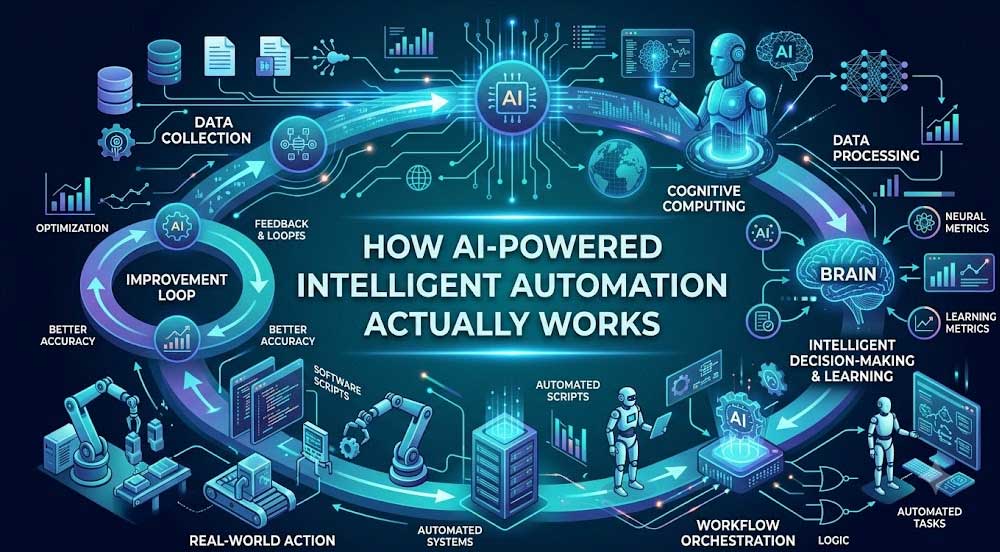
How AI-Powered Intelligent Automation Actually Works
A modern intelligent automation architecture typically begins with data collection. The system can receive structured and unstructured information from ERP platforms, CRM systems, websites, emails, PDFs, databases, APIs, mobile applications, documents, and other enterprise sources.
Next, AI models interpret the information. For instance, an intelligent document processing model can identify an invoice number, supplier, tax information, line items, payment terms, and total amount. Natural language processing can understand customer requests, while machine learning models can identify unusual transactions or predict operational outcomes. The next layer is decision intelligence.
Instead of simply asking whether a workflow should continue, the system can evaluate context. It can compare the information against business rules, historical patterns, policies, risk thresholds, and available data. Finally, an orchestration layer executes the appropriate action.
An AI agent or automation workflow may update an ERP record, create a CRM task, send an approval request, trigger a payment workflow, notify an employee, or escalate an exception. This creates a continuous cycle:
Capture → Understand → Decide → Act → Monitor → Improve
That cycle is the foundation of intelligent automation.
AI Model-Based Algorithms Make Automation More Adaptive
The major advantage of AI-powered automation is its ability to work with changing information. Rule-based automation depends heavily on predefined conditions. However, real businesses rarely operate with perfectly predictable inputs. Therefore, organizations can combine several AI techniques.
Machine learning models can detect patterns and anomalies. Natural language models can interpret human language. Classification models can categorize documents and requests. Predictive models can estimate future outcomes. Recommendation algorithms can suggest the next best action. AI agents can coordinate multiple steps across applications.
For example, a financial automation workflow could evaluate a transaction using historical transaction patterns, supplier information, invoice data, approval rules, and anomaly scores. If the transaction falls within an acceptable risk threshold, the workflow can continue automatically. However, if the model identifies unusual behavior, the system can route the case to a finance professional. This approach creates a practical balance between automation and human oversight.
AI Agents Are Changing End-to-End Business Automation
AI agents are becoming an important part of intelligent automation because they can plan and execute multiple steps rather than simply perform one predefined task. McKinsey reported in its latest 2025 survey that 62% of organizations were at least experimenting with AI agents, while 23% reported scaling an agentic AI system somewhere in the enterprise.
However, experimentation is not the same as successful deployment. An AI agent needs access to reliable enterprise data, authorized tools, clear objectives, business rules, security controls, monitoring, and escalation mechanisms. For example, an order-management agent could receive a customer request, retrieve customer information, check inventory, verify pricing, identify applicable discounts, create an order, update the CRM, and notify the customer.
Therefore, the real value comes from orchestration rather than simply deploying an isolated chatbot.
Intelligent Automation and Digital Transformation Must Start With Data
AI cannot produce reliable business outcomes from unreliable data. This is one of the most overlooked challenges in digital transformation. Organizations may have large amounts of information, but that does not necessarily mean they have usable, trusted, contextualized data. IBM’s 2025 CDO study found that only 26% of surveyed chief data officers were confident that their data capabilities could support new AI-enabled revenue streams.
Consequently, businesses should treat data quality, integration, governance, access control, and context as core components of automation. In practical terms, this means connecting systems, eliminating duplicate records, standardizing important data, monitoring data quality, and ensuring AI systems can access the right information at the right time.
Governance and Security Cannot Be an Afterthought
As automation becomes more intelligent, the risks also become more important. An automation system that only moves files presents a different risk profile from an AI agent capable of accessing enterprise systems and taking actions. IBM’s June 2026 study of 2,000 technology executives found that 77% of surveyed organizations said AI adoption was already outpacing their current governance capabilities, while only 11% said they were fully prepared for the expected scale of AI-agent deployment.
Therefore, intelligent automation should include identity management, access controls, audit trails, human approval thresholds, data protection, model monitoring, exception handling, and continuous performance measurement. The objective is not to slow automation down. Instead, governance should be designed into the workflow so that businesses can scale automation with confidence.
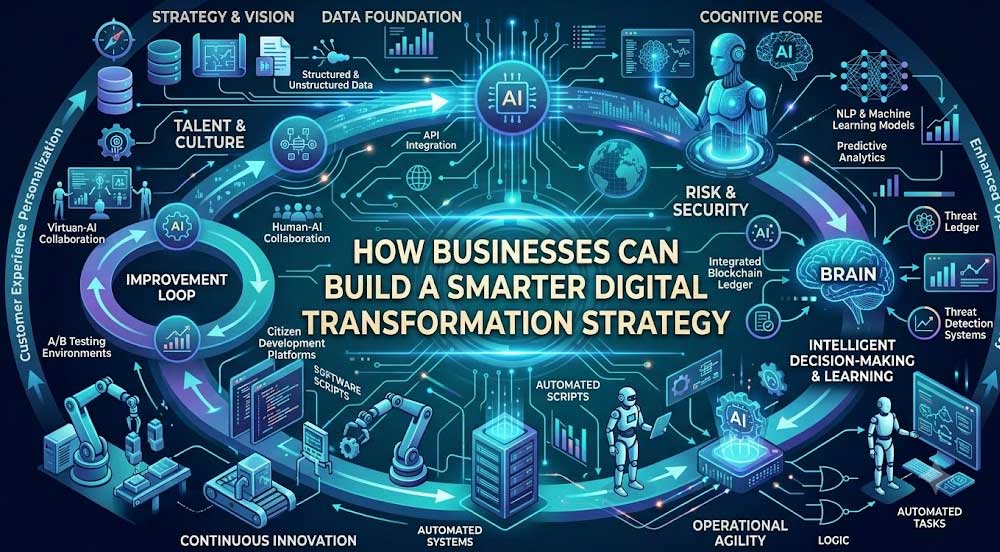
How Businesses Can Build a Smarter Digital Transformation Strategy
The most effective approach is to begin with business problems rather than technology. A company should first identify where employees spend significant time on repetitive work, where errors frequently occur, where customers experience delays, and where disconnected systems create unnecessary effort.
Next, the organization should map the complete workflow rather than automating only one task. For example, automating invoice data entry may provide a useful improvement. However, connecting invoice capture, purchase-order matching, approval, exception handling, ERP posting, payment processing, and reconciliation can produce substantially greater value.
The next step is to establish measurable KPIs. Automation should be evaluated using business outcomes such as processing time, cost per transaction, error rate, straight-through processing rate, customer response time, exception volume, revenue impact, and employee productivity. McKinsey’s research similarly emphasizes well-defined KPIs and workflow redesign as important practices for capturing value from AI.
Intelligent Automation Use Cases Across Industries
In finance, intelligent automation can streamline invoice processing, accounts payable, bank reconciliation, expense management, fraud detection, and financial reporting. In healthcare, it can assist with document processing, appointment workflows, claims processing, patient communication, and administrative coordination.
In manufacturing, automation can connect production data with inventory, procurement, quality management, maintenance, and supply-chain workflows. In retail and e-commerce, AI can support demand forecasting, customer personalization, inventory optimization, order processing, and customer service.
In logistics, intelligent systems can coordinate shipment information, documentation, exception management, route-related workflows, and customer notifications. Therefore, intelligent automation is not restricted to one department. When properly designed, it can become an enterprise-wide capability.
What Is the Difference Between Automation and Intelligent Automation?
Traditional automation primarily follows predefined rules. Intelligent automation combines those workflows with AI-based interpretation, prediction, decision-making, and adaptive execution. For example, traditional automation may send every invoice below a predefined amount through the same workflow. Intelligent automation can evaluate supplier history, invoice content, purchase-order matching, risk indicators, and business context before determining the appropriate action. Consequently, intelligent automation is particularly valuable when processes contain documents, variable inputs, exceptions, decisions, and multiple systems.
Why 2026 Is the Right Time to Scale Intelligent Automation
The technology landscape has reached an important transition point. AI adoption is widespread, but enterprise-scale implementation remains difficult. McKinsey reported that only 7% of surveyed organizations said AI was fully scaled across their organizations in its 2025 analysis.
At the same time, enterprise AI governance and control are becoming increasingly important as organizations move toward agentic systems. IBM’s 2026 research shows that organizations are under pressure to increase AI deployment while simultaneously improving visibility, governance, security, and financial control.
Therefore, the competitive advantage will not necessarily belong to companies that purchase the most AI tools. It will increasingly belong to companies that redesign their processes, connect their data, integrate AI into operational workflows, and measure business outcomes.
The Future of Digital Transformation Is an Intelligent Operating Model
Digital transformation is moving beyond websites, cloud migration, dashboards, and individual automation projects. The next stage is an intelligent operating model in which AI, automation, enterprise applications, data, and people work together.
For example, an AI system can identify an issue. An intelligent workflow can determine what should happen next. An AI agent can coordinate actions across applications. A human employee can handle exceptions that require judgment. Finally, analytics can measure the result and feed insights back into the system. That creates a continuously improving business process rather than a one-time automation project.
As IBM has highlighted in its 2026 enterprise AI strategy, organizations need coordinated systems for agents, data, automation, and governance rather than isolated AI deployments.
Frequently Asked Questions About Intelligent Automation and Digital Transformation
What is intelligent automation?
Intelligent automation is the combination of AI, machine learning, workflow automation, RPA, natural language processing, intelligent document processing, and business rules to automate business processes while supporting intelligent decisions and exception handling.
How does intelligent automation support digital transformation?
It connects business systems and automates end-to-end processes instead of improving isolated tasks. As a result, organizations can reduce manual work, improve operational visibility, accelerate processes, and create more consistent customer experiences.
Can small and mid-sized businesses use intelligent automation?
Yes. Intelligent automation does not have to begin with an enterprise-wide transformation. A business can start with a high-volume process such as invoice processing, customer support, data entry, reconciliation, or document processing and expand after measurable results are achieved.
What role do AI agents play in business automation?
AI agents can interpret objectives, plan multiple steps, interact with enterprise tools, execute actions, and escalate exceptions. However, they require reliable data, security controls, governance, monitoring, and clearly defined boundaries to operate safely.
How long does intelligent automation implementation take?
The timeline depends on process complexity, system integration, data quality, security requirements, and the level of customization. A focused proof of concept can usually be delivered faster than a multi-department transformation. The best approach is to begin with a clearly measurable business problem and expand based on results.
Scale Smarter With Intelligent Automation
The biggest mistake businesses can make in 2026 is treating AI and automation as separate technology projects.
Instead, intelligent automation should become part of the way the business operates.
If your teams are still spending hours transferring data between systems, processing documents manually, chasing approvals, reconciling information, responding to repetitive customer requests, or managing disconnected workflows, there may be significant opportunities for intelligent automation.
At PMDG Technologies, businesses can explore AI-powered automation, intelligent data processing, workflow optimization, enterprise application integration, AI document processing, and digital transformation solutions designed around measurable operational outcomes.
Ready to identify where intelligent automation can create measurable value in your business? Explore PMDG Technologies or contact the PMDG Technologies team to discuss a practical automation roadmap.