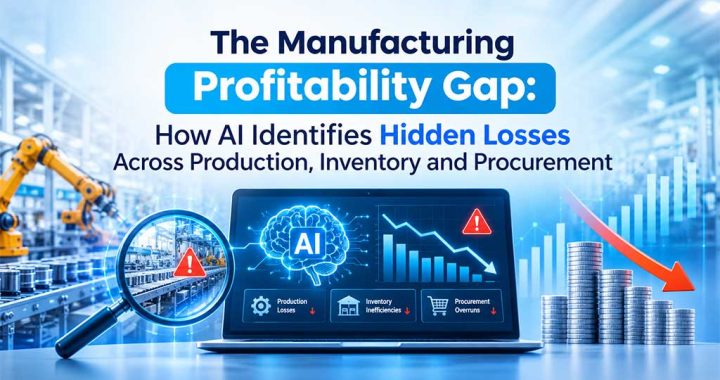
A manufacturing plant can achieve its daily production target and still lose money. A machine may operate below its optimal capacity for several hours. Raw materials may be consumed faster than expected. A production line may wait for an upstream process to finish. Quality defects may remain undetected until final inspection. Meanwhile, procurement teams may continue purchasing materials based on outdated demand estimates.
Individually, these problems may appear insignificant. Across multiple production lines, shifts and facilities, however, they can create substantial financial losses.The bigger problem is that traditional manufacturing systems often report what has already happened rather than identifying what is likely to happen next.
This is where AI automation in manufacturing introduces a different operating model. Instead of simply recording production figures, intelligent manufacturing systems analyze machine signals, production orders, material consumption, quality records, workforce activity and ERP transactions to identify operational risks before they become expensive problems.
The real opportunity is not simply automating individual factory tasks. It is connecting production intelligence with business decisions so that manufacturers can move from reactive operations to predictive and increasingly autonomous workflows.
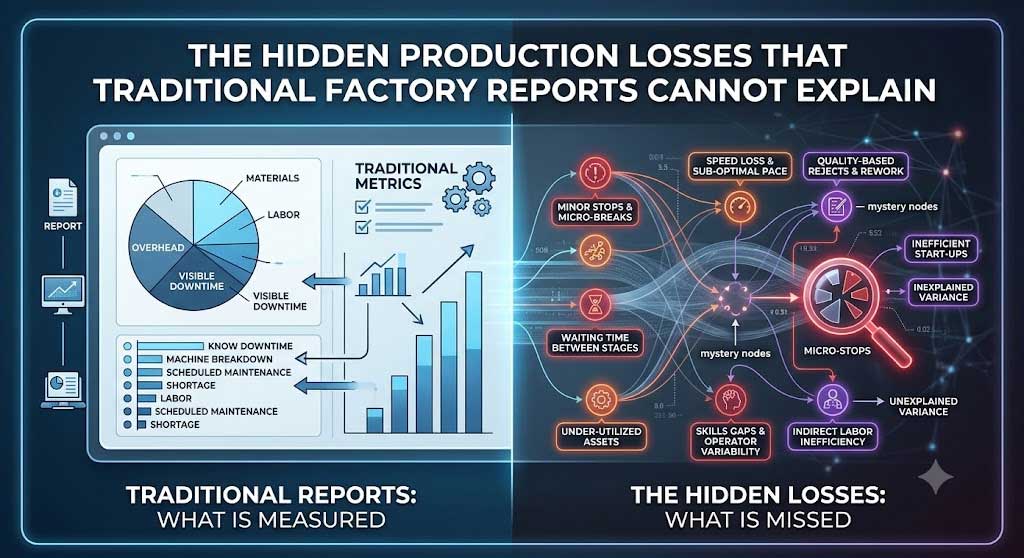
1. The Hidden Production Losses That Traditional Factory Reports Cannot Explain
Most manufacturers already collect production data through ERP systems, manufacturing execution systems (MES), machine controllers and quality management platforms. However, collecting data does not automatically create operational intelligence.
Consider a production line scheduled to manufacture 5,000 components during a shift. The final report shows that only 4,350 components were completed. The report identifies a shortfall of 650 components, but it may not explain the combined reasons behind that loss.
Was the machine operating at reduced speed? Did material replenishment arrive late? Were there repeated micro-stoppages? Did defective components increase rework? Did a downstream workstation become a bottleneck? AI-powered manufacturing analytics can correlate these different data points instead of treating each operational event independently.
For example, an AI model can compare historical machine performance, cycle times, material consumption, operator shift records and production schedules to identify recurring patterns associated with production losses. This creates a more useful picture of factory performance.
The important shift: Manufacturers move from asking, “How much did we produce?” to asking, “Where did production capacity disappear, why did it happen, and what should we change before the next shift?”
2. AI-Powered Production Intelligence: Detect Bottlenecks Before They Become Production Delays
A production bottleneck rarely exists in isolation. A machining station operating slightly slower than expected can affect assembly schedules. Delayed assembly can increase work-in-progress inventory. Increased work-in-progress can delay dispatch commitments and affect customer delivery schedules.
Traditional reporting may identify the delay only after production targets have been missed. AI-powered production intelligence can evaluate multiple operational signals together. For example, an intelligent monitoring system can:
- Compare actual machine cycle times against expected production cycle times.
- Identify workstations where processing times are consistently increasing.
- Detect growing work-in-progress quantities between production stages.
- Compare planned and actual output across shifts.
- Identify recurring idle time and production interruptions.
- Estimate how current bottlenecks could affect downstream production orders.
More importantly, the system can recommend corrective actions based on operational constraints. If a workstation becomes a recurring bottleneck, the system could recommend redistributing production workloads, adjusting shift priorities or reviewing machine availability. With appropriate system integrations and authorization rules, selected actions can also be triggered automatically. This turns production monitoring into production decision support.
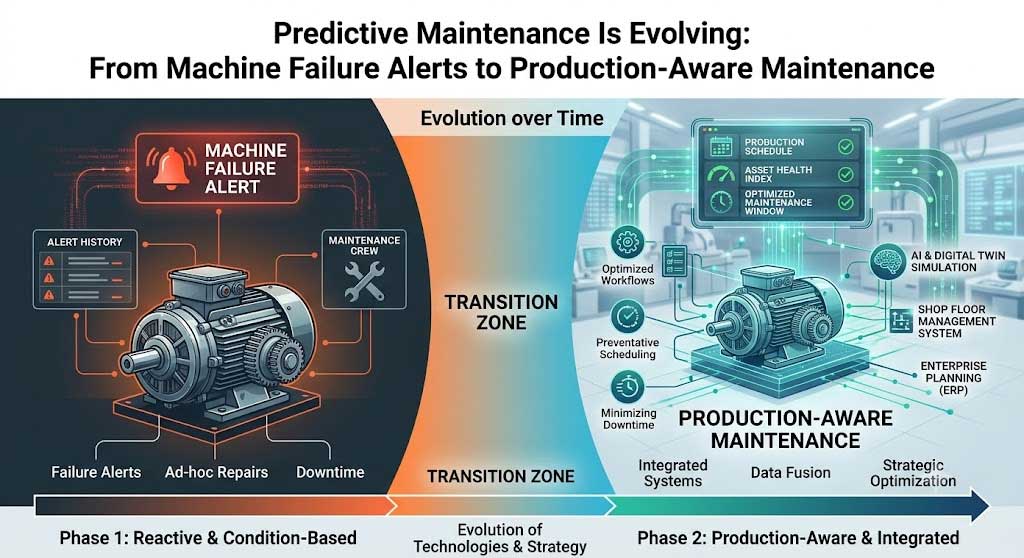
3. Predictive Maintenance Is Evolving: From Machine Failure Alerts to Production-Aware Maintenance
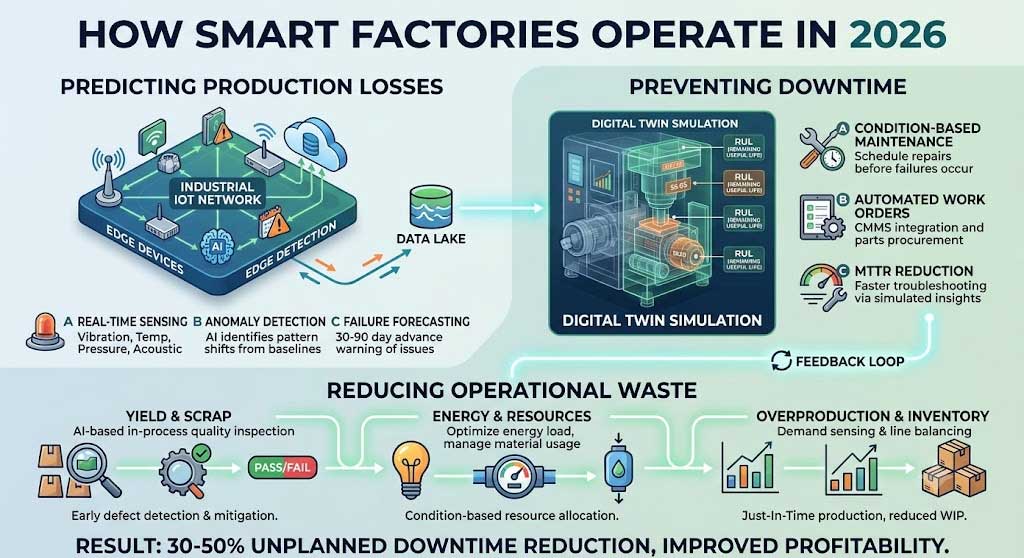
Traditional preventive maintenance generally follows predefined service intervals. Predictive maintenance uses equipment condition and historical performance data to estimate when maintenance may be required. However, advanced manufacturing environments need something more sophisticated.
A machine failure does not only create a maintenance expense. It can interrupt an entire production sequence, delay material consumption, increase labor idle time and affect delivery commitments. This is why maintenance predictions should be connected to production planning. Imagine a CNC machine operating continuously across multiple shifts.
Its vibration readings gradually increase, operating temperature becomes inconsistent and cycle times begin to fluctuate. An AI-based condition monitoring model can analyze these signals against historical machine behavior and identify an abnormal operating pattern.
The system can then:
- Generate an early equipment-risk alert.
- Estimate the likelihood or urgency of a developing equipment issue.
- Identify affected production orders.
- Check available alternative machine capacity.
- Recommend a maintenance window based on production priorities.
- Notify maintenance and production supervisors.
The objective is not to predict every machine failure with certainty. It is to provide earlier, evidence-based warnings and help maintenance teams prioritize interventions.
Advanced opportunity: Connect predictive maintenance with ERP work orders, spare-parts inventory and production schedules. This allows manufacturers to consider equipment health, spare-parts availability and customer delivery commitments together.
4. AI-Powered Quality Intelligence: Identify Defects Before They Multiply
Quality problems become significantly more expensive when defects move through multiple production stages before detection. A surface defect identified immediately after machining may require a relatively simple correction. The same defect discovered after assembly, finishing and packaging can create substantial rework and material losses.
Computer vision and machine learning can improve inspection processes by analyzing images, measurements and production data. For example, an AI-powered visual inspection system can examine manufactured components for:
- Surface scratches and cracks.
- Dimensional inconsistencies.
- Missing or incorrectly positioned components.
- Welding and assembly irregularities.
- Packaging defects.
- Abnormal surface patterns.
But the real value emerges when inspection data connects with production history. Suppose a particular production batch starts showing a higher frequency of surface defects. An integrated AI system could compare defect records against machine settings, material batches, operating temperatures, production shifts and equipment conditions.
This helps quality teams investigate potential root causes instead of merely separating defective products. AI-assisted inspection should operate with validated acceptance thresholds, traceability and human review for uncertain or high-impact decisions. The result is a shift from defect detection toward defect prevention.
5. The Next Manufacturing Challenge: Predicting Material Waste Before It Affects Margins
Material waste is not always caused by defective production. It can also result from inaccurate consumption estimates, incorrect production parameters, inefficient cutting patterns, excessive setup quantities, material handling errors and changing production requirements. Many manufacturers calculate material consumption after production is completed. By then, the opportunity to prevent the loss has already passed.
AI-driven material intelligence can compare expected consumption with actual consumption throughout production. For example, a manufacturer producing metal components can analyze:
- Bill of materials (BOM) requirements.
- Actual material issued to production.
- Machine-level consumption records.
- Scrap and rejection quantities.
- Rework requirements.
- Historical material utilization.
- Production order completion data.
If actual consumption begins exceeding expected consumption, the system can flag the deviation while the production order is still active. More advanced models can identify recurring material-loss patterns across products, machines and production shifts.
Manufacturers can use these insights to review production parameters, improve material allocation and optimize purchasing decisions. This creates a direct connection between shop-floor efficiency and financial performance.
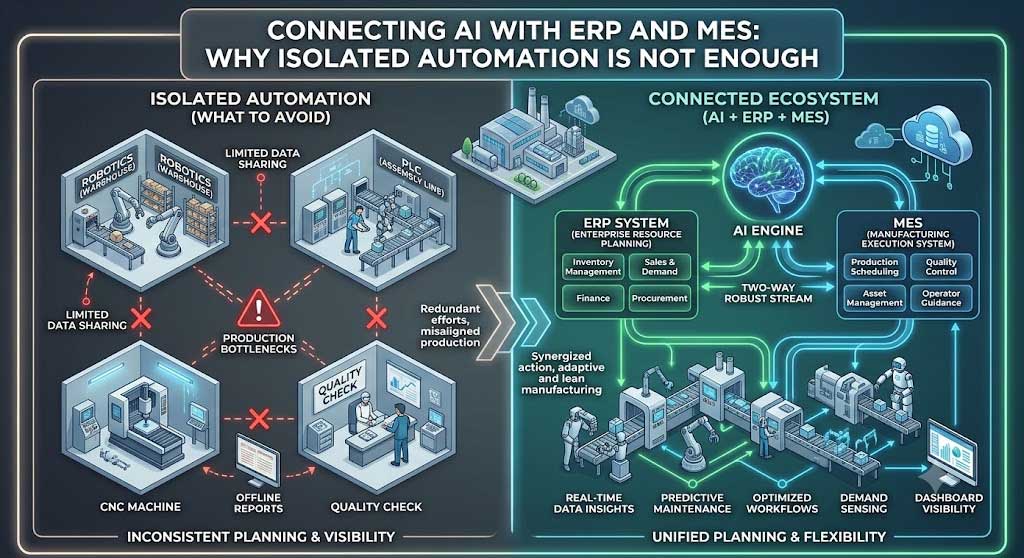
6. Connecting AI With ERP and MES: Why Isolated Automation Is Not Enough
One of the biggest limitations of manufacturing automation is disconnected information. Machine monitoring platforms may provide equipment data. MES platforms may track production execution. ERP systems may manage procurement, inventory, finance and order processing. When these systems operate without effective integration, teams spend valuable time reconciling information manually.
An AI-powered manufacturing environment should connect these operational layers. Consider a practical workflow:
Customer order → Production planning → Material availability → Machine scheduling → Production monitoring → Quality inspection → Finished goods inventory → Dispatch planning → Financial reporting
At every stage, data from one process influences the next. For example, when AI identifies a potential machine delay, the system could evaluate the affected production order, material availability and delivery schedule. It could then recommend a revised production sequence and notify the relevant teams.
With controlled integrations, approved workflow actions can update ERP records, create maintenance requests or initiate material replenishment activities. This is where manufacturing automation moves beyond isolated tools and becomes an integrated operational intelligence layer.
7. Agentic AI: Moving From Manufacturing Alerts to Coordinated Operational Workflows
Traditional automation generally follows predefined rules. For example, if inventory falls below a specified threshold, a system generates a replenishment notification.
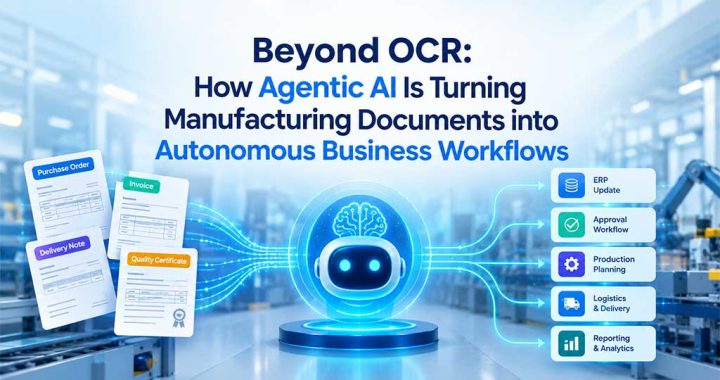
Agentic AI introduces a more advanced approach. AI agents can interpret a business objective, gather information from connected systems, evaluate available options and coordinate multiple steps within defined permissions. Consider a production material shortage.
An AI agent could:
- Identify a material shortage affecting an active production order.
- Check current warehouse stock and reserved quantities.
- Review open purchase orders and supplier delivery information.
- Evaluate alternative production schedules.
- Estimate the impact on planned output and delivery commitments.
- Prepare a replenishment recommendation.
- Route the recommendation for procurement approval.
The system should not independently approve purchases or modify critical production plans without the required authorization.
Instead, manufacturers can introduce human-in-the-loop controls for financial approvals, safety-sensitive activities and operationally significant decisions. This approach makes automation more context-aware while retaining management oversight.
8. How Manufacturers Can Measure the Financial Impact of AI Automation
Implementing AI without measuring business outcomes can lead to expensive technology projects with unclear returns. Manufacturers should establish baseline performance before introducing automation. The most useful metrics include:
| Operational area | KPI to monitor |
|---|---|
| Production | Overall Equipment Effectiveness (OEE) |
| Maintenance | Mean Time Between Failures (MTBF) |
| Maintenance | Mean Time To Repair (MTTR) |
| Quality | First Pass Yield (FPY) |
| Quality | Defect and rework rates |
| Inventory | Material utilization and inventory turnover |
| Planning | Schedule adherence |
| Delivery | On-time delivery performance |
| Finance | Cost per unit produced |
| Energy | Energy consumption per unit |
A practical financial evaluation should consider both direct and indirect savings. For example, reduced unplanned downtime may improve production availability. Better quality inspection may reduce rework and scrap. Improved material forecasting may reduce excess inventory.
However, manufacturers should avoid treating every operational improvement as an independent financial saving. The same improvement may influence multiple KPIs, and its financial benefits should not be double-counted.
A useful approach is to calculate:
Net AI Automation Value = Verified Operational Savings + Additional Contribution From Increased Output − Implementation Costs − Ongoing Operating Costs
Implementation costs should include integration, sensors, infrastructure, model development, training, maintenance and ongoing monitoring. This makes AI investment decisions more realistic and easier to justify to management.
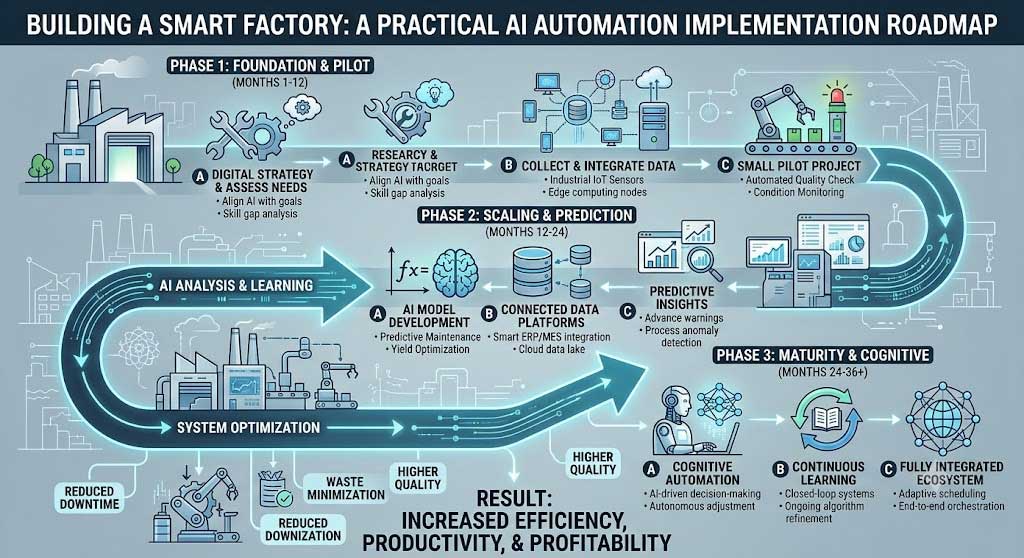
9. Building a Smart Factory: A Practical AI Automation Implementation Roadmap
Manufacturers do not need to automate every department simultaneously. A phased implementation approach helps organizations validate technology, measure results and expand automation based on proven outcomes.
Phase 1: Identify operational losses
Analyze production reports, machine downtime, material consumption, quality records and manual workflows. Identify processes where operational inefficiencies have measurable financial consequences.
Phase 2: Establish connected data infrastructure
Integrate relevant machine data, ERP transactions, MES information and quality records. Address data consistency, timestamps, equipment identifiers and missing information.
Phase 3: Introduce targeted AI models
Start with a clearly defined use case, such as machine anomaly detection, production bottleneck identification, material consumption monitoring or automated visual inspection.
Phase 4: Connect predictions with business workflows
Ensure that AI-generated insights reach the appropriate production, maintenance, quality and procurement teams. Integrate approved actions with existing ERP and manufacturing systems.
Phase 5: Validate performance and scale
Compare results against baseline KPIs. Monitor model accuracy, false alarms, operational adoption and actual financial impact. Expand to other production lines only after the initial implementation demonstrates measurable value. Security, access controls, industrial network segmentation, audit trails and human authorization should be considered throughout the implementation.
10. The Future of Manufacturing Is Not Just Automated. It Is Operationally Intelligent.
The next generation of manufacturing competitiveness will not depend only on installing faster machines or increasing production capacity. It will depend on how effectively manufacturers use operational data to identify problems, predict disruptions and coordinate decisions across their facilities.
AI automation can help connect machine intelligence, production planning, quality management, inventory control and enterprise applications into a more responsive manufacturing environment. The competitive advantage comes from knowing where production losses are developing, understanding their business impact and responding before they become expensive disruptions.
For manufacturers, the question is no longer simply whether AI can automate factory operations. It is whether their existing operational systems can identify and respond to inefficiencies quickly enough to protect productivity and profitability.
How PMDG Technologies Helps Manufacturers Move Toward Intelligent Automation
At PMDG Technologies, we help businesses explore intelligent digital transformation through AI, automation, ERP solutions and custom enterprise application development. Our manufacturing-focused automation capabilities can support organizations looking to improve:
- AI-powered production monitoring and operational visibility.
- Intelligent document processing for purchase orders, invoices and manufacturing records.
- ERP-integrated workflow automation.
- Manufacturing inventory and material management.
- AI-assisted quality inspection and data analysis.
- Predictive maintenance and operational intelligence.
- Automated reporting and business process optimization.
Rather than introducing disconnected automation tools, the objective is to develop integrated solutions aligned with each manufacturer’s existing processes, technology infrastructure and operational priorities.
Ready to identify where AI automation can improve your manufacturing operations?
Connect with PMDG Technologies to explore intelligent manufacturing automation solutions designed around your business workflows.
Website: https://www.pmdgtech.com/
Explore: https://www.pmdgtech.com/automation-services.php
Email: business@pmdgtech.com
Contact PMDG Technologies to discuss your manufacturing automation requirements.