A production line rarely stops because manufacturers lack information. More often, it stops because the right information does not reach the right person at the right moment. A machine begins operating outside its normal parameters, raw material consumption increases unexpectedly, or a supplier delays a critical component. Although these warning signs may already exist in production reports, ERP systems and machine-generated data, connecting them to an immediate operational decision remains a significant challenge.
Traditional manufacturing automation has helped businesses digitize repetitive activities and reduce manual intervention. However, most conventional systems still depend on predefined rules, fixed workflows and human authorization to respond when unexpected situations occur.
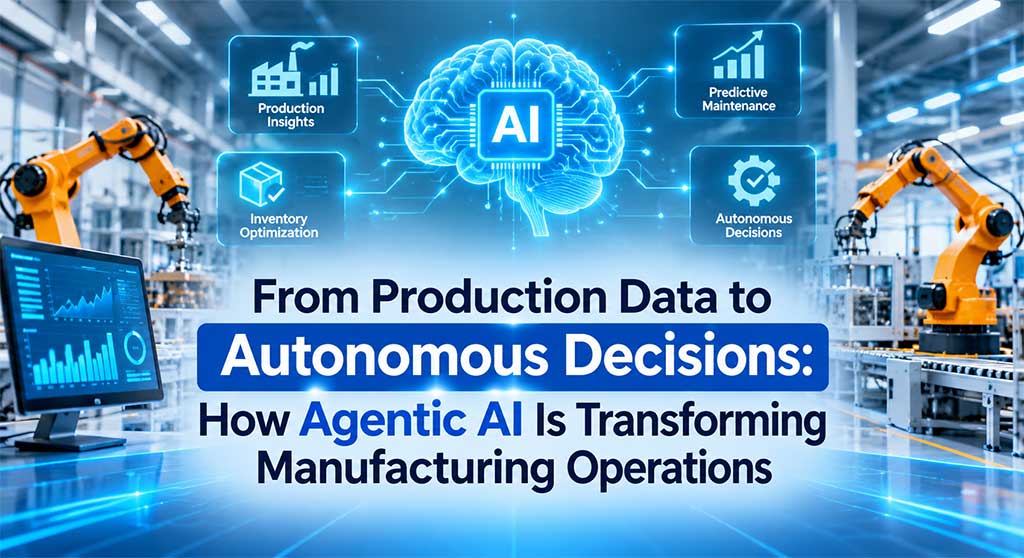
This is where agentic AI in manufacturing introduces a fundamentally different approach. Instead of simply reporting what happened or predicting what might happen, AI agents can interpret operational conditions, evaluate possible responses, coordinate with connected systems and execute authorized actions.
The result is a transition from data-driven manufacturing to increasingly autonomous manufacturing operations, where decisions are faster, workflows are more adaptive and production teams gain greater control over operational performance.
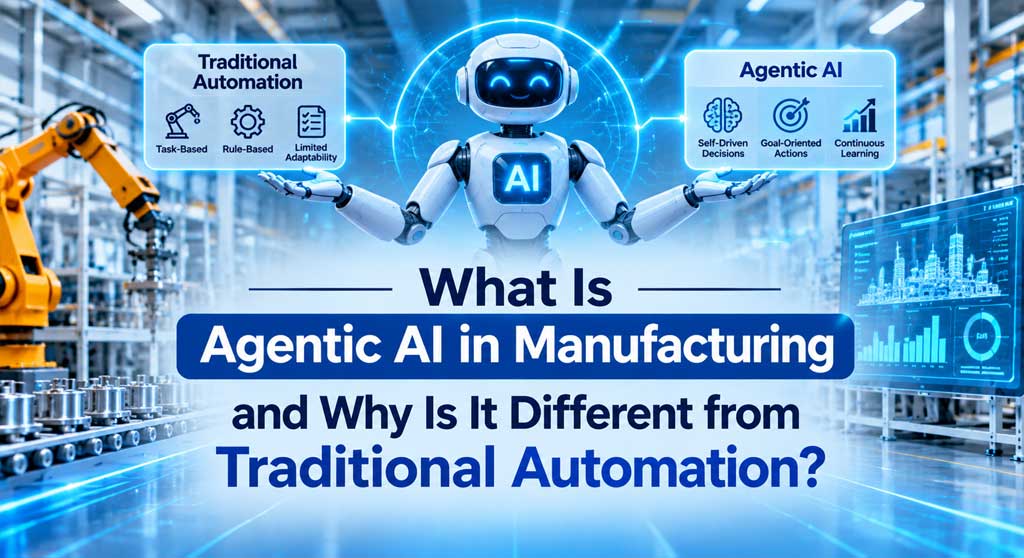
What Is Agentic AI in Manufacturing and Why Is It Different from Traditional Automation?
Agentic AI refers to intelligent AI systems capable of pursuing defined objectives through multiple steps of reasoning, planning, tool usage and feedback. Unlike conventional automation, which follows instructions programmed around anticipated conditions, an AI agent can evaluate changing circumstances and select an appropriate action within its assigned permissions.
Consider a conventional production monitoring system. When machine temperature exceeds a predefined threshold, it generates an alert. A supervisor must investigate the issue, identify the affected production schedule, check maintenance availability and decide what should happen next.
An agentic AI system can connect these activities. It can examine machine sensor readings, compare them with historical operating patterns, estimate the likelihood of equipment failure, check production commitments and recommend an alternative schedule. Where permissions allow, it can also initiate a maintenance request and notify the relevant team.
The important difference is that the system does not stop at identifying an issue. It coordinates the response.
From Rule-Based Automation to Goal-Oriented Intelligence
Traditional automation typically answers the question, “What should happen when this predefined condition occurs?” Agentic AI addresses a broader question: “Given the current operational situation and business objective, what should happen next?”
For example, when a manufacturing facility experiences a shortage of a critical component, traditional automation might generate a low-stock notification. However, an intelligent agent can examine available inventory, open purchase orders, supplier delivery commitments and production priorities before recommending an alternative procurement or scheduling decision.
Consequently, manufacturers can move beyond isolated automation towards connected decision-making across production, procurement, inventory and finance.
Why Manufacturers Are Moving Towards Autonomous Decision-Making
The shift towards agentic AI is supported by growing industry investment and changing operational requirements. According to the TCS–AWS Future-Ready Manufacturing Study 2025, 75% of surveyed manufacturing leaders expect AI to become one of the top three contributors to operating margins by 2026. Furthermore, 74% anticipate that AI agents will independently manage between 11% and 50% of routine production decisions within the following three years. However, only 21% consider their organizations fully AI-ready.
These findings highlight an important challenge: manufacturers recognize the value of intelligent automation, but many still lack the connected data infrastructure required to implement it effectively. Several operational problems explain this transition.
Production Delays Caused by Disconnected Information
Production managers frequently work with information distributed across MES platforms, ERP applications, machine monitoring systems and spreadsheets. Consequently, identifying the actual reason behind a production delay can require multiple departments and several hours of investigation.
Agentic AI can correlate production events, machine performance, material availability and workforce schedules. Rather than waiting for separate reports, it can identify relationships between operational disruptions and initiate an appropriate response.
Unplanned Machine Downtime and Maintenance Uncertainty
Reactive maintenance often begins only after equipment performance deteriorates significantly. Even when predictive maintenance systems generate warnings, maintenance teams must still determine urgency, resource availability and production impact.
AI agents can combine predictive maintenance outputs with production schedules, equipment history and spare-parts inventory. This allows maintenance decisions to consider both equipment condition and business consequences.
Inventory Imbalances and Procurement Inefficiencies
Excess inventory ties up working capital, whereas insufficient materials interrupt production. Conventional replenishment systems often struggle when supplier reliability, changing demand and production priorities fluctuate simultaneously.
Agentic AI can evaluate demand forecasts, consumption rates, supplier lead times and existing purchase commitments to recommend inventory adjustments and procurement actions.
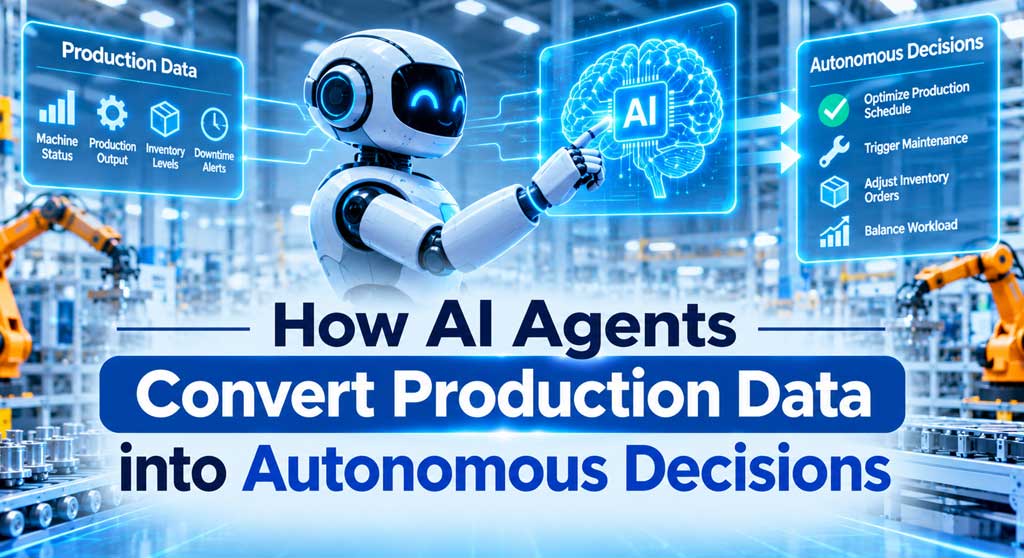
How AI Agents Convert Production Data into Autonomous Decisions
The real strength of agentic AI comes from its ability to connect multiple stages of operational intelligence.
1. Real-Time Data Collection and Contextual Understanding
An autonomous manufacturing system begins by collecting information from industrial IoT sensors, programmable logic controllers, MES platforms, ERP systems, warehouse management applications and quality inspection tools.
However, collecting information alone is insufficient. The system must understand what the information represents within the manufacturing process.
For example, an increase in machine vibration may not immediately indicate equipment failure. When combined with operating speed, temperature, maintenance history and product specifications, the same signal may reveal an emerging mechanical problem.
This contextual understanding allows AI agents to distinguish between normal operating variations and potentially serious abnormalities.
2. AI Model-Based Analysis and Predictive Reasoning
Once operational data becomes available, specialized AI models evaluate patterns, identify deviations and estimate potential outcomes.
A manufacturing AI architecture may combine time-series forecasting models for production and demand prediction, anomaly detection models for identifying unusual machine behaviour, computer vision models for quality inspection and optimization algorithms for production scheduling.
Furthermore, a large language model can interpret operational instructions, coordinate tools and translate analytical findings into actionable workflows.
The architecture should not depend on a language model making every technical decision. Instead, validated predictive models, engineering constraints and optimization algorithms should provide the evidence on which an agent operates.
For example, if an AI model predicts that a machine has an elevated probability of failure during the next production shift, an agent can compare that risk against delivery deadlines, maintenance availability and alternative machine capacity before selecting an appropriate response.
3. Multi-Agent Collaboration Across Manufacturing Departments
A single AI agent cannot efficiently manage every manufacturing function. Therefore, a coordinated multi-agent architecture can divide responsibilities among specialized agents.
A production planning agent evaluates machine capacity, order priorities and material requirements. Meanwhile, an inventory agent monitors stock levels and replenishment requirements. A maintenance agent examines equipment health, and a procurement agent evaluates supplier commitments and purchasing conditions.
These agents exchange relevant information through controlled interfaces and coordinate decisions around shared business objectives.
For example, when a supplier misses a delivery commitment, the procurement agent identifies the shortage, the inventory agent evaluates available stock, and the production planning agent calculates the impact on upcoming orders.
Rather than leaving each department to investigate independently, the system produces a coordinated response.
4. Autonomous Workflow Execution and Continuous Feedback
After evaluating possible actions, an agent can execute approved workflows through ERP, MES and other connected applications.
These actions may include creating maintenance tickets, updating proposed production schedules, generating purchase requisitions, notifying supervisors or initiating quality inspection workflows.
However, execution must remain governed by business permissions. High-impact decisions involving machine safety, production shutdowns, financial commitments or changes to validated operating parameters should require appropriate human approval.
After an action is completed, the system monitors the outcome and compares actual results with the expected outcome. This feedback helps improve future recommendations and operational decisions.
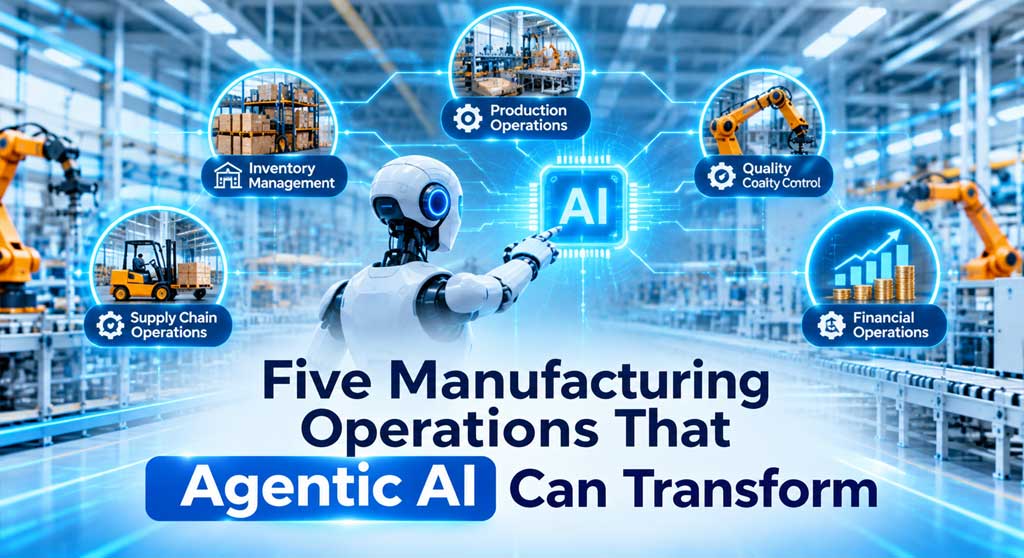
Five Manufacturing Operations That Agentic AI Can Transform
Autonomous Production Planning and Dynamic Scheduling
Fixed production schedules become difficult to maintain when customer orders change, machines experience downtime or material deliveries are delayed. Agentic AI can continuously evaluate machine availability, production capacity, workforce requirements and delivery priorities. When disruptions occur, it can calculate alternative schedules and recommend adjustments that minimize operational impact.
As a result, production teams gain greater flexibility without manually rebuilding schedules every time conditions change.
Intelligent Quality Control and Defect Prevention
Traditional quality inspection often identifies defects after production has already consumed materials, machine time and labour. By combining computer vision, sensor analytics and historical quality records, AI agents can identify unusual process conditions and initiate targeted inspections.
For example, when repeated surface defects appear in a particular production batch, an agent can correlate inspection results with machine settings, material batches and operating conditions. It can then identify potential causes and escalate corrective actions before the issue affects additional products.
Predictive Maintenance and Equipment Coordination
Predictive maintenance becomes more valuable when its findings influence production decisions. An AI agent can evaluate equipment health, estimate maintenance urgency, verify spare-parts availability and identify a suitable maintenance window. Furthermore, it can coordinate with production planning to reduce disruption while protecting delivery commitments.
Intelligent Inventory and Procurement Management
Inventory decisions should consider more than minimum stock thresholds. Agentic AI can connect consumption patterns, demand forecasts, supplier performance, material lead times and purchase commitments. Consequently, it can identify potential shortages earlier, recommend replenishment quantities and flag unusual procurement costs.
This creates a more connected relationship between procurement decisions and actual production requirements.
Manufacturing Finance and Operational Cost Control
Production inefficiencies frequently create financial consequences that remain hidden across separate business systems. For instance, excess material consumption, repeated machine downtime, duplicate supplier invoices and unexpected purchase price variations can gradually reduce manufacturing margins.
AI agents can connect production information with procurement transactions, inventory movements and financial records to identify unusual cost patterns. By escalating discrepancies and initiating authorized reconciliation workflows, manufacturers can gain better visibility into the financial impact of operational decisions.
The Technology Architecture Required for Reliable Agentic Manufacturing
Deploying autonomous AI requires more than connecting an AI model to a manufacturing dashboard. A reliable architecture should integrate industrial data acquisition, secure data pipelines, ERP and MES connectivity, specialized predictive models, agent orchestration, controlled tool execution and continuous monitoring.
Manufacturers should also establish a common operational data model so that different applications interpret machine identifiers, material codes, production orders and timestamps consistently. In addition, every agent should operate within clearly defined permissions. Decisions must be traceable, actions should be logged and critical operations should have approval mechanisms and rollback procedures wherever technically appropriate.
Cybersecurity is equally important because manufacturing environments connect information technology with operational technology. Unauthorized access to machine controls or poorly governed AI integrations can create physical and operational risks. Therefore, autonomous decision-making should progress through controlled stages, beginning with recommendations and approved workflows before expanding towards greater operational autonomy.
How Manufacturers Can Start Implementing Agentic AI
The most effective starting point is not attempting to automate an entire factory. Instead, manufacturers should identify one recurring operational problem with measurable business consequences. A production delay caused by material shortages, repeated maintenance escalations or manual invoice reconciliation can provide a practical starting point.
First, establish baseline performance using measurable indicators such as downtime hours, schedule adherence, inventory turnover, defect rates and manual processing time. Next, connect the relevant operational data sources and validate their accuracy. Introduce specialized AI models to generate predictions, followed by an agent that can interpret those predictions and coordinate approved actions.
Initially, maintain human approval for consequential decisions. Once the system demonstrates reliable performance, expand its responsibilities gradually using defined permission levels and measurable acceptance criteria. This approach helps manufacturers avoid expensive technology experiments that produce impressive demonstrations but fail to improve everyday operations.
What Is the Future of Autonomous Manufacturing Operations?
The next stage of manufacturing intelligence will involve interconnected AI agents working across production, engineering, procurement, quality, logistics and finance. The World Economic Forum’s 2026 Intelligent Industrial Operations Outlook describes the industry’s movement towards connected, increasingly autonomous industrial systems in which humans and intelligent technologies collaborate in real time.
This evolution will make manufacturing operations more adaptive. Instead of depending entirely on periodic reports and manual intervention, factories will increasingly use continuous intelligence to anticipate disruptions, evaluate alternatives and coordinate responses.
Nevertheless, autonomy will not eliminate the need for experienced manufacturing professionals. Their responsibilities will increasingly focus on engineering judgment, exception management, operational strategy and AI governance. The competitive advantage will belong to manufacturers that combine reliable industrial data, domain expertise and intelligent decision systems rather than simply adopting AI as another standalone software tool.
Frequently Asked Questions About Agentic AI in Manufacturing
What is agentic AI in manufacturing?
Agentic AI in manufacturing uses intelligent AI agents to analyze operational information, plan multi-step actions, interact with connected business systems and execute authorized workflows. It helps manufacturers move beyond basic automation towards adaptive, goal-oriented operational decision-making.
How is agentic AI different from traditional manufacturing automation?
Traditional automation follows predefined rules and workflows. Agentic AI can interpret changing conditions, evaluate multiple possible actions, coordinate across applications and adapt its response according to defined objectives and permissions.
Can agentic AI independently control manufacturing production?
Agentic AI can manage selected production workflows, scheduling recommendations, inventory coordination and maintenance processes. However, physical machine control and safety-critical decisions require validated control systems, engineering safeguards and appropriate human authorization.
What data is required to implement agentic AI in manufacturing?
Manufacturers typically require production records, machine sensor data, ERP transactions, MES information, inventory records, maintenance history, quality inspection results and supplier information. The required data depends on the operational use case.
What are the biggest challenges in implementing agentic AI?
Common challenges include fragmented data, legacy application integration, inconsistent machine information, cybersecurity risks, unreliable predictions, insufficient governance and limited employee readiness. Addressing these foundations is essential before increasing AI autonomy.
Turn Your Manufacturing Data into Intelligent Business Decisions
Your factory already generates valuable information through production systems, machine sensors, inventory applications, procurement transactions and financial records. The real opportunity lies in connecting these data sources and transforming them into decisions that improve everyday operations.
At PMDG Technologies, we help businesses explore AI-powered automation, intelligent enterprise applications and connected digital workflows designed around operational requirements. Whether your objective is to improve production planning, reduce manual processing, strengthen financial visibility or build intelligent manufacturing workflows, the right AI architecture can help turn disconnected information into measurable operational improvements.
Stop collecting production data without acting on it. Start building manufacturing operations that can understand, decide and respond.
Get a Free Consultation with PMDG Technologies
Explore our AI and Automation Services to discover how intelligent automation can support your manufacturing transformation.
Website: https://www.pmdgtech.com/
Email: business@pmdgtech.com