Manufacturing teams rarely struggle because they lack equipment. Instead, production slows when repetitive manual work consumes valuable time, critical information remains trapped inside spreadsheets, approvals take too long, and quality issues surface only after products leave the production line. These operational bottlenecks increase costs, reduce output, and make it difficult to meet growing customer expectations.
AI-powered manufacturing automation changes this equation by helping factories make faster decisions, automate repetitive tasks, monitor production in real time, and improve efficiency without replacing existing operations. Rather than relying solely on manual reporting, businesses can use AI to detect patterns, predict issues before they become expensive, and keep production moving with greater accuracy.
As manufacturers across India, Southeast Asia, and global industrial markets continue investing in digital transformation, AI is becoming a practical business tool instead of an experimental technology. Organizations adopting intelligent automation are improving productivity while reducing operational waste across production, quality control, maintenance, inventory management, and administrative workflows.
This guide explains how AI-powered manufacturing automation works, where factories lose time and money, and how businesses can implement practical automation strategies that deliver measurable results.
Why Manual Work Continues to Slow Manufacturing Operations
Walk through almost any factory, and you’ll notice that modern machinery often works alongside surprisingly manual processes. Operators record production numbers on paper. Supervisors update Excel sheets. Maintenance teams receive breakdown reports only after equipment fails. Finance teams manually reconcile invoices. HR departments spend hours collecting employee documents.
Individually, these tasks seem manageable. Together, they create hidden operational costs that quietly reduce profitability every day.

The biggest challenge is that manual processes create delays between an event happening and management becoming aware of it. If a production machine slows down at 10 AM, but the daily report reaches leadership at 5 PM, several hours of productivity may already be lost.
Common operational pain points include delayed production reporting, manual quality inspections, repeated data entry, approval bottlenecks, inventory inaccuracies, equipment downtime, and disconnected business systems.
Instead of treating these problems separately, AI-powered automation connects them into a single intelligent workflow where information moves automatically across departments.
What Is AI-Powered Manufacturing Automation?
AI-powered manufacturing automation combines artificial intelligence with workflow automation, machine learning, computer vision, and business process automation to help factories perform routine tasks with minimal human intervention while improving decision-making.
Unlike traditional automation, which follows fixed rules, AI learns from production data, identifies patterns, detects anomalies, and recommends actions based on changing conditions.

For example, a traditional automation rule might stop a machine after producing 1,000 units. An AI-powered system can identify unusual vibration patterns after 700 units and recommend maintenance before an expensive breakdown occurs.
Similarly, instead of manually checking thousands of manufactured components, AI-powered vision systems can inspect products continuously and flag defects within seconds.
The real advantage comes from combining intelligence with automation, allowing factories to react faster while reducing manual effort across production, maintenance, logistics, finance, and administration.
How AI Reduces Manual Work Across the Factory Floor
Manual work extends far beyond production lines. Many factories spend significant time handling paperwork, approvals, inspections, and reporting.
Production Monitoring Without Manual Reporting
Production reporting often depends on operators entering shift data into spreadsheets or handwritten logs. This creates delays, inconsistencies, and limited visibility.

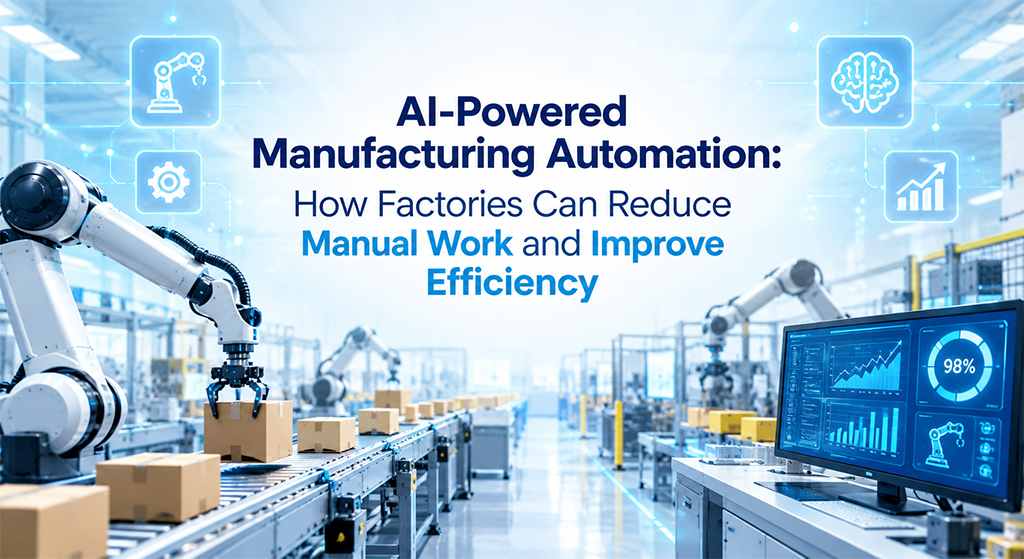
AI-powered monitoring systems automatically collect production data from machines, sensors, ERP systems, and operator inputs. Supervisors receive live dashboards showing production status, output, machine utilization, and bottlenecks as they happen.
Instead of waiting for end-of-day reports, managers can intervene immediately when production slows.
Intelligent Quality Inspection
Traditional quality inspection requires human inspectors to examine products visually, which becomes increasingly difficult during high-volume production.

Computer vision systems use AI cameras to identify scratches, cracks, dimensional errors, missing components, and packaging defects with consistent accuracy.
Because inspections happen continuously, manufacturers can reduce waste, improve customer satisfaction, and minimize costly product recalls.
Automated Document Processing
Manufacturing businesses process thousands of purchase orders, invoices, delivery notes, compliance documents, and quality reports every month.
Instead of manually entering this information into ERP systems, intelligent document processing extracts relevant data automatically and routes it to the correct workflow.
This reduces administrative workload while improving data accuracy.
Predictive Maintenance Instead of Emergency Repairs
Unexpected equipment failures remain one of the largest hidden costs in manufacturing.

AI analyzes vibration, temperature, pressure, energy consumption, and historical maintenance records to identify early warning signs before machines fail.
Maintenance teams can schedule repairs during planned downtime instead of responding to expensive emergencies.
The Business Impact of AI Manufacturing Automation
The value of AI extends beyond faster processes. The biggest benefits come from improving overall operational efficiency.
Manufacturers typically experience faster decision-making because managers gain access to live operational data rather than delayed reports. Production teams spend less time performing repetitive administrative tasks. Inventory becomes more accurate through automated tracking and demand forecasting. Quality improves through consistent inspection processes. Maintenance costs decrease as predictive insights reduce unexpected failures.
Research across industrial automation markets indicates that manufacturers implementing AI-driven production optimization often report measurable improvements in productivity, quality consistency, maintenance efficiency, and operational visibility. While results vary by industry and implementation maturity, the direction of improvement remains consistent across multiple manufacturing sectors.
Where AI Delivers the Fastest ROI
Many manufacturers assume AI requires replacing existing systems. In reality, the fastest returns often come from automating existing workflows rather than rebuilding operations.

Factories typically achieve strong ROI in production monitoring, inventory optimization, quality inspection, maintenance scheduling, invoice processing, employee onboarding, warehouse operations, and approval workflows.
These improvements often require integrating AI with ERP systems, MES platforms, IoT devices, and existing business applications instead of replacing them.
AI Algorithms Behind Smart Manufacturing
Modern manufacturing automation relies on multiple AI models working together. Machine learning analyzes historical production data to predict future outcomes. Computer vision identifies defects using image recognition. Natural language processing extracts information from documents. Anomaly detection algorithms identify unusual machine behavior.
Forecasting models improve production planning and inventory management. Workflow automation engines coordinate approvals, notifications, and business processes. Together, these technologies create intelligent systems that continuously improve operational performance as more production data becomes available.
Solving Manufacturing Pain Points with Connected Automation
One of the biggest reasons digital transformation projects fail is that departments continue working in isolation. Production uses one system. Maintenance uses another. Finance manages spreadsheets. HR collects documents manually. Warehouse teams maintain separate inventory records. Connected automation eliminates these silos by allowing information to move automatically between systems.
For example, when inventory falls below a defined threshold, AI can recommend procurement actions. When production slows unexpectedly, supervisors receive instant alerts. When equipment requires maintenance, work orders can be generated automatically without waiting for manual reporting. This connected approach reduces delays while improving collaboration across departments.
A Practical Roadmap for Implementing AI Manufacturing Automation
Successful AI adoption rarely begins with replacing an entire factory. Instead, leading manufacturers focus on solving one operational bottleneck at a time. The first step is identifying repetitive processes that consume significant manual effort. Next comes integrating existing systems so production data becomes accessible. AI models can then automate reporting, monitor operations, predict issues, and optimize workflows.
Once early improvements become measurable, businesses can expand automation across additional departments. This phased approach reduces implementation risk while allowing organizations to demonstrate ROI before scaling.
How PMDG Technologies Helps Manufacturers Automate Smarter
PMDG Technologies helps manufacturers build intelligent automation solutions that reduce manual work while improving operational efficiency. Our approach focuses on solving real business problems rather than introducing unnecessary complexity.
We help manufacturing businesses implement AI-powered workflow automation, ERP integration, intelligent document processing, real-time production monitoring, predictive maintenance solutions, custom enterprise applications, and business process automation designed for scalable growth.
Instead of forcing organizations to replace existing infrastructure, we integrate automation into current business systems, allowing teams to improve productivity without disrupting operations.
Frequently Asked Questions About AI Manufacturing Automation
Can small and mid-sized manufacturers adopt AI automation?
Yes. AI adoption no longer requires massive infrastructure investments. Many manufacturers begin with workflow automation, document processing, production monitoring, or predictive maintenance before expanding further.
Will AI replace factory workers?
AI primarily automates repetitive and time-consuming tasks while supporting employees with better insights and faster decision-making. Human expertise remains essential for production, quality oversight, engineering, and continuous improvement.
Which manufacturing processes should be automated first?
Processes involving repetitive manual work, delayed reporting, document handling, quality inspection, and maintenance planning often deliver faster implementation value because they reduce operational bottlenecks immediately.
Can AI integrate with existing ERP systems?
Yes. Modern AI automation platforms can integrate with ERP systems, MES platforms, IoT devices, and existing manufacturing software to create connected workflows.
The Future Belongs to Intelligent Manufacturing
Manufacturing companies no longer compete only on production capacity. They compete on speed, efficiency, accuracy, and their ability to respond quickly when conditions change.
Factories that continue relying on manual reporting, disconnected workflows, and reactive maintenance often struggle with rising operational costs and slower decision-making. In contrast, businesses that embrace AI-powered manufacturing automation gain real-time visibility, reduce repetitive work, improve quality, and create more resilient operations.
The opportunity isn’t about replacing people. It’s about removing unnecessary manual effort so skilled teams can focus on solving higher-value problems.
Organizations that begin their automation journey today position themselves for stronger productivity, better customer satisfaction, and sustainable long-term growth.
Ready to Reduce Manual Work in Your Factory?
If your manufacturing business still depends on spreadsheets, paper-based reporting, delayed approvals, or disconnected systems, it’s the right time to explore AI-powered automation.
PMDG Technologies helps manufacturers implement practical AI and automation solutions that improve productivity, reduce operational costs, and integrate seamlessly with existing business systems.
Book a free manufacturing automation consultation today.
Visit www.pmdgtech.com
Discover how AI-powered workflow automation can help your factory work smarter—not harder.