Why Manufacturing Companies Are Losing Profit Even When Production Is Running at Full Capacity
A manufacturing plant can achieve its monthly production target, process hundreds of purchase orders and maintain a steady flow of customer deliveries, yet still experience declining profit margins. The reason is often not a lack of sales or production capacity. Instead, profitability gradually disappears through operational inefficiencies that remain hidden across production, inventory and procurement.
For example, a machine operating below its optimal speed may increase the cost per unit without triggering a major production alert. Similarly, excess raw materials can consume working capital, while inaccurate procurement decisions may result in higher purchasing costs. Individually, these problems might appear manageable. However, when they occur simultaneously across multiple departments, their combined financial impact can become substantial.
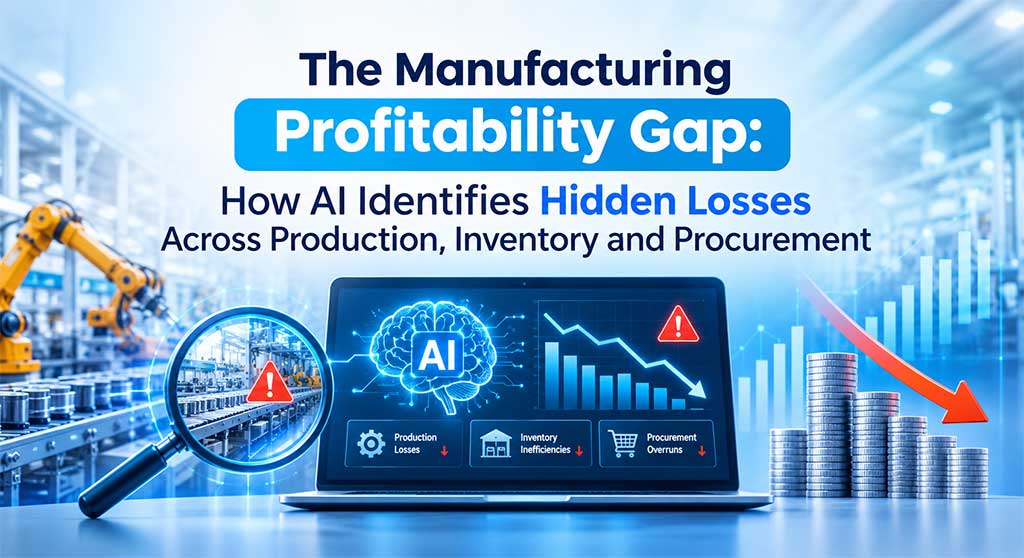
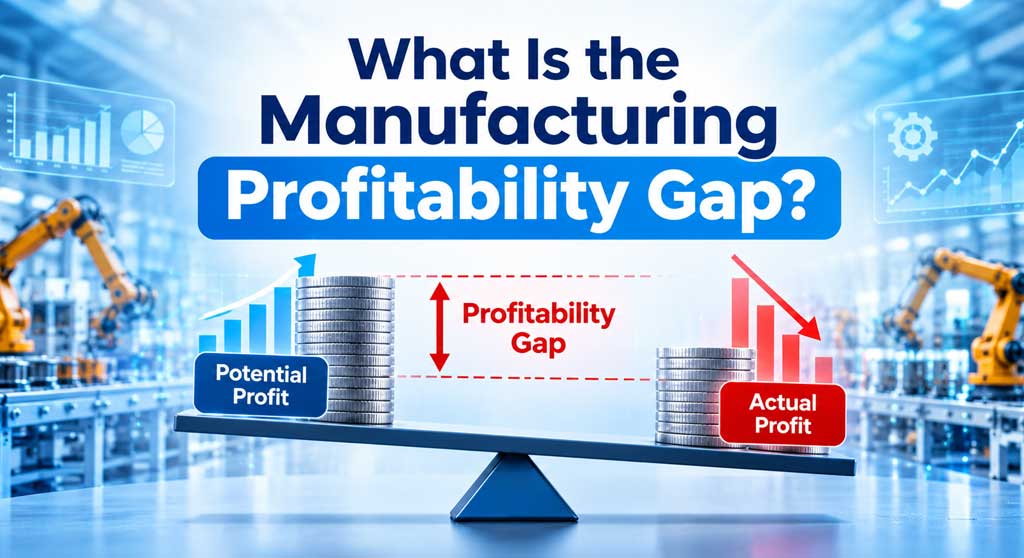
This is what creates the manufacturing profitability gap: the difference between the profit a manufacturer expects to earn and the actual profit remaining after operational inefficiencies are considered.
According to Deloitte’s 2026 Manufacturing Industry Outlook, 80% of surveyed manufacturing executives planned to allocate at least 20% of their improvement budgets to smart manufacturing initiatives. Furthermore, the report highlights growing interest in AI, automation, connected operations and data-driven decision-making.
Consequently, manufacturers need more than conventional production reports to protect their margins. They need intelligent systems that can identify where money is being lost, explain why it is happening and recommend corrective actions before those losses become permanent. This is where AI-powered manufacturing profitability analysis becomes valuable.
What Is the Manufacturing Profitability Gap?
The manufacturing profitability gap refers to the difference between expected manufacturing profitability and actual financial performance caused by inefficiencies throughout business operations. Traditional cost accounting generally identifies expenses after transactions have occurred. For instance, finance teams may discover increasing material costs during monthly closing, while production managers may identify equipment inefficiencies through weekly performance reports.
However, by the time these reports reveal a problem, the business may already have lost money through wasted materials, excessive machine usage, unnecessary purchases or delayed production. AI changes this approach by connecting operational and financial information continuously. Instead of examining production, inventory and procurement as separate functions, AI-powered analytics evaluates how decisions in one department affect the financial performance of another.
For example, purchasing additional raw materials might appear to be a sensible decision when suppliers announce price increases. However, if customer demand subsequently declines, the manufacturer could face excessive inventory, higher storage expenses and reduced working capital.
An AI-based profitability system can evaluate purchasing history, demand forecasts, production requirements and inventory levels together. As a result, it can identify whether purchasing decisions are supporting actual business demand or creating unnecessary financial exposure.
1. AI Identifies Hidden Production Losses That Increase Manufacturing Costs
Production inefficiency is one of the most overlooked reasons behind declining manufacturing profitability. Although factories monitor production quantities, machine availability and shift performance, these indicators do not always reveal the actual financial cost of operational problems.
For instance, a production line may complete 8,000 units against a target of 8,500 units. Nevertheless, the production report might not explain whether the shortfall resulted from machine speed variations, repeated changeovers, material shortages, quality rework or inefficient workforce allocation.
How AI Detects Machine Downtime and Production Bottlenecks
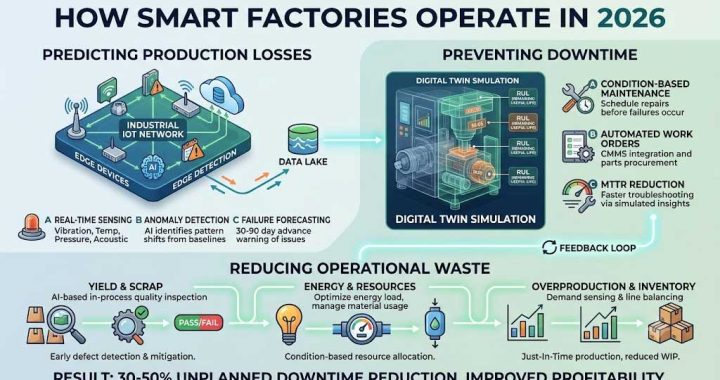
AI-powered production analytics combines machine sensor readings, equipment performance history, production schedules and maintenance records to identify patterns associated with lost production capacity. Machine learning models can analyse vibration, temperature, operating speed and equipment utilisation to identify unusual behaviour before it develops into an equipment failure.
Furthermore, predictive maintenance models can estimate the probability of equipment failure by comparing current operating conditions with historical failure patterns. For example, when a machine repeatedly operates outside its normal temperature range, an AI model can identify the developing risk and notify maintenance teams before an unexpected breakdown interrupts production.
However, equipment downtime is only one part of the problem. AI can also analyse production sequences, changeover durations and work-in-progress movement to identify bottlenecks that reduce throughput. As a result, manufacturers can understand which machines, production stages or operating conditions are increasing the cost of each manufactured unit.
How AI Reduces Scrap, Rework and Quality-Related Financial Losses
Quality problems create costs beyond the materials used in defective products. They also consume machine capacity, employee time, inspection resources and additional production energy. Traditional quality inspections often identify defects after products have completed several manufacturing stages. Consequently, manufacturers may discover expensive quality problems only after significant resources have already been consumed.
AI-powered visual inspection and anomaly detection can analyse images, sensor readings and production parameters to identify defects earlier. Moreover, machine learning algorithms can compare defect patterns with operating conditions to identify possible root causes.
For example, if surface defects repeatedly occur when a particular machine operates at a specific temperature or production speed, an AI model can highlight the relationship for engineering teams to investigate. This helps manufacturers move beyond detecting defective products towards understanding the operational conditions that create them. The financial benefit is particularly important because preventing one recurring production defect can reduce material waste, rework hours and unnecessary machine utilisation simultaneously.
2. AI Exposes Inventory Costs Hidden Behind Excess Stock and Material Shortages
Inventory is essential for uninterrupted manufacturing. However, maintaining more stock does not automatically improve operational efficiency. In fact, manufacturers frequently face two opposing problems: excess inventory that ties up working capital and insufficient inventory that interrupts production. Both situations reduce profitability, although their financial impact appears in different areas of the business.
How AI Identifies Slow-Moving, Excess and Obsolete Inventory
Conventional inventory management often depends on fixed reorder levels, historical consumption and manually prepared stock reports. Unfortunately, these methods may not respond quickly enough when customer demand changes, production schedules are revised or raw material consumption fluctuates.
AI-powered inventory optimization uses historical sales, current orders, production requirements, supplier lead times, seasonality and consumption patterns to estimate future material requirements. Furthermore, demand forecasting models can identify changing consumption patterns that may not be visible through traditional averages.
For example, a manufacturer might hold six months of a particular component because its previous production schedule required consistent consumption. However, a recent change in product demand may have reduced its actual requirement. AI can identify the difference between projected consumption and available stock, highlighting materials at risk of becoming slow-moving or obsolete.
Consequently, procurement teams can adjust future purchasing decisions while inventory managers can prioritize existing materials before additional stock is ordered.
How AI Prevents Stockouts and Their Impact on Production Profitability
Excess stock creates carrying costs, whereas stockouts can create production delays, emergency purchasing and missed delivery commitments. Therefore, inventory optimization must balance availability with working capital rather than simply minimizing stock quantities. AI models can evaluate supplier lead times, historical demand fluctuations, safety stock requirements and production schedules to calculate more responsive replenishment recommendations.
For example, if a critical component has an unpredictable delivery lead time, an AI system can identify the risk of a potential shortage by comparing expected consumption against confirmed incoming supplies. Additionally, it can recommend adjusting reorder quantities or evaluating alternative suppliers. As a result, manufacturers gain better control over inventory investment while reducing the risk of production interruptions.
3. AI Detects Procurement Inefficiencies That Increase Material Purchasing Costs
Procurement decisions directly influence manufacturing margins because raw materials, components and supplier services represent significant operating expenses. Nevertheless, many manufacturers still struggle to identify whether they are purchasing materials at competitive prices, ordering the correct quantities or receiving the agreed commercial terms. The problem becomes more complicated when multiple plants, suppliers and purchasing teams operate through disconnected systems.
How AI Identifies Supplier Price Variations and Unnecessary Purchasing Costs
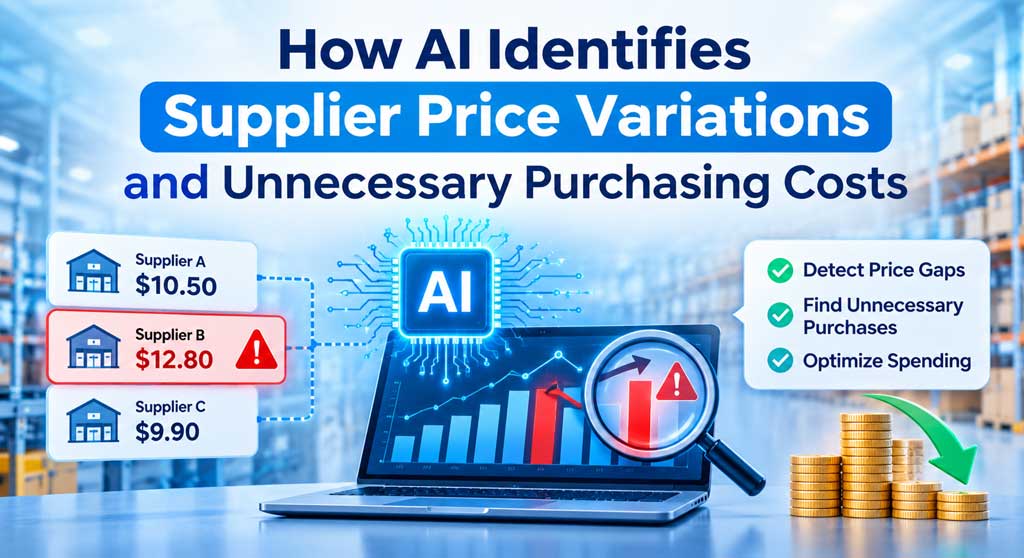
AI-powered procurement analytics can compare purchase orders, supplier quotations, historical purchasing prices, invoice values and material specifications. For example, if the same material is purchased from different suppliers at significantly different prices, an AI model can highlight the variation and help procurement managers investigate whether the difference is justified by quality, quantity, delivery or contractual conditions.
Furthermore, anomaly detection algorithms can identify unusual price increases, duplicate purchase orders and purchasing patterns that deviate from established business rules. These insights help procurement teams identify opportunities for supplier negotiations and more consistent purchasing decisions.
However, the objective is not simply to select the cheapest supplier. Manufacturers must also consider delivery reliability, material quality, payment terms and supplier performance. By evaluating these factors together, AI can support purchasing decisions that consider the total cost of procurement rather than the quoted price alone.
How AI Automates Purchase Order, Goods Receipt and Invoice Matching
Another significant source of financial leakage occurs when purchase orders, goods receipt notes and supplier invoices do not match. For instance, a supplier invoice may contain a higher quantity or different price than the original purchase order. If the discrepancy is not identified before payment, the manufacturer could incur an avoidable expense.
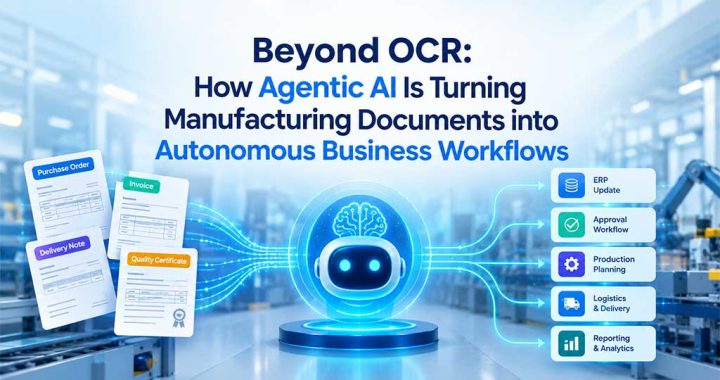
AI-powered document processing can extract information from purchase orders, goods receipt notes and invoices. Subsequently, intelligent matching algorithms compare supplier details, item descriptions, quantities, prices and tax information.
When discrepancies appear, the system can flag the transaction and route it to the appropriate finance or procurement employee for verification. Moreover, AI-based anomaly detection can identify suspicious duplicate invoices, unusual payment requests and repeated billing discrepancies. This approach improves financial control while reducing manual reconciliation effort and unnecessary payment leakage.
4. How AI Connects Production, Inventory and Procurement to Reveal the Complete Profitability Picture
Although production, inventory and procurement can each generate cost savings independently, the greatest opportunity comes from understanding how they influence one another. For example, an unexpected production delay may increase raw material storage time. At the same time, procurement teams may continue placing orders based on an outdated production schedule.
As a result, the manufacturer experiences additional inventory costs even though the original problem occurred on the production floor. Traditional departmental reporting may show these problems separately. However, an integrated AI-based manufacturing analytics platform can connect the underlying events.
AI-Powered Manufacturing Cost Intelligence
An advanced manufacturing profitability system can combine ERP transactions, machine data, inventory movements, purchase orders, supplier invoices and production records. AI models then evaluate these data sources to identify relationships between operational activities and financial outcomes. For example, the system can compare planned production costs against actual costs while considering material consumption, machine utilisation, labour hours, scrap rates and procurement prices.
Furthermore, predictive analytics can estimate how current operational conditions may influence future production expenses and gross margins. This makes it possible to identify not only where losses have occurred but also where similar losses are likely to develop.
How AI Recommends Corrective Actions Instead of Simply Reporting Problems
Identifying a financial problem is useful. However, manufacturers need actionable recommendations to prevent recurring losses. This is where advanced machine learning and AI-assisted decision systems provide additional value. For instance, if an AI model identifies increasing material consumption, it can highlight the production line, material category and operating conditions associated with the deviation.
Similarly, when demand forecasts indicate excess inventory risk, the system can recommend reviewing upcoming purchase orders before additional materials arrive. With appropriate business rules and human approval, agentic AI workflows can also initiate tasks such as requesting supplier quotations, generating exception reports or routing approval requests. Nevertheless, high-impact decisions involving supplier commitments, production changes and financial transactions should remain subject to authorized human oversight.
5. How Manufacturers Can Implement AI-Based Profitability Optimization
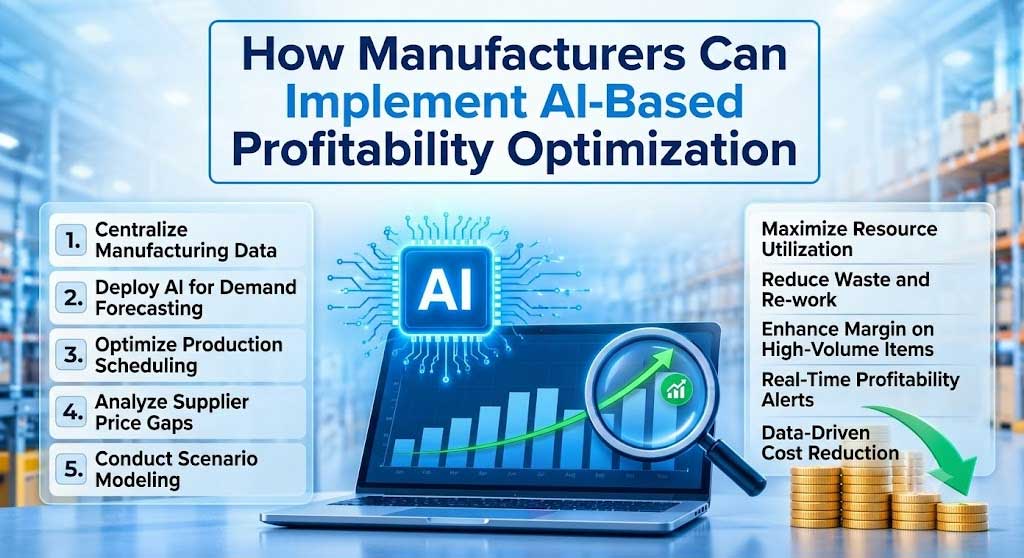
Implementing AI across manufacturing operations does not require replacing every existing business application. Instead, manufacturers should begin by identifying the areas where financial losses are most significant. The first step is to establish a reliable data foundation. Production records, inventory transactions, purchase orders, supplier invoices and financial information must be connected through consistent data definitions.
Without reliable information, even advanced AI models can produce misleading recommendations. Next, manufacturers should establish baseline performance measurements. These may include production cost per unit, equipment downtime, scrap and rework costs, inventory turnover, supplier price variance and procurement cycle time.
Once the baseline is established, AI models can be introduced into specific workflows where their recommendations can be measured against actual business results. For example, a manufacturer experiencing frequent material shortages could begin with AI-based demand forecasting and inventory optimization. Another business facing high reconciliation costs could prioritize intelligent invoice matching and procurement analytics.
Furthermore, manufacturers should validate model performance using actual operational data, monitor prediction accuracy and periodically retrain models when production conditions or demand patterns change. Most importantly, AI recommendations should be connected to clearly defined business workflows. Otherwise, manufacturers may generate sophisticated reports without translating insights into measurable financial improvements.
6. What Is the Future of AI-Driven Manufacturing Profitability?
Manufacturing intelligence is moving beyond traditional dashboards towards systems that can predict problems, coordinate workflows and support operational decisions. Deloitte’s 2026 Manufacturing Industry Outlook identifies agentic AI as an emerging opportunity across manufacturing operations and supply chains. Similarly, its research highlights the importance of connected technologies, data analytics and smart manufacturing investment.
Consequently, the next stage of manufacturing profitability optimization will involve connecting operational intelligence with financial decision-making. Instead of waiting for monthly reports to reveal increasing production costs, manufacturers will increasingly be able to monitor cost deviations as they develop.
Likewise, AI-driven procurement systems will support more informed supplier decisions, while predictive inventory models will help businesses balance material availability against working capital requirements. Ultimately, the competitive advantage will not come from collecting more manufacturing data. It will come from understanding that data and converting it into timely, financially meaningful decisions.
Conclusion: Stop Measuring Production Alone. Start Measuring Manufacturing Profitability.
A factory can increase production output without improving profitability. Similarly, higher inventory availability does not necessarily indicate better inventory management, and lower purchase prices do not always represent lower procurement costs. The real challenge is understanding how decisions across production, inventory and procurement affect the company’s financial performance.
AI-powered manufacturing profitability analysis provides a way to connect these operational activities, uncover hidden cost leakage and identify opportunities for improvement before small inefficiencies become significant financial problems. For manufacturers looking to improve margins, the first step is not necessarily increasing production capacity. Instead, it is identifying where existing operations are consuming more money than they should.
PMDG Technologies helps manufacturing businesses explore intelligent automation, AI-powered analytics, ERP integration and connected business workflows to improve operational visibility and decision-making.
Discover where your manufacturing operations are losing profitability. Book a Free Manufacturing Automation Consultation with PMDG Technologies.
Visit: https://www.pmdgtech.com/automation-services.php
Email: business@pmdgtech.com
Frequently Asked Questions About AI in Manufacturing Profitability
What is AI-powered manufacturing profitability analysis?
AI-powered manufacturing profitability analysis uses machine learning, predictive analytics and operational data to identify hidden costs across production, inventory and procurement. It helps manufacturers understand cost deviations, predict potential losses and make better operational decisions.
How does AI identify hidden manufacturing costs?
AI analyses information from ERP systems, production machines, inventory records, purchase orders and supplier invoices. By identifying unusual patterns and relationships between these datasets, it can reveal excessive material consumption, production bottlenecks, equipment downtime, inventory waste and procurement discrepancies.
Can AI reduce production costs in manufacturing?
Yes. AI can help reduce production costs by identifying machine performance issues, predicting equipment failures, improving production scheduling, detecting quality defects and reducing material waste. Actual savings depend on the manufacturer’s processes, data quality and implementation.
How does AI improve manufacturing inventory management?
AI improves inventory management by forecasting material demand, identifying slow-moving stock, calculating replenishment requirements and detecting potential stock shortages. Consequently, manufacturers can balance material availability with inventory carrying costs.
How does AI improve procurement efficiency?
AI can compare supplier prices, analyse purchasing patterns, detect duplicate invoices, automate purchase order matching and identify unusual procurement transactions. These capabilities help businesses improve purchasing visibility and strengthen financial controls.
What data is required to implement AI in manufacturing?
Manufacturers can begin with ERP data, production schedules, machine operating records, inventory transactions, purchase orders, goods receipt notes, supplier invoices and historical demand information. The required datasets depend on the specific business problem being addressed.
Is AI suitable for small and medium-sized manufacturing companies?
Yes. Small and medium-sized manufacturers can begin with focused AI applications such as demand forecasting, inventory optimization, invoice processing or predictive maintenance. A phased implementation allows businesses to evaluate measurable benefits before expanding AI across additional operations.